Thursday, March 13, 2014

...and so it begins

I'd like to announce officially - spring began at Cape May yesterday, March 11th. Why do I say this? Well, yesterday was the first day that Tom Reed set himself up at a dune crossover at Cape May Point and started staring out over the water. And as soon as he started logging what he saw, the Cape May Springwatch was under way. While Cape May is justly famous for its often spectacular fall migration, the geography that helps to create this spectacle has completely the opposite effect in spring. To reach Cape May Point in spring, birds either have to come straight across the wide opening of the Delaware Bay, or drift down southward from further north; while neither scenario might sound inviting to the birds, if you think more laterally, you realise that there is plenty to speculate on here.

In fall, Cape May's migration largely consists of songbirds and raptors through September and October, then seaducks from October into early December. But in spring it's a different package with herons and egrets, shorebirds, gulls, gannets and others coming into the picture. March might seem early to be thinking of spring migration, given that many sites have to wait until May before things really take off, but spring migration really does start this early in Cape May - and today certainly proved that, as you will see!

The first count made on 11th was typically quiet (though such days make for good comparison with the busy ones), yet produced some nice finds, including two Red-necked Grebes, three Great Egrets, four Laughing Gulls (yes, the early birds are heading into town now!), two Common Mergansers, two Wood Ducks and a Pine Warbler. The latter is always nice to report - watching songbird migrants coming in low over the waves and heading for cover behind the dunes is always exciting. On the 12th, Megan and I joined Tom and we logged a reasonable Canada Goose movement, a flurry of Northern Gannets coming out of the bay and a continuing pre-migration build up of Red-throated Loons in The Rips. Two Pine Warblers were noted and some interesting movements of songbirds saw parties of American Robins, Common Grackles and Red-winged Blackbirds making circuits around the point but seemingly not really heading anywhere.

Work beckoned after a time but, as the day progressed, it was becoming clear that spring was beginning to produce some interesting birds. An adult Little Gull gave many people the run-around as it toyed with us along the bayshore, seemingly showing up at random locations without a care for the fevered, would-be observer who had to negotiate the busy streets of Villas and Del Haven several times to keep pace with the sightings (and still it eluded many). A scattering of Laughing Gulls showed up from the ferry terminal northward, while Miami Beach in Villas attracted nearly 200 Bonaparte's Gulls, up to five Black-headed Gulls and - eventually - the Little Gull.

So birds are moving, spring is definitely making it's presence felt, though we now have another 36 hours or so of horribly cold weather again as I can hear the wind howling outside and areas north and west of us get yet more snow dumped on them. Take a rain check on birding tomorrow, then head this way to be part of Cape May Springwatch - let the counting commence!!

Though I titled this post '..and so it begins', this short series of photos from today will readily demonstrate to you that I could have subtitled it 'not the best photo I've ever taken' or 'what a gray day' (one for the Brits there!)....

For me, Springwatch started with this party of Red-breasted Mergansers, heading out of Delaware Bay this morning and beginning their long, northward journey. Cape May Point offers some great migration watching right through the spring period with birds often passing close along the shoreline [photo by Mike Crewe].

He the usurper waits in the wings... or summer parking lot gull meets winter parking lot gull. My first Laughing Gull of the year prepares to move in while a Ring-billed Gull contemplates heading out of town at the Cape May Ferry Terminal today [photo by Mike Crewe].
 
Lunchtime visits to Miami Beach are a must during March; this site has a sandbar, pushed up by the outflow of water from Fishing Creek, which is one of the last places to be covered by high tide. Check tide tables and visit on a rising tide to get the best from this place - here, a second calendar year and adult Black-headed Gull (check for red on the bills) mix in with Bonaparte's and Ring-billed Gulls [photo by Mike Crewe].

Today's prize for gull fans - a dapper, adult Little Gull. Note the completely black underwing with white trim and the rounded wingtips. Though most of the North American population of this species winters not far off our coastline, this is a surprisingly scarce species at Cape May with, typically, just one or two birds a year [photo by Mike Crewe].
 
Saving the best until last - and not wishing to blow my own trumpet, but... while shooting up to Miami Beach lunchtime today with Warren and Megan, I spotted this distinctive shape heading northward over Fishing Creek Road toward Cape May Airport. Checking the record books, this seems to constitute the earliest ever record of Swallow-tailed Kite for New Jersey and continues a recent trend of March records for the Cape May area [photo by Mike Crewe].

Monday, March 10, 2014

Waxing Poetical...

What better bird to wax poetical over than the waxwing. Though we might be tempted to think that a waxwing is a waxwing is a waxwing, there are, in fact, three species of waxwing in the world - Cedar, Bohemian and Japanese. While Bohemian is by far the most widespread (occurring throughout the northern temperate zones of Eurasia and North America), the most familiar species for the vast majority of North Americans is the Cedar Waxwing. Bucking the trend set by other waxwing species, Cedar Waxwings wander far to the south in winter, venturing well down into southern Mexico at times - I once saw one sharing a tree in a hotel garden on Oaxaca with a stunning male Vermilion Flycatcher! So this is the 'standard' waxwing by which others are judged.

Cedar Waxwings are probably at their lowest ebb with us in Eastern North America at the moment, but there are a few small groups around town and, just last week, I chanced across a group of 17 hanging out in the parking lot at the Lobster House, right next to Cape May Harbor. So do look out for these birds and enjoy them all the more armed with the little factoids I give you below:

Cedar Waxwings are an extraordinary combination of colors; soft dove gray, vinaceous pink and old gold, with finishing touches of black, white, flaming scarlet and brilliant yellow. Since there are no true cedars in North America, they should really be called Juniper Waxwings! [Photo by Mike Crewe]

Birds can be aged and sexed by the sealing wax-red tips to the secondary flight feathers (these give the birds their English name), which develop over time. The bird top left in this picture has no red so will almost certainly be a young, first-winter bird [photo by Mike Crewe]. 

Cedar and Bohemian Waxwings share the same tail pattern, with a bright yellow tip. Japanese Waxwings have a scarlet tip to the tail. Occasionally you find a bird with an orange tail tip (there was one in the Lobster House group) and this aberration has been traced to birds feeding on particular, non-native berries during the time at which these feathers are being grown [photo by Mike Crewe].
 
All waxwings are prodigious berry eaters, though they will eat a lot of insects when they are available and can often be seen flycatching from treetops in spring. Like geese, they seem to have a poorly developed digestive system which requires a high intake of food (and a high outlet at, well, the other end!) and the dryness of late-season berries means much drinking goes on. If you find a group of feeding waxwings, chances are that, sooner or later, you will have a great opportunity to see them drinking from any available water. In mid-winter, they regularly eat snow if water isn't available [photo by Mike Crewe].

Even when seen up close, the feathers of waxwings are unusual amongst birds in that they seem to form a much closer, tighter fit than the feathers of other birds. This gives them an unusually sleek look that is shared by other closely-related birds - the silky-flycatchers of tropical America and the amazing Hypocolius of the Middle East [photo by Mike Crewe].

Cedar Waxwings can be unpredictable in their appearance in your area, but they are predictable in another way - it's a safe bet that when you see them, they will be having a bad hair day! [Photo by Mike Crewe]

Friday, March 7, 2014

Week in review: 1 – 7 March, 2014

  CMBO is pleased to provide weekly summaries of the Cape's birding highlights. Coverage is limited to sightings in Cape May County. Readers should keep in mind that some reports may not be confirmed. The vast majority of information utilized in these reports comes from eBird data and "Keekeekerr" text alerts. Observers are encouraged to send reports and photos to compiler Tom Reed (coturnicops at gmail dot com).

--===============--

Weather: The period opened with seasonably cool and calm conditions 1 Mar, followed by a brief bout of southerlies that allowed temperatures to surpass 50ºF on 2 Mar. A rare March snowstorm affected the Cape during the first half of 3 Mar, with snowfall totals ranging from 4–7" throughout the county. Bitter cold followed the storm, with temperatures failing to surpass the freezing mark again until mid-morning 5 Mar. Chilly conditions lingered 6 Mar, as an onshore flow developed ahead of a coastal storm that brushed past the area 7 Mar.

Birding Summary: Observers submitted sightings of 143 species to eBird during the period 1–7 Mar. The best diversity days occurred on 1 Mar and 2 Mar, when 107 species were reported. The 2014 cumulative county list currently stands at 184 species. There were no additions to the annual list this week. Notable birds included Ross's Goose, "Eurasian" Green-winged Teal, Snowy Owl, Black-capped Chickadee, Smith's Longspur, "Gambel's" White-crowned Sparrow, and Painted Bunting.

Location Abbreviations: CMP (Cape May Point), CMPSP (Cape May Pt. State Park), SHPt (Stone Harbor Point).
 
--===============--

WATERFOWL THROUGH BITTERN
       A Ross's Goose was a surprise find at Lily Lake, CMP 4 Mar (BM, KM, m. ob.). It lingered in the area through 5 Mar, but has not been reported since. There are only a handful of confirmed records for this species in Cape May County.  Two male Eurasian Wigeon remained near the Bree-Zee-Lee Yacht Basin along Ocean Drive (between Cape May and Wildwood Crest) through 7 Mar (GD, DG, SW). A rare bird, particularly on Cape Island, was the "Eurasian" Green-winged Teal that appeared on Lily Lake 1 Mar (MiC, MeC) and continued through at least 5 Mar (m. ob.). Reports of Red-necked Grebes continued to trickle in. "New" sightings included one at Lily Lake 5–7 Mar (CV, m. ob.), another offshore North Cape May 1 Mar (BP), and 3 at the Davies Sports Complex in Cape May Court House 7 Mar (GD, DG, SW). Northern Gannet has been slow to arrive in nearshore waters. This week's only land-based report consisted of a single bird seen from CMP 2 Mar (BB, PG, DW). At least one American Bittern lingered at SHPt through 7 Mar (m. ob.). 

[Ross's Goose at Lily Lake, CMP on 4 Mar. Photo by Michael O'Brien.] 

SHOREBIRDS THROUGH OWL
       Hereford Inlet's winter flock of American Oystercatchers still contained at least 25 birds this week (m. ob.). Like various other early-season migrants, northbound Oystercatchers have not yet been noted. A wintering Semipalmated Plover continued at the north end of Avalon 2 Mar (m. ob.). Two Lesser Yellowlegs were either hardy lingerers or early migrants at Jake's Landing the same day (MO'B). Razorbill has been much less numerous this winter, but a single bird was found close to shore at Avalon's 8th Street Jetty 1 Mar (DF). An Iceland Gull put in an appearance at the Bree-Zee-Lee Yacht Basin 7 Mar (MO'B). At least one Eurasian Collared-Dove remained loyal to its patch in CMP, where it was last reported 5 Mar (VK). The neighborhoods bordered by Coral, Harvard, Lehigh, and Lincoln Avenues are typically the best places to search for the dove(s). Snowy Owl fans will be happy to know that a couple of the big white owls were still present in and around Cape May. At least one individual remained along the Cape May City beachfront through at least 4 Mar (m. ob.), and another was observed on a rooftop at 91st Street, Stone Harbor 1 Mar (AF). 

 [Snowy Owl at Poverty Beach, Cape May on 3 Mar. Photo by Michael O'Brien.]

PHOEBE THROUGH BUNTING
       An Eastern Phoebe continued to survive the harsh winter at West Cape May, last photographed along Sunset Boulevard 5 Mar (MO'B). An obvious movement of Horned Larks occurred on the trailing edge of the snowstorm 3 Mar. An impressive 123 were tallied at Sunset Beach, including multiple flocks that continued north along Delaware Bay (CV). Cape May County's fourth Black-capped Chickadee continued to delight observers at CMP. It was last observed along Yale Avenue 7 Mar (GD). After an absence of 31 days, the Smith's Longspur resurfaced at SHPt 4 Mar (TR). It continued through 7 Mar (m. ob.), frequenting the extensive dune/marsh vegetation along the western edge of the Point. At least four Lapland Longspurs and two Snow Buntings were also seen again at SHPt 5–7 Mar (m. ob.). An Orange-crowned Warbler held on at CMPSP through at least 5 Mar (m. ob.), while a Saltmarsh Sparrow was noted at SHPt 6 Mar (MF). A minimum of 29 "Ipswich" Savannah Sparrows occupied the snow-covered dunes at SHPt 4 Mar (TR). Another surprise came by way of an adult "Gambel's" White-crowned Sparrow at the Magnesite portion of Higbee Beach WMA 6 Mar (MiC). Finally, the long-staying Painted Bunting remained at CMP through 7 Mar (m. ob.). The most recent sightings have come from feeders at 113 Harvard Avenue and 101 Lincoln Avenue.

 [Smith's Longspur at SHPt, 4 Mar. Photo by Tom Reed.]


["Gambel's" White-crowned Sparrow at the Magnesite portion of 
Higbee Beach WMA, 6 Mar. Photo by Mike Crewe.]


--===============--
Contributors: 
Barb Bassett (BB), Megan Crewe (MeC), Mike Crewe (MiC), Glen Davis (GD), Alison Fetterman (AF), Don Freiday (DF), Mike Fritz (MF), Sam Galick, Doug Gochfeld (DG), Pete Grannis (PG), Vincent Koczurik (VK), Bob McLennan (BM), Karen McLennan (KM), Michael O'Brien (MO'B), Beth Polvino (BP), Tom Reed (TR), Christopher Vogel (CV), Dianna Wentink (DW), Scott Whittle (SW).

----
References:

eBird. 2012. eBird: An online database of bird distribution and abundance [web application]. eBird, Cornell Lab of Ornithology, Ithaca, New York. Available: http://www.ebird.org. 
Fogg, B. 2013. Keekeekerr: Recent Text Alerts. Available: http://www.keekeekerr.com

Wednesday, March 5, 2014

Spotlight on... Winter Firefly

If you’re like me, you probably don’t think much about fireflies in the winter. After all, they’re summer insects, dancing over darkened fields and backyards on humid July and August evenings, flashing heatless lightning. Except some are not just summer insects; some – like the Winter Fireflies currently huddling on tree trunks across Cape May County – are around right now.


As fireflies go, the Winter Firefly (Ellychnia corrusca) may seem to be a bit of a dud. It flies during the day, rather than at night, and it doesn’t have any light-producing organs. Instead, it uses pheromones (chemical substances released into the atmosphere) to attract a mate. But it’s an incredibly hardy species which overwinters even in areas where temperatures regularly drop below freezing.

In the winter, adult Winter Fireflies are found on tree trunks, where they shelter in grooves and folds of the bark. From late September to mid-March, they don’t fly at all, instead marching up and down a trunk in search of sap flows. They are particularly fond of maples, and can reportedly become a real pest at maple syrup collection pails. Since they have a high survival rate -- from 88 - 99% per month in some locales -- they should be quite common out there at the moment. Watch for them on a maple near you!

Tuesday, March 4, 2014

Ross's Goose and other waterbirds in the news

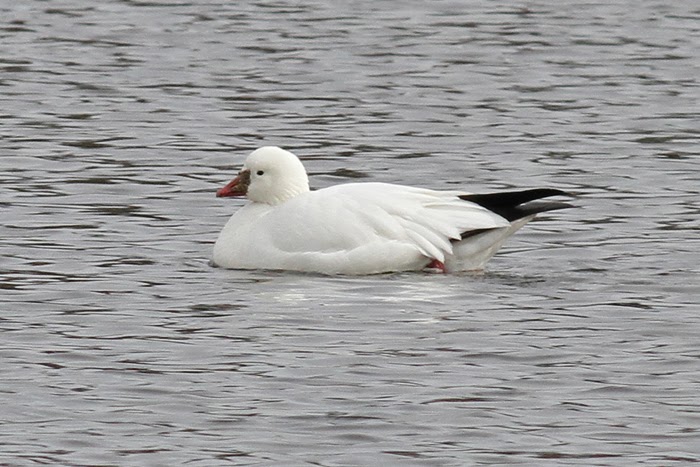
It's been a good few days for fans of waterfowl around Cape May, as icy weather continues to hold the East Coast in its grip. The marinas and boatyards around the area still hold good numbers of ducks and grebes, with Red-necked and Horned Grebes in particular being well worth the time spent in the cold. But there's been a sudden, surprise contender for birding hot spot of the week, as Lake Lily - down at Cape May Point - has weighed in with a male Eurasian Teal (first found last Saturday and still present today) and a Ross's Goose. The goose was found by Bob and Karen McLennan this morning, who popped into the Northwood Center to ask us if the white goose on the lake was a Snow Goose. Of course it was always going to be a Snow Goose - odd wandering birds often appear briefly with the wintering Canada Geese at the point. But as Warren Cairo and I checked the bird out from right in front of the center it really looked surprisingly small. It had its head tucked away out of view, but by the time I had set up a scope, its head was up and revealing a stubby little bill with a bluish base - a Ross's Goose! Though the bird apparently flew off after about half an hour, it may well still be in the area, so do keep an eye on the Canada Goose flocks!

The Painted Bunting seems to have abandoned the Northwood Center of late and gone back to feeders closer to the beachfront, being seen on Lincoln and Harvard Avenues over the last couple of days. I gather from Glen Davis that the Black-capped Chickadee is still lurking in the back streets of Cape May Point, while the male Snowy Owl continues to be reported from Beach Avenue in Cape May. Perhaps shock of the day today was news from Tom Reed that the Smith's Longspur is still feeding happily in the dunes at Stone Harbor Point! Not a huge surprise perhaps, but it does show that, no matter what the weather, seek and you shall find!

Back to Lake Lily though and some food for thought, inspired by Tom Reed's doggedness to re-find the longspur. If you want to put something more into your birding, consider picking a local spot and try to schedule regular visits to it over a longer period of time. By trying to standardize your effort (same time of day, duration of visit etc) and keeping records of your finds (via eBird of course!), it is amazing what information you can put together on bird movements through a single site. Lake Lily offers great potential for this due to its location and even watching it day in day out, it is amazing just what I have noticed there. Turnover of birds can be quite rapid, especially now with waterfowl on the move and starting to head north and I am sure we shall be seeing more interesting birds there in the coming days.

Staring out over a bewildering medley of waterfowl, it can sometimes seem a daunting task trying to find the one that looks just that little bit different. Here's the view that faced me upon my arrival at work last Saturday morning. So which one is the interesting one? Well, think about vertical versus horizontal lines... [photo by Mike Crewe]
 
Cropping the same picture and zooming in to the middle, notice the Green-winged Teal with the stripe that's going the wrong way... [photo by Mike Crewe]
 
Waking the ducks up and pulling them out into the open gives us a better fighting chance. Now the difference is easier to see - one of these ducks is not like the other ones! The middle bird is a Common or Eurasian Teal and a nice bird to find at Cape May. This is a bird to watch since, though only considered a race of Green-winged Teal in North America, taxonomic committees in other parts of the world now recognize this taxon as a full species and a worthy tick for your list [photo by Mike Crewe].

A final look at the Eurasian Teal, here at the final part of its crazy courtship display. As well as the distinctive white stripe formed by edges of the longest scapulars, note also that Eurasian Teal has more extensive and more obvious cream piping bordering the green face patch, so even a head view amongst the crowd could be enough to pick one out [photo by Mike Crewe].

Though not a good identification shot, this photo of today's Ross's Goose shows just how small these birds are compared with the local Canada Geese [photo by Mike Crewe]. 

Full on Ross's Goose - note the small headed, small billed appearance without the black 'grin' line found on the bill of Snow Goose and with a bluish tint to the base of the bill. Ross's Goose is a rare bird on the East Coast, its main wintering grounds being in the south-western states and along the Texas coast. But they do turn up here from time to time so are worth keeping an eye open for - of course, finding one in a flock of five thousand Snow Geese is going to be a little harder than this! [Photo by Mike Crewe]
 
While you are near the water, do keep an eye out for other surprises. On a short trip with my volunteer naturalists to Mott's Creek in Atlantic County last Saturday evening, I was very pleased to find this American Mink swimming down the creek and providing great photo opportunities of a species that is normally very difficult to approach [photo by Mike Crewe].

Saturday, March 1, 2014

Week in review: 22 – 28 February, 2014

CMBO is pleased to provide weekly summaries of the Cape's birding highlights. Coverage is limited to sightings in Cape May County. Readers should keep in mind that some reports may not be confirmed. The vast majority of information utilized in these reports comes from eBird data and "Keekeekerr" text alerts. Reports and photos that may be of use for weekly summaries can be emailed to compiler Tom Reed (coturnicops at gmail dot com).
 
--===============--

Weather: It was a fairly quiet week. The period opened with mild temperatures, courtesy of short-lived southerly flow. High temperatures ranged well into the 50s on 22–23 Feb under ample sunshine. Seasonably cool temperatures returned 24–27 Feb, before another cold blast dropped daytimes highs into the 20s on 28 Feb.

Birding Summary: Observers submitted sightings of 149 species to eBird during the period 22–28 Feb. The best diversity day occurred on 22 Feb, when 123 species were reported. The 2014 cumulative county list currently stands at 184 species. Notable birds this week included Black-headed Gull, Snowy Owl, Black-capped Chickadee, and Painted Bunting.

Location Abbreviations: CMP (Cape May Point), CMPSP (Cape May Pt. State Park), SCMM (South Cape May Meadows), SHPt (Stone Harbor Point).
 
--===============--

WATERFOWL THROUGH RAPTORS 
       The Tundra Swan duo at CMPSP/SCMM continued through 28 Feb (m. ob.), while two male Eurasian Wigeons remained along Ocean Drive near the Bree-Zee-Lee Yacht Basin through at least 25 Feb (SG). Canvasback was noted at Davies Sports Complex in Cape May Court House 22–24 Feb (MiC, MeC et al.). The two female King Eiders joined five Common Eiders in Hereford Inlet (viewable from North Wildwood) 23 Feb (AK). Three Red-necked Grebes continued along Ocean Drive in the area of Cape May Harbor through at least 25 Feb (SG). At least one American Bittern lingered at SHPt until 27 Feb (DA). A Rough-legged Hawk was noted again at Jake's Landing 28 Feb (MF). 

RAILS THROUGH OWLS  
     A wintering Semipalmated Plover was viewed from the "free bridge" at Nummy Island 23 Feb (MiC, MeC). A Lesser Yellowlegs at the pond along Reed's Beach Rd 23 Feb was possibly an early migrant (KL). Otherwise, shorebird numbers and diversity remained poor. One or two Black-headed Gulls continued to be reported from the lower Delaware Bay coastline, most recently at the Ferry Terminal/Douglass Rotary Park 27 Feb (KL). A record-early Laughing Gull entertained observers at the same location 25 Feb (BB, m. ob.). Jake's Landing continued to host multiple Short-eared Owls (m. ob.), while Snowy Owls were reported from the beach at CMPSP 22 Feb (GD) and at SHPt 27 Feb (DA).

WOODPECKERS THROUGH FINCHES
       Red-headed Woodpecker remains largely absent this winter, though one was seen again at TNC's Lizard Tail Swamp Preserve 28 Feb (KH).  The spring's first Tree Swallows appeared at several locations 22 Feb (v. ob.). Cape May County's fourth Black-capped Chickadee was still attending a feeder along Lincoln Ave, CMP through 25 Feb (MP). The Painted Bunting of CMP recently moved to the bird feeders at CMBO's Northwood Center, where it was last reported 27 Feb (m. ob.).

--===============--

Contributors: 
Deidre Asbjorn (DA), Bill Boyle (BB), Megan Crewe (MeC), Mike Crewe (MiC), Glen Davis (GD), Mike Fritz (MF), Sam Galick (SG), Kathy Horn (KH), Andy Keister (AK), Karl Lukens (KL), Mike Pasquarello (MP)

----
References:
eBird. 2012. eBird: An online database of bird distribution and abundance [web application]. eBird, Cornell Lab of Ornithology, Ithaca, New York. Available: http://www.ebird.org. 
Fogg, B. 2013. Keekeekerr: Recent Text Alerts. Available: http://www.keekeekerr.com

Don't believe the weather, believe me!!

Spring is coming, honestly... I know it doesn't feel like it with yet another week of sub-freezing temperatures forecast, but somehow, spring really is coming. Those occasional days when the temperature creeps up a little higher are producing little flushes of insect activity. A few days ago, with temperatures almost reaching 60F at Cape May, it was noticeable that Honey Bees were getting out and about and - finally - the first butterflies of the year were recorded. The South Jersey Butterfly Log had not a single record of any butterfly in January which is most unusual, but those species that overwinter as adult insects are now just starting to get out and about - keep an eye out in sunny, woodland spots that are out of the wind.

A number of birds species are clearly on the move now too; a sudden pulse of Tree Swallows last weekend, singing Eastern Bluebirds, a few Eastern Phoebes and a noticeable increase in the numbers of American Woodcock are all good, early indicators of a change in the season. Of course, the bulk of such activities are induced by day length not by temperature and early-moving insectivorous birds like Tree Swallows can really be in trouble when we get cold spells at this time of year.

But even if it's still too cold out there for you to feel like going for a stroll right now, the very fact that spring is knocking at the door can induce a warm feeling. Take that warm feeling, wrap yourself up in it and enjoy the great outdoors!

American Woodcock are on the move northward now and in many areas will already be displaying. This poor guy flew into a window along New England Road but recovered after a few minutes and lived to fight another day. Don't forget our Woodcock Dance which is a pre-registered event and always brilliant fun - coming up next Saturday, March 8th [photo by Ed Russell] 
 
Mourning Cloak in Middle Township, February 22nd [photo by Will Kerling]
 
Eastern Comma in Middle Township, February 23rd. Both Eastern Comma and Mourning Cloak are species that hibernate as adults and are thus most often the first butterflies of the year for many folks. Perhaps a better sign that spring is truly coming is when we see the first butterflies that have overwintered as pupae and emerge as fresh adults in spring. For this you will need to wait until later in March and keep an eye out for Blueberry Azures or maybe a Small White [photo by Will Kerling].
 
Some insects seem to thumb their noses at the cold and get on with life - albeit at a slower pace. One or two species of moth can be seen throughout the winter months - especially Fall Cankerworm in our area - while other cold weather specialists include the Winter Firefly, shown here. This is an interesting insect that we will bring you more on... [photo by Chris Borkowski]

Despite being cold-blooded, some reptiles and amphibians appear surprisingly early in the year. This Garter Snake is one of two found taking the sun at Cape May Point State Park on February 23rd. A sizeable hibernaculum for this species once existed at the state park but seems to have steadily declined in recent years [photo by Chris Borkowski].
 
Some animal behavior seems to defy obvious interpretation! Will Kerling watched this Muskrat as it took naps in the leaf litter at the back of the beach and wandered along the strand on the Delaware Bayshore last weekend! [Photo by Will Kerling]