Mike Kilpatrick operates a nature photography guide service specializing in New Jersey coastal marsh and seashore subjects. A life-long resident of North Wildwood, NJ his work has appeared in national publications, including Nature Conservancy and Ducks Unlimited.
Summer's Main Event
by Mike Kilpatrick
The main event of salt marsh bird life in the summer is the nesting season of colonial gulls and terns. Colonies of Laughing Gulls, Forster’s Terns and Common Terns are strung along the tidal waterways behind the Atlantic coast barrier islands, where nests can be found in very high density.
 |
Laughing Gull with chicks, nesting in wrack on marsh edge.
© Michael Kilpatrick |
In order to avoid losing nests to tides, the gulls and terns tend to nest on wrack. Wrack forms as the tide ebbs and flows across the marsh, pushed into masses of dead reeds. It accumulates in, and along, the taller grass boarders of breached ponds and creeks and forms slightly raised platforms used to support nests. Predominant among the wrack nesters is the Laughing Gull and Forster’s Tern.
 |
Pair of Forster's Terns at the nest.
© Michael Kilpatrick |
Less frequent is the common tern being more associated with beach nesting colonies yet they join the wrack nesting community with enough frequency that finding a few nesting on the marsh is not a surprise.
 |
Common Tern nest in wrack.
© Michael Kilpatrick |
Amidst the colony drama created by many thousands of birds spread across a vast area, it is easy to overlook a rare player whose appearance on the stage is fleeting: The Gull-billed Tern. It, like the common tern, is more often associated with beach nesting locations but it is a nomadic and adaptable bird that has shown throughout its range a diversity of nesting locations including the marsh. Once known as “The Marsh Tern”, nesting records in New Jersey, at the northern edge of its range, are sporadic. On the Cape May Peninsula, such records are few and far between.
But exist they do, as I discovered this past season. I was tucked in the tall grass edge of a breached pond in pursuit of photos with clear views of a line of Laughing Gulls and Forster’s Terns nesting along a small creek west of Stone Harbor/Avalon. The colony soon forgot me and I watched parent birds tend to their nesting cuties.
 |
Gull-billed Tern with young.
© Michael Kilpatrick |
The chorus of calls around me included Laughing Gulls and Forster’s Terns along with an intermittent Clapper Rail, passing egrets and Herring Gulls. A second tern voice emerged in the background: a Common Tern. Then there was another addition to the choir, a different voice, it was a Gull-billed Tern. As my attention turned to this voice, it became a consistent presence in the marsh chorus. It was not just one bird. It was with excitement that I set out to locate the source of these voices. One Gull-billed Tern passing overhead turned into another and then two more passed overhead. Following their flight, they appeared to be landing and rising from the same spot. When a passing Herring Gull was quickly met by a mob of Common and Gull-billed Terns rising off the marsh, I had one thought: “Nesting?” When finally approaching this area, it was apparent. On a mat of wrack there were twenty-one Gull-billed Terns with eight nests along with nests of Common Terns present in slightly higher numbers.
 |
Gull-billed Tern and chick exchanging calls.
© Michael Kilpatrick |
That afternoon, I embarked on an obsessed search of the literature, as books flung from the shelf began to form chaotic piles upon the floor. I uncovered a timeline spanning hundreds of years of natural history observations, starting with writings of Philadelphia Naturalist William Bartram in the 1700’s through recent sightings on eBird. Across the observations of naturalists and plume hunters and information contained in modern research papers and state survey records, one conclusive truth emerged. There is very little information about the Gull-billed Tern nesting in Cape May County.
But, the record was not entirely empty. The most compelling information on the gull-billed tern was offered by Charles S. Shick in 1890, published in The Auk, who wrote “A rather common visitor. Breeds on meadows and sand flats at the southern point of the island. I have found it to breed in the company with Larus artricilla. Mr. Harry G. Parker has also taken eggs in the same locality.”
 |
No Laughing Gulls Allowed!
Gull-billed Tern driving off a Laughing Gull chick from its territory.
© Michael Kilpatrick |
The island he references is the Seven-mile Beach Island, know better today as Stone Harbor and Avalon, described by Shick as “one of the richest ornithological fields open to collectors.” It is interesting that Witmer Stone, in his iconic “Bird Studies of Old Cape May” leans toward discrediting Shick’s account of the gull-billed tern. Yet, on the morning of July 2, 2016, as I stood on a marsh island behind Stone Harbor and Avalon, the gull-billed tern was present and nesting, surrounded by Larus atricilla (laughing gull).
 |
The stately Gull-billed Tern showing of its namesake feature.
© Michael Kilpatrick |
The 19th century records are complimented with two other references confirming nesting in Cape May County. The US Fish and Wildlife Service Status Review and Conservation Recommendations for the Gull-billed Tern in North America notes no research studies specific to the Gull-billed Tern have been conducted in New Jersey other than annual aerial censuses of mixed gull and tern colonies. Still, very few nests are actually discovered despite this bird being an annual breeder. Clay and Pat Sutton make reference in Birds and Birding at Cape May of two pairs nesting on Stone Harbor Point in 2003.
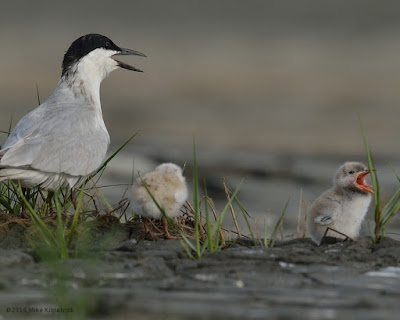 |
Gull-billed Tern family vocalizing.
© Michael Kilpatrick |
The lack of accessible references about the Gull-billed Tern on the Cape May Peninsula may not represent the entirety of what is, or was known. It is likely that only a fraction of what was observed regularly makes it into the public record.
Today we have the luxury of advanced tools and technology that allows all of us to participate and contribute, at any level, to the ever evolving ornithological record. From novice to expert, from research scientist to casual vacationer, from birder to photographer to fisherman to hunter, thanks to citizen science tools like eBird, the ornithological record now accommodates participation. As a result, in the future this record will be much more complete.
It’s always a memorable moment when a Gull-billed tern crosses over head and it is certainly exciting to find them nesting in Cape May County. It is also thrilling to take a journey through the ever evolving ornithological record: combing through historic references, the experience of the present moment (as mine on the morning of July 2nd), and imagining someone 100 years in the future creating their own map of discovery from the references recorded today.
Editor's Note: Annual aerial surveys by the State of New Jersey do detect Gull-billed Terns each year in the marshes from Stone Harbor northward. Their low-density nesting does indeed make them harder to find than other species. For those interested seeing more of these marsh breeding species, our Birding by Boat trip on The Osprey and/or The Skimmer Salt Marsh Safari are both highly recommended.


 Our trip began on the 7:00am Cape May - Lewes Ferry. It was a gorgeous morning with clear skies and a calm crossing of the bay making for excellent views of inshore bottlenose dolphin as well as several good looks at WILSON’S STORM PETREL. Other birds encountered were a single Bonaparte’s Gull near the New Jersey side, a flyby Solitary Sandpiper, and two flocks of lingering (presumably non-breeding) Black Scoter, one about midway across and the other on the beach near the ferry terminal in Lewes, Delaware.
  After a short break in the nature center we headed south to the parking lot opposite Herring Point, where we walked the newly constructed Gordon’s Pond connector trail - a state of the art multi-use boardwalk trail that traverses dunes, pine forest, marsh, and eventually Gordon’s Pond at the very south. This trail is very popular with day bikers and cyclists alike, and so requires one to pay close attention to where you’re standing! That said, the birding from here is excellent, and there are several pull-out sections that allow you to sit and enjoy the scenery while the commuters whiz by. At the beginning of the trail we spotted an Eastern Hognose snake. Eastern Hognose display some of the most fascinating anti-predatory behaviors. As Catherine Busch approached the snake, it flattened out its head like a cobra and assumed the strike position! Then it rattled its rattle-less tail mimicking a rattlesnake, and finally, once Catherine picked it up to show the group, it wrapped itself in a writing ball, defecated, and flopped its head back with its tongue lolling out the side; playing dead!!! Check out the photos for the full experience.

 Doubling back, we returned to our cars and headed for Bombay Hook, but not without first stopping at the famous Sambo’s Tavern for some local seafood and a cold drink to temper the rising heat of the day.
  Although we arrived as the tide was falling fast, Bombay Hook still produced good numbers of shorebirds and wadingbirds. Hundreds of Short-billed Dowitchers (no definitive Long-billed this time though) joined a mix of Semipalmated and Western Sandpipers, with Westerns in much higher numbers than we typically get in New Jersey. More Black-necked Stilts were present along the refuge drive, while Cattle, Great and Snowy egrets joined Great Blue and Little Blue herons. We were unable to turn up any American Avocet, which are common here in the late summer, probably due to the poor timing with the tides. Even still, Bombay Hook is aways worth the visit, even if you spend an equal amount of time trying to deter the greenhead flies from biting you as you do scanning the flats for the odd shorebird!


