There's been a few strangers at the point of late... "Strangers?" I hear you ask. Well, birds that are not quite so expected here right now. Even in mid summer, it seems that the old Cape May magic weaves its spell and draws in those oddball wandering birds!
Today, our Walk for All People at the state park turned up a Merlin, which was chased off by the local Red-winged Blackbirds - clearly they thought that this bird should not be here at the moment either! The American Coot that showed up last week also still lingers on the east half of Lighthouse Pond (though it is likely that this bird has been around since last winter when we had unusually high numbers of this species, it's just been hiding somewhere out of view) and a Great Shearwater was again off the point - presumably the same bird as seen on Tuesday. Up to three Mississippi Kites are wandering the point and, though mostly in some distant corner where we can't find them, they do seem to appear from time to time over the Rea Farm, so that's my tip for a location if you want to see them! These birds are more typically birds of spring here but, as this species continues to push its breeding range north, I guess we can hope to see them more regularly in future. A Sandwich Tern and three Lesser Black-backed Gulls were reported from the South Cape May Beach on 2nd, while Stone Harbor Point and nearby Champagne Island have recently hosted up to 58 Royal Terns, seven Lesser Black-backed Gulls, single Sandwich and Black Terns and a summering Surf Scoter. Black Tern and Whimbrel were reported from The Osprey boat trip on 5th and there was a small, early movement of Bobolinks over the point this morning.
Thursday, July 5, 2012
Monday, July 2, 2012
Great Shearwater
Pete Dunne's monday morning walk at The Meadows turned up a nice surprise today with a Great Shearwater cruising the calm waters off the South Cape May Beach. A good hour later, the bird was still present and feeding actively among all the gulls and terns that were busy catching fish in The Rips off Coral Avenue. Oh for a small boat so as to be out there to get real frame-filling shots of this fabulous seabird! While we were watching, a small fishing boat was cruising back and forth among the birds and passing within just a few yards of the shearwater!


Great Shearwater (left) with Laughing Gull for size comparison. It is amazing just how big a lens you really need to get close enough for good shots of birds - or how close you have to be to the bird! This shearwater looked magnificent through a scope and at times I could even see the sun glint in its eye - and yet a 400mm lens wasn't really enough! Here though, you can see the dark-capped look, pale neck collar and typical underwing pattern of a Great Shearwater [photo by Mike Crewe].

From above, the same head pattern is visible on the Great Shearwater and it also shows a narrow white rump patch, dark tail and a dark outer wing with contrastingly pale secondaries [photo by Mike Crewe].

Friday, June 29, 2012
June's Final Surprise?
Perhaps Clay Sutton tallied the final surprise bird of June on Wednesday (27th) with a Mississippi Kite which drifted south over Hidden Valley - the first raptor of Fall!! Well, in reality it is probably a non-breeding bird that has spent spring and early summer wandering the east coast and a little edge of Northerly in the wind for a short period brought it to the cape.
As I type, a real hum-dinger of a thunderstorm is rattling away outside and certainly put paid to working through the moth trap for a while! Such summer storms bring much needed water to Cape May though and at least the temperature has temporarily dropped from yesterday's 91F! If weather patterns like this continue, it will certainly be worth being out there looking for birds, as any passing migrants will be downed by the passing showers. Check out wetland areas for early returning shorebirds (Vince Elia reported two Spotted Sandpipers at the Plover Ponds on 28th) and beaches for wandering terns.

As I type, a real hum-dinger of a thunderstorm is rattling away outside and certainly put paid to working through the moth trap for a while! Such summer storms bring much needed water to Cape May though and at least the temperature has temporarily dropped from yesterday's 91F! If weather patterns like this continue, it will certainly be worth being out there looking for birds, as any passing migrants will be downed by the passing showers. Check out wetland areas for early returning shorebirds (Vince Elia reported two Spotted Sandpipers at the Plover Ponds on 28th) and beaches for wandering terns.

Mississippi Kite over Hidden Valley on Wednesday [photo by Clay Sutton].
Wednesday, June 27, 2012
End to End Wildlife
As we enter our high summer period, Cape May County really does become a tale of two ends; there are wildlife spectacles to be enjoyed in all corners of the county, but the furthest ends really do offer some wonderful experiences. On my Wednesday walk at Cape May Point State Park this morning, we had the fine sight of at least five Brown Pelicans fishing among the hordes of Laughing Gulls and Forster's Terns out in the rips, a wonderfully starch-white Roseate Tern was on the beach and the first Lesser Yellowlegs of Fall blipped all too briefly past. In contrast, our Belleplain Wildlife walks on Sunday mornings take us right up into the northern corner of the county and each week we have consistently enjoyed some fabulous experiences. Birds don't tend to be our main priority on these Belleplain walks (we do them later in the morning after bird activity has tailed off a little), and yet birds nevertheless do feature strongly. Recently, a singing Yellow-throated Vireo accompanied us for much of our walk and a dayglow Prothonotary Warbler zipped right across the road in full sunshine. Singing Black-and-white Warblers and American Redstarts have featured in these walks too, as well as some stunning dragonflies and awesome orchids - the latter including Rose Pogonia, Grass-pink and the peculiar Green Fringed Orchid.
All of our summer walks continue to provide some great birding opportunities for walk members; at The Beanery, Black-crowned Night Herons, Blue Grosbeaks and Orchard Orioles have been a feature, while a pair of Horned Larks also appears to be breeding there this year, which is great news (keep an eye on our Field Trips section for all the details on what our walk groups are enjoying!). And don't forget the boat trips on the back bays too - some fine pictures keep winging their way to me from folks enjoying good birding out there!
Elsewhere, Tom Reed consistently reports Sandwich Tern and occasional Roseate Tern at Stone Harbor Point, while an interesting Brown Pelican movement has been taking place offshore, with the largest party involving 21 birds that passed north off Cape May Point on 24th. Up at Brigantine, Wilson's Phalarope, Snow Goose, Brant and White-faced Ibis were all still being reported up to a few days ago at least - and more shorebirds will begin to pass through any day now.




All of our summer walks continue to provide some great birding opportunities for walk members; at The Beanery, Black-crowned Night Herons, Blue Grosbeaks and Orchard Orioles have been a feature, while a pair of Horned Larks also appears to be breeding there this year, which is great news (keep an eye on our Field Trips section for all the details on what our walk groups are enjoying!). And don't forget the boat trips on the back bays too - some fine pictures keep winging their way to me from folks enjoying good birding out there!
Elsewhere, Tom Reed consistently reports Sandwich Tern and occasional Roseate Tern at Stone Harbor Point, while an interesting Brown Pelican movement has been taking place offshore, with the largest party involving 21 birds that passed north off Cape May Point on 24th. Up at Brigantine, Wilson's Phalarope, Snow Goose, Brant and White-faced Ibis were all still being reported up to a few days ago at least - and more shorebirds will begin to pass through any day now.

Our Belleplain Wildlife walks continue to start with a run through the moths at the state forest headquarters (courtesy of Lorraine McCay and her team - thanks guys!). Recently Tony Leukering had a nice find with a Southern Flannel, a species that the books indicate occurs to the south of New Jersey. Quite good numbers of this species are now appearing at Belleplain and - you have to admit - it is a beast worth seeing! [Photo by Mike Crewe]

Appearing in a wet patch near you right now! Large stands of brilliantly-colored Orange Milkwort make a fabulous sight throughout our region [photo by Mike Crewe].

An orchid highlight for me on a recent Belleplain Wildlife walk was the discovery of a small colony of Green Fringed Orchids - sadly they had been needlessly mown to the ground two days later...[photo by Mike Crewe].

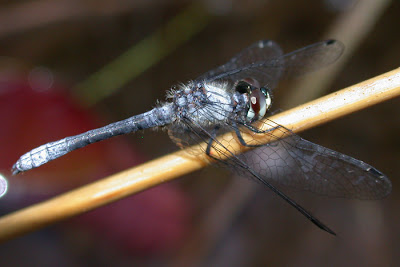
Another tale of two ends - two ends of the size scale: recent visits to Belleplain have turned up a fabulous array of dragonflies, which should be peaking in time for our July 14th dragonfly workshop folks! In one day, I had the delight of seeing Cape May's smallest and its largest dragonfly in the same day. At a mere 0.8 inches long, this male Elfin Skimmer is truly minuscule for a dragonfly - and yet easily as feisty as its larger cousins! [Photo by Mike Crewe]

At the top end of the dragonfly scale, this beast is almost our largest dragonfly (the Swamp Darner just beats it by a nose!). This has the awesome name of Dragonhunter and is a species that specializes in catching and eating other dragonfly species. Note the undersized head (a feature of the clubtail group that it belongs to) and the oversized hind legs [photo by Mike Crewe]

A closer look at the business end of a Dragonhunter [photo by Mike Crewe].

Down at Cape May Point, the ponds at the Rea Farm are producing good views of Black-crowned Night Herons [photo by Karl Lukens].

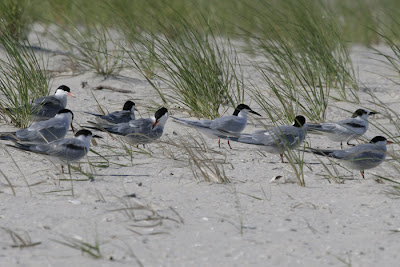
Common Terns are nesting now in the back bays - this one was photographed on one of our back bay boat trips recently - clearly a great opportunity to get up close and personal with these birds [photo by Beth Polvino].

Breeding-plumaged Common Loons are an all too scarce sight in Cape May County, but this bird has been delighting our boat trip participants regularly of late [photos (above and below) by Beth Polvino].

Saturday, June 23, 2012
White-winged Dove and other news
Yesterday, Sam Galick and Vince Elia were out on a saltmarsh breeding bird survey and reported a White-winged Dove which flew across the parking lot at Corson's Inlet State Park. There's been one or two fly-through reports of this species already this year so it is certainly worth giving any dove you see a second look. Bob Lubberman from The Osprey reported a Gull-billed Tern nesting among other Terns on the back bays behind Wildwood, while Black Skimmers steadily increase at Cape May Point, which may be associated with disruption at the main breeding colony at Malibu Beach where a cat has apparently been seen recently.
Further afield at Forsyth NWR, Brigantine, single Snow Goose and Brant were seen on the most recent wildfowl count there and reports continue to come in on a singing male Dickcissel near mile marker 9 on the driving loop. A White-faced Ibis appears to be summering at the refuge too.
One bird that slipped my net was a Cliff Swallow, reported by Sam Galick at Cape May Point State Park on June 16th - another one of those weird June things!


Further afield at Forsyth NWR, Brigantine, single Snow Goose and Brant were seen on the most recent wildfowl count there and reports continue to come in on a singing male Dickcissel near mile marker 9 on the driving loop. A White-faced Ibis appears to be summering at the refuge too.
One bird that slipped my net was a Cliff Swallow, reported by Sam Galick at Cape May Point State Park on June 16th - another one of those weird June things!

This White-winged Dove flew through Corson's Inlet out on the barrier islands on June 22nd - keep your eyes peeled for that distinctive white wing stripe [photo by Sam Galick].

Annual surveys carried out by New Jersey Audubon staff are proving to be the best way to get an idea of population levels of saltmarsh breeding birds. Many of these species are very elusive simply because they live in a world that is very difficult for us to access because of all the water and thick mud, and because the very dense vegetation makes viewing the birds very difficult (not to mention the bugs!). Early morning surveys to record singing birds give us a much better feel for breeding of numbers of species such as Saltmarsh (above) and Seaside Sparrows, and Clapper Rails [photo by Sam Galick].
Friday, June 22, 2012
June Birds & Recent Pictures
Flaming June has hit Cape May with a vengeance right now as temperatures sour into the 90s and everything ducks for cover. Good tern watching continues at South Cape May Beach and fluffy Piping Plover chicks can now be seen on the Plover Ponds. First signs of return migration are already under way with one or two reports of Whimbrels coming through now. At a little before 8:00AM this morning, Sam Galick reported a White-winged Dove which did a quick fly-by at the parking lot at Corson's Inlet. A White-breasted Nuthatch at the corner of Bayshore and New England was something of a surprise this morning.
Time for a quick review of the batches of photos that I have been sent recently.


Time for a quick review of the batches of photos that I have been sent recently.

A trip around the back bays can produce great birding pretty much any time of year, and is certainly well worth while mid-summer while migration takes a back seat for a short while. An adult Glossy Ibis offers a perfect photo opportunity at the Wetlands Institute at Stone Harbor [photo by Jane Ellison].

Tricolored Herons are never common here, but they can be seen in small numbers without too much difficulty. This bird was photographed recently at the Wetlands Institute, Stone Harbor [photo by Jane Ellison].

In contrast to Tricolored Herons, the back bays are brimmed full of Eastern Willets, a bird that never misses an opportunity to announce its presence, especially during the breeding season [photo by Tony Leukering].

If you leave the back bays and head to the South Cape May Beach, keep an eye out for gulls along the tideline. In contrast to other gull species, that mostly loaf higher up the beach and go off to feed elsewhere, Lesser Black-backed Gulls regularly feed along the tideline and this can be a good way to locate them. This second-calendar-year Lesser Black-back is currently hanging out on the South Cape May Beach [photo by Tom Reed].

American Oystercatchers are busy catching mole crabs along the tideline right now...

...and feeding them to their growing youngsters [photos by Jane Ellison].

Many people don't realize that Ghost Crabs can be a big threat to young beach birds. Ghost Crabs feed mostly at night when birds are roosting and will readily take small birds or eggs if they get the chance [photo by Jane Ellison].

The first sign of autumn migration - a calling Whimbrel over Cape May Point on the longest day of the year [photo by Tom Reed].

It is interesting how native bird species adapt to feeding from introduced plants. This male Orchard Oriole is feeding on nectar from the flower spikes of Red-hot Pokers (Kniphofia spp.) and will help to pollinate the flowers in the process. Red-hot Pokers are native to Southern Africa but are popular garden plants in many countries; in Europe, bird species as diverse as Blue Tits and Great Spotted Woodpeckers regularly nectar-feed from these flowers [photo by Debbie Hudson].

Once in a while you chance across something really unusual out in the wild - recently, Debbie Hudson came across this albino snake at Cox Hall Creek WMA. Identifying albino snakes can be tricky as there is always the possibility of it being an escaped pet and thus a non-native species. However, this species looks as though it is most likely a local Rat Snake [photo by Debbie Hudson].
Wednesday, June 20, 2012
Terns again
Shortly after posting my last blog piece on terns, I received a text message, alerting me to a Roseate Tern on the wooden railing that sticks out into Bunker Pond. Having just done the post, I already knew that I was short on Roseate Tern photos so quickly shot out to address this! By the time I got there, the bird had already flown, but this just pushed me to work a little harder for my bird...
Deciding to check the beach, I soon found a Roseate Tern among a group of 20 or so Common Terns - the latter a species that doesn't use the railing at Bunker Pond anywhere near as much as do Forster's Terns. The terns were too far for photographs, perched as they were inside the roped off breeding beach, and I decided to move away quickly as the Black Skimmers clearly didn't want me there! The sight of the male skimmer feigning injury to draw me away and then avidly strafing the top of my head was plenty enough for me to work out that they are quite definitely breeding this year! What was unusual to me about the Roseate Tern was that it was not banded - much research effort has gone into banding Roseate Terns to allow much closer study and a better understanding of this species, which remains very scarce throughout much of its range and vulnerable to pollution incidents and disturbance during the breeding season. Walking straight back into the state park, I was very surprised to then find not one but two Roseate Terns on the Bunker Pond railing - and both were banded! So here's where you can help out; with a close enough view, good optics and a fair dollop of patience, you can have a go at reading the band numbers on the legs of these two terns. Here's some pictures to point you in the right direction and get you started - let's see if we can get all the numbers between us!


If you are keen to learn more about tern identification, why not consider joining our special one-day tern workshop which take places on Saturday, August 4th. Contact our program registrar for more details on 609-861-0700.
Deciding to check the beach, I soon found a Roseate Tern among a group of 20 or so Common Terns - the latter a species that doesn't use the railing at Bunker Pond anywhere near as much as do Forster's Terns. The terns were too far for photographs, perched as they were inside the roped off breeding beach, and I decided to move away quickly as the Black Skimmers clearly didn't want me there! The sight of the male skimmer feigning injury to draw me away and then avidly strafing the top of my head was plenty enough for me to work out that they are quite definitely breeding this year! What was unusual to me about the Roseate Tern was that it was not banded - much research effort has gone into banding Roseate Terns to allow much closer study and a better understanding of this species, which remains very scarce throughout much of its range and vulnerable to pollution incidents and disturbance during the breeding season. Walking straight back into the state park, I was very surprised to then find not one but two Roseate Terns on the Bunker Pond railing - and both were banded! So here's where you can help out; with a close enough view, good optics and a fair dollop of patience, you can have a go at reading the band numbers on the legs of these two terns. Here's some pictures to point you in the right direction and get you started - let's see if we can get all the numbers between us!

At a distance, a Roseate Tern strikes you as a rather pale bird overall, with a long, dark bill. This adult Roseate Tern (center) is among a gathering of adult (red bills) and second-calendar-year (black bills) Common Terns on the South Cape May Beach. Though the young Common Terns have black bills, note that they also have white foreheads and black carpal bars (the dark line on the wing) [photo by Mike Crewe].

Coming in much closer, the Roseate's features are even more apparent. Note the long, finely-pointed bill, the relatively pale upperparts and the very long tail streamers. The white upper edge to the folded wing that I mentioned in the last post is hard to see here because of the pale sky behind, but it is present and this feature should always be looked for [photo by Mike Crewe].

If you have a real stroke of luck, you can get the birds to line up for you on the Bunker Pond railing! Here, left to right, are Forster's Tern, Common Tern and Roseate Tern. Look carefully at the relative proportions of bills, the upperpart and underpart color and - especially - the length of the outer tail streamers relative to the wing tips on each bird. Here, I have drawn a short red line to indicate where the tips of the tail streamers fall for each bird. The Forster's Tern is intermediate, the Common Tern very short (falling well short of the wing tip) and the Roseate Tern by far the longest (click on the photo for a slightly bigger picture) [photo by Mike Crewe].

Here's how you can really help - zooming right in on the Roseate Tern photos, it is actually possible to read some of the digits on the bands. On this bird, it is possible to see 482 on the right (closest) leg and a 2 on the left leg with a smaller 6 above it. So we have a start - if we can get the whole number, researchers can learn about the movements of this bird - and so can we! [Photo by Mike Crewe]

And don't forget to keep an eye out for other birds in the area too. I was very surprised to see this second-calendar-year Bonaparte's Gull turn up on June 16th at Bunker Pond - a winter visitor in mid-June! [Photo by Mike Crewe]
If you are keen to learn more about tern identification, why not consider joining our special one-day tern workshop which take places on Saturday, August 4th. Contact our program registrar for more details on 609-861-0700.