When winds turn to the south or south-west, Cape May's Migration Mainline becomes Migration Flatline, as birds continue to migrate via other routes. But it's Cape May, and it's September so never let it be said that Cape May doesn't have birds! Despite a temporary halt in streaming migrants overhead, the text services and listserves are still hopping with information. The Long-tailed Jaeger, though elusive, is still around and was reported working the tern flocks in The Rips off St Mary's this morning. It also put in an appearance at Higbee Beach and flew right over the dike. If you are looking for this bird, it's worth bearing in mind that at least two Parasitic Jaegers were out there this morning, so care and good looks are required. The Lark Sparrow first reported at Cox Hall Creek WMA by Don Freiday on 6th was still present this morning (8th) and seems to be hanging out mostly just south-west of the main lake - and often feeding out on the main walking trail. Other single Lark Sparrows have been reported from Higbee Dike on 6th and over the Hawkwatch Platform on 8th.
The American Golden Plover that was feeding on Bunker Pond on 2nd didn't hang around for long, but the species is still being reported on and off from Brigantine, where recent reports have also included a Baird's Sandpiper and up to six Buff-breasted Sandpipers. Bunker Pond held a Marbled Godwit briefly on 7th and a few early returning birds there these past few days have included Belted Kingfisher, Pied-billed Grebe, Northern Pintail and American Wigeon. One other duck report of interest was of a female Hooded Merganser on a small pond in Cape May Court House; perhaps this bird has summered somewhere in the area.
One or two Brown Pelicans have been reported from various sites lately, though none seem to be hanging around too long. On 4th, an Olive-sided Flycatcher paused for a while at the intersection of Bayshore and New England Roads, on 6th, a Mississippi Kite put in a brief appearance at Cape May Point - always an uncommon bird this time of year - and a Giant Swallowtail was a nice find by Michael O'Brien at the state park on 8th.
For the slightly more adventurous, the latest boat trip out to the Wilmington Canyon on 7th seems to have been a great success. Though official counts of species have not been received yet, I do know that participants enjoyed Cory's Shearwater, Leach's and Band-rumped Storm-petrels, Red-necked Phalarope, Bridled Tern and both Pomarine and Long-tailed Jaegers - quite a trip it seems! For more information on other pelagic trips in our area, visit See Life Paulagics website.
Well, time to put the kettle on and contemplate tomorrow's birds - Bye, Norm & Cindy - see you again soon!
Sunday, September 8, 2013
Saturday, September 7, 2013
Long-tailed Jaeger and other Cape May Craziness!!
In a game of two halves, today was something of a Cape May Classic; one of those days when you drag yourself out of bed at O'dark thirty, both eyes on one side of your face and your tongue feeling lke a felt ferret. You really could do with another two hours in bed, but you just know that, if you don't get up, you're going to miss something - and you'll regret if for an awfully long time.
The weather was strangely variable today, with winds beginning in the NW and veering to the East and producing conditions that made it difficult to predict what birds would do. The dike flight at Higbee Beach was not big, but produced some interesting birds (see Sam's Post), while our Higbee Beach walk this morning was tricky to say the least - gusty winds kept birds down in cover but we slowly built up a nice list that included a Veery feeding on grapes, a scattering of Baltimore Orioles and Blue-gray Gnatcatchers and some skulking Common Yellowthroats. The highlight of the walk though (albeit brief) was the extraordinary sight of a perched Common Nighthawk being mobbed by a Blue-winged and a Golden-winged Warbler, two Northern Parulas and some Carolina Chickadees!
The Hawkwatch beckoned but, with winds veering quickly and then dying off, the flight of hawks headed in completely the wrong direction; though raptors were passing through Cape May Point, seeing tested the patience of Job as birds went stratospheric and headed out over the bay at a height of several thousand feet. Over 170 Ospreys were logged passing south today, but many were the merest specks in the sky and Tom Reed had to resort to a prone position to have any chance of locating anything. With cloudless skies and calm conditions, the heat haze frazzled the landscape and the afternoon looked like it would tail off as an un-noteworthy event. But it wasn't to be as news soon broke of a juvenile Long-tailed Jaeger on South Cape May Beach, to the south of The Meadows. This was a chance not to be missed and anyone in the position to do so was soon on the spot and enjoying a bird that is more than a little tricky to get onto your Cape May list. Though the bird was on view for some time, it eventually headed out toward 2nd Avenue jetty, where it seemed to take great pleasure in breezing through the Black Skimmer flock and harassing a Forster's Tern or two. The bird promptly disappeared but was later refound by Richard Crossley at Poverty Beach.
Though the jaeger was very mobile today - and was surely the bird seen by Tom Reed briefly from the Hawkwatch Platform yesterday - it is quite possible that it will remain in the area for a few days, so it is worth keeping an eye out for it around Cape May, though it could feasibly pop up anywhere between Villas and the Coast Guard Unit...
Oh, and as a amazing finale to today's activities, the Minotaur V rocket launched from Virginia and headed to the moon was visible this evening from Cape May (an awesome sight from the back yard!) as a brilliant orange flare, headed right out over the ocean around 11:30pm - what a day!!
As the UK National Lottery would put it, you have to be in it to win it, so I would suggest a day in the field this weekend - start at Higbee Beach, make your way to the Hawkwatch around 10:00am, then be ready to hurtle off for who knows what in the afternoon!!




The weather was strangely variable today, with winds beginning in the NW and veering to the East and producing conditions that made it difficult to predict what birds would do. The dike flight at Higbee Beach was not big, but produced some interesting birds (see Sam's Post), while our Higbee Beach walk this morning was tricky to say the least - gusty winds kept birds down in cover but we slowly built up a nice list that included a Veery feeding on grapes, a scattering of Baltimore Orioles and Blue-gray Gnatcatchers and some skulking Common Yellowthroats. The highlight of the walk though (albeit brief) was the extraordinary sight of a perched Common Nighthawk being mobbed by a Blue-winged and a Golden-winged Warbler, two Northern Parulas and some Carolina Chickadees!
The Hawkwatch beckoned but, with winds veering quickly and then dying off, the flight of hawks headed in completely the wrong direction; though raptors were passing through Cape May Point, seeing tested the patience of Job as birds went stratospheric and headed out over the bay at a height of several thousand feet. Over 170 Ospreys were logged passing south today, but many were the merest specks in the sky and Tom Reed had to resort to a prone position to have any chance of locating anything. With cloudless skies and calm conditions, the heat haze frazzled the landscape and the afternoon looked like it would tail off as an un-noteworthy event. But it wasn't to be as news soon broke of a juvenile Long-tailed Jaeger on South Cape May Beach, to the south of The Meadows. This was a chance not to be missed and anyone in the position to do so was soon on the spot and enjoying a bird that is more than a little tricky to get onto your Cape May list. Though the bird was on view for some time, it eventually headed out toward 2nd Avenue jetty, where it seemed to take great pleasure in breezing through the Black Skimmer flock and harassing a Forster's Tern or two. The bird promptly disappeared but was later refound by Richard Crossley at Poverty Beach.
Though the jaeger was very mobile today - and was surely the bird seen by Tom Reed briefly from the Hawkwatch Platform yesterday - it is quite possible that it will remain in the area for a few days, so it is worth keeping an eye out for it around Cape May, though it could feasibly pop up anywhere between Villas and the Coast Guard Unit...
Oh, and as a amazing finale to today's activities, the Minotaur V rocket launched from Virginia and headed to the moon was visible this evening from Cape May (an awesome sight from the back yard!) as a brilliant orange flare, headed right out over the ocean around 11:30pm - what a day!!
As the UK National Lottery would put it, you have to be in it to win it, so I would suggest a day in the field this weekend - start at Higbee Beach, make your way to the Hawkwatch around 10:00am, then be ready to hurtle off for who knows what in the afternoon!!

Identifying jaegers in the field is one of the most challenging tasks for a birdwatcher; there is much overlap in size between the three species, while plumages of all three are highly variable and pinning down diagnostic field characters are not easy. When first located today, the juvenile Long-tailed Jaeger (aged by the overall rather plain brown coloration with contrastingly strongly-barred undertail coverts) was resting on the beach just south of the TNC's Migratory Bird Refuge (aka The Meadows). Resting birds are particularly problematic, but note the strongly bicolored, relatively small, bill [photo by Mike Crewe].

In a standing pose, the jaeger still looks relatively delicate and, in this shot, notice that the primary flight feathers are all dark, without the pale tips that are usually present on Parasitic Jaegers at this time of year [photo by Mike Crewe].

In flight, we have a few more clues to help us identify this bird as a Long-tailed Jaeger. Classically, this bird shows strong, white feather shafts to just the two outermost primaries - Parasitic Jaeger would typically show four or five white shafts. Though difficult to see here, another useful feature of Long-tailed Jaeger is that the secondary flight feathers tend to be contrastingly darker than the wing coverts. In Parasitic Jaeger, the secondaries and wing coverts tend to be more uniform in color [photo by Mike Crewe].

As an exercise in identifying birds by photographs after the event, this photo - if the only one obtained of this bird - could have been problematic. Here, the wings are over-extended as the bird lifts off powerfully and there appears to be extensive white on the upper side of the primaries. In fact, this is due to the angle of the feathers relative to the sun, as well as the posture revealing pale bases to the primaries that under most viewing conditions would normally be unseen - it's always wise to take as many photos as possible to help build up a better, more accurate impression of a bird [photo by Mike Crewe].

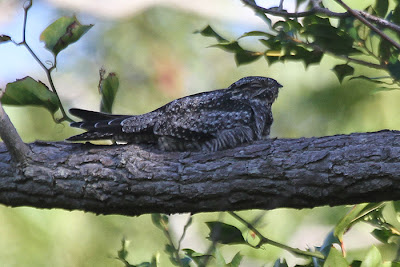
It's a good time of year to be checking that that odd piece of wood really is part of the tree! This Common Nighthawk was perched near the SW corner of the first field at Higbee Beach today [photo by Mike Crewe].

Fieldcraft lesson number 378 - always be on the look-out for birds; September is a great month to be looking for Lesser Black-backed Gulls at Cape May and I counted nine along South Cape May Beach as I yomped down toward the jaeger today. This typical second calendar year bird shows a much paler head than an American Herring Gull of comparable age, with a clearly defined, bicolored bill and a pale eye [photo by Mike Crewe].

As if you need reminding - Eurasian Collared Doves are still hanging out along Lincoln Avenue. Currently, three birds are being reported, one of which appears to be a juvenile so it does look as though our single pair bred again this year. Here's one of the adults near Lincoln and Lehigh this evening [photo by Mike Crewe].

Wednesday, September 4, 2013
From Hawkwatch to The Dike
Having kicked off the 2013 Hawkwatch on its first day at the weekend, I managed time on Tuesday morning to join Sam Galick on Higbee Dike, on what proved to be a day that wasn't massive on birds, but certainly provided plenty to enjoy. This was actually the first time I had an opportunity to use a faster-focusing camera lens that I had bought some while ago and was hoping that it would cope with the tiny specs zipping overhead - it did! Higbee Dike can seem daunting to a lot of people in so many ways. The dike itself is daunting enough and, this year, another six feet or so has been added to the height. The bank is pretty steep and not recommended for anyone without Rocky Mountain Goat blood in their veins, but there is always the viewing platform on the other side of the track which offers plenty of good views of passing birds.
If you ascend to the top of the dike, you will find yourself right at tree top height, indeed, slightly higher than that now, and with a commanding view of the whole area. Much of what passes the dike has, traditionally, been counted by ear - birds being identified by their distinctive (to some at least!) flight calls. But things are changing a little now, with modern digital cameras producing more and more pixels and allowing finer and finer detail. But there's another way that increased pixels help - you can zoom in to a smaller and smaller part of the picture and still have a surprising amount of detail. This latter system is what works on the dike. You might not get a prize-winning photograph, but you get a picture of a readily identifiable bird - even when it's a tiny blip, way, way, out there. Sam Galick is one of a number of growing 'masters of the art' of using a camera as an identification tool and you can enjoy regular posts from him this season on our Seasonal Research blog. For those who haven't made the crossover yet, here's a few pictures from my first attempts on the dike...


Recent Sightings
With the season really taking off now, there's plenty of birds lining up to be seen around Cape May and more to follow in the next couple of days I reckon. On September 1st, another early Philadelphia Vireo was at Cox Hall Creek WMA and a White-rumped Sandpiper was reported from the South Cape May Meadows (still present on 2nd at least, when joined by a Baird's Sandpiper), while an early juvenile Bonaparte's Gull was photographed at the state park on August 31st. Carol McClelland reported 10 Piping Plovers still enjoying the beach at Stone Harbor, while the same location has been holding very good numbers of Red Knot recently. On September 2nd, a Western Kingbird flew south at Higbee Dike and was later seen a little closer in the first field at Higbee Beach, from where it flew off toward the bayshore. September 3rd kicked off with a young male Yellow-headed Blackbird passing south with Bobolinks at Higbee Dike and another, or perhaps the same, Western Kingbird, this time passing Cape May Point. Late on September 3rd, a Say's Phoebe was located behind the dunes by the Plover Ponds at the state park by Tom Reed. There has been no further reports of it today but - keep your eyes peeled!


If you ascend to the top of the dike, you will find yourself right at tree top height, indeed, slightly higher than that now, and with a commanding view of the whole area. Much of what passes the dike has, traditionally, been counted by ear - birds being identified by their distinctive (to some at least!) flight calls. But things are changing a little now, with modern digital cameras producing more and more pixels and allowing finer and finer detail. But there's another way that increased pixels help - you can zoom in to a smaller and smaller part of the picture and still have a surprising amount of detail. This latter system is what works on the dike. You might not get a prize-winning photograph, but you get a picture of a readily identifiable bird - even when it's a tiny blip, way, way, out there. Sam Galick is one of a number of growing 'masters of the art' of using a camera as an identification tool and you can enjoy regular posts from him this season on our Seasonal Research blog. For those who haven't made the crossover yet, here's a few pictures from my first attempts on the dike...

Groups of Bobolinks were pouring through Cape May yesterday morning with over 1300 logged at the dike. With so many going through, it wasn't too hard to get passable photos. Heavy bills, streaked flanks and double wingbars are all visible here; we even had some birds with a few black feathers left over from breeding plumage, while one group contained a young male Yellow-headed Blackbird [photo by Mike Crewe]

Swallows are readily identifiable by their streamlined shape and relatively long, pointed wings. Add rusty underparts and a long, forked tail and you have a Barn Swallow [photo by Mike Crewe].

Don't be afraid to take pictures of common birds such as these Feral Rock Pigeons. Taking photos of common birds and studying them is a good way to familiarize yourself with them. These then become your 'yardsticks' by which you measure other, less common, species. Note the stocky bodies and relatively small heads typical of pigeons and doves. Feral Rock Pigeons most closely resembling their wild counterparts have very white underwings with neat, black trailing edges [photo by Mike Crewe].

Sometimes you have to remember to allow for the amber glow of early morning light. Remove the orange cast and this thick set bird with long bill and feet, broad, rounded wings and a well-streaked neck soon becomes a juvenile Green Heron [photo by Mike Crewe].

Of course, some birds are pretty obvious whatever the lighting conditions! An adult Bald Eagle gave us a quick sideways glance as it cruised by. The power of modern cameras is demonstrated here by the fact that this bird was flying by way out over Higbee Beach - quite some distance from the dike [photo by Mike Crewe].

Birds even further out over the water can also be picked out with the camera and identified. This young Brown Pelican lumbered past well offshore, accompanied by a Royal Tern yesterday morning [photo by Mike Crewe].

But it's warblers that people come to see at the dike and they offer some rather unique challenges. Quick and frequent changes of direction and a generally rather rapid flightline means that many, many pictures never see the cold light of day and, if you try the camera ID method, you will spend more time deleting than saving. But the lucky shots will come, like this American Redstart, rising out of the reeds along the dike and calling as it passes by in the warm glow of an early morning well spent on the dike [photo by Mike Crewe].
Recent Sightings
With the season really taking off now, there's plenty of birds lining up to be seen around Cape May and more to follow in the next couple of days I reckon. On September 1st, another early Philadelphia Vireo was at Cox Hall Creek WMA and a White-rumped Sandpiper was reported from the South Cape May Meadows (still present on 2nd at least, when joined by a Baird's Sandpiper), while an early juvenile Bonaparte's Gull was photographed at the state park on August 31st. Carol McClelland reported 10 Piping Plovers still enjoying the beach at Stone Harbor, while the same location has been holding very good numbers of Red Knot recently. On September 2nd, a Western Kingbird flew south at Higbee Dike and was later seen a little closer in the first field at Higbee Beach, from where it flew off toward the bayshore. September 3rd kicked off with a young male Yellow-headed Blackbird passing south with Bobolinks at Higbee Dike and another, or perhaps the same, Western Kingbird, this time passing Cape May Point. Late on September 3rd, a Say's Phoebe was located behind the dunes by the Plover Ponds at the state park by Tom Reed. There has been no further reports of it today but - keep your eyes peeled!

Marbled Godwits were once rare on the East Coast but are now to be expected in fall, with some birds often remaining through much of the winter. Keep an eye out for them now on our boat trips into the back bays; this one was photographed by Charles Krueger from The Osprey on 1st.

White-rumped Sandpipers are regular passage migrants in small numbers; look for a larger, longer-winged bird than accompanying peeps - and an all-white rump if you see it fly [photo by Karl Lukens].

Say's Phoebe at Cape May Point State Park on September 3rd - a heavily-molting adult and perhaps not the prettiest of flycatchers...[photo by Mike Crewe].

We like to welcome all newcomers to our community of Cape May birders, so please welcome the latest addition. If you visit the Hawkwatch Platform or Higbee Dike you'll run into Captain soon enough - he's getting far too much attention already! [photo by Mike Crewe].
Monday, September 2, 2013
Never a dull day at the Hawkwatch
Day one of the 2013 Cape May Hawkwatch; so how did it go? Well, if you were in town looking for hawks, then it's fair to say it wasn't your lucky day. With just two Ospreys and a Merlin making it onto the official count sheet, you might by very easily led into thinking that we had a dull day on the Hawkwatch Platform today, but no, not a bit of it. Unlike other hawkwatches that might be situated on a remote hill top somewhere, the Cape May Hawkwatch pretty much always provides something to look at and Tom Reed's total of 83 species logged from the platform is testament to a great day out for anyone there to enjoy it.
With two American Golden Plovers moving through almost at the very start of the day, it was soon clear that it was going to be a good shorebird day and, with a breezy south-westerly drifting in off the bay, many of the shorebirds were passing right over the platform. With a reasonable Bobolink flight early on, a good mix of terns, gulls and skimmers and an almost full suite of swallows and martins, today was a great day to be out witnessing visible migration at its very best. Here's a few photos that sum up the day.


With two American Golden Plovers moving through almost at the very start of the day, it was soon clear that it was going to be a good shorebird day and, with a breezy south-westerly drifting in off the bay, many of the shorebirds were passing right over the platform. With a reasonable Bobolink flight early on, a good mix of terns, gulls and skimmers and an almost full suite of swallows and martins, today was a great day to be out witnessing visible migration at its very best. Here's a few photos that sum up the day.

Ospreys are certainly contemplating heading south now, but most of today's birds, like this adult, were happy to just catch sunfish in the sunshine at Bunker Pond today [photo by Mike Crewe].

A fair range of ducks are already sneaking back into our area from breeding grounds further north - though most males are still in their rather drab summer plumage right now. This was almost a nice opportunity to compare Green-winged and Blue-winged Teal in flight but the Green-winged kind of got lost round the back there somewhere [photo by Mike Crewe].

Caspian Terns always draw a crowd of admirers when these big brutes make a few feeding circuits of Bunker Pond [photo by Mike Crewe].

A good movement of swallows and martins took place, but most eye-catching in this family today was the steadily growing flock of Tree Swallows along the dune edge and around Bunker Pond [photo by Mike Crewe].

Steady numbers of shorebirds passed the Hawkwatch Platform throughout most of the day today, including some very obliging flocks of Pectoral Sandpipers [photo by Mike Crewe].

Semipalmated Sandpipers cutting the corner of Cape May Point and giving a chance to photograph a few shorebirds heading left instead of right! [Photo by Mike Crewe]

Patience pays off when opportunities are coming thick and fast. This Pectoral Sandpiper gave a great opportunity for photographs as it whizzed past the platform and headed toward the bay [photo by Mike Crewe].

Squeeky clean plumage and a soft, cinnamon wash to the chest help to mark this Short-billed Dowitcher out as a juvenile, heading south for the first time in its life [photo by Mike Crewe].

The grand finale - formation flying by a brace of Greater Yellowlegs! Differences in underpart and underwing patterning between molting adult (upper) and juvenile Greeater Yellowlegs is nicely demonstrated here [photo by Mke Crewe].
Saturday, August 31, 2013
Countdown to Hawks
Well August is done and September is looming on the horizon. For many people, the first weekend in September is Labor Day weekend, the last big beach weekend of the year. For many of us at Cape May, the dawning of September marks the dawning of another Cape May Hawkwatch season.
Tomorrow, at somewhere close to 06:00am, I'll wager, Tom Reed will be climbing the steps of the Hawkwatch Platform, sweeping the skies with a trusty pair of Swarovski binoculars and - hopefully not long after - marking down the first raptor of the season. Truth be known, the weather doesn't look like it's going to send us too many raptors on the first day of the season, but tomorrow won't be about the birds for most of the people there. Tomorrow will be about reaquainting with old friends, bringing down a snack or two and just hanging out, just being there on the first day of the season. Having travelled a goodly chunk of the world in my time, I can honestly say that I know no other place that provides the birding cameraderie and good birds in the way that the Cape May Hawkwatch Platform does. If you can be there tomorrow, please do come and join in the fun. If you can't be there, we'll see you later in the season - the birds will only get better, but we're still going to have a great day tomorrow!!

Tomorrow, at somewhere close to 06:00am, I'll wager, Tom Reed will be climbing the steps of the Hawkwatch Platform, sweeping the skies with a trusty pair of Swarovski binoculars and - hopefully not long after - marking down the first raptor of the season. Truth be known, the weather doesn't look like it's going to send us too many raptors on the first day of the season, but tomorrow won't be about the birds for most of the people there. Tomorrow will be about reaquainting with old friends, bringing down a snack or two and just hanging out, just being there on the first day of the season. Having travelled a goodly chunk of the world in my time, I can honestly say that I know no other place that provides the birding cameraderie and good birds in the way that the Cape May Hawkwatch Platform does. If you can be there tomorrow, please do come and join in the fun. If you can't be there, we'll see you later in the season - the birds will only get better, but we're still going to have a great day tomorrow!!

The 2013 Seasonal Research and Interpretive Naturalist Team with CMBO Director Pete Dunne, and Program Director Mike Crewe. We look forward to your company in the field this year. Short profiles of the team will be posted this coming week on our Seasonal Research page [photo by Rene Buccina].
Thursday, August 29, 2013
Warbler fun continues - time to start reading the signs...
Reports of a nice range of warblers continue to trickle in to the bird observatory from all directions, with recent days producing Chestnut-sided, Blackburnian, Kentucky and Connecticut Warblers among the more familiar species. With odd birds turning up at seemingly unpredictable times and locations, what's the best strategy for finding them around Cape May? Well, though a cursory glance at the sightings may seem to show a set of random occurences, reading the weather and understanding bird movements can increase your chances of hitting the right spot. The last couple of days have produced classic examples of predictable warbler appearances for me. Wednesday started fair but the weather gradually closed in and the afternoon produced some drizzly weather. It was no great surprise to me that brightly-colored sprites began appearing in the trees around the Northwood Center at Cape May Point around the time that the rain started - why?
Well, from now until early November, it is safe to assume that, for much of the time, songbirds will be on the move through our area. Birds heading south may continue to move throughout the day if conditions are favorable - hot and sunny weather tends to cause them to pause for a rest and to cool off in the shade, cloudy weather and calm conditions can encourage birds to continue to move unless they are strictly nocturnal migrants. Overcast, calm conditions on Wednesday morning were ideal for onward migration but, any bird doing so would have at some point flown headlong into the front that passed through and brought rain. The top tip here then is, if it starts to drizzle midday or early afternoon, head out to Cape May Point and start checking the trees for migrant songbirds. A quick look round the Northwood Center on Wednesday afternoon quickly produced 12 Yellow Warblers, eight American Redstarts, two Red-eyed Vireos, two Black-and-white Warblers and a Blue-gray Gnatcatcher, all moving through the trees in a loose feeding flock - and it had all started with the surprise appearance of a Blackburnian Warbler right outside my window.
Learning the 'tricks of the trade' is not easy, but is certainly worthwhile and paid off for Tom Reed this evening when he had the presence of mind, on an Easterly wind, to check out the sea off Stone Harbor Point and turned up Northern Gannet, Cory's Shearwater and two Parasitic Jaegers. To help you with mastering bird-finding skills, you will find some useful links on our blog pages, in the left hand margins. Look for links that help you to find out local wind patterns, tide patterns and migration predictions, and use them to be in the right place at the right time...
Keep an eye on the weather and keep your diary clear for next Wednesday or Thursday morning - the weather predictions look interesting, with a swing to Northeast winds after a run of Southerlies.


Recent Sightings
August 25th produced a skulking but well-watched and photographed Kentucky Warbler at Higbee Beach, while a check of the high tide roost at Miami Beach, Villas on 26th revealed 115 Royal Terns there. One or two Black Terns have been visiting Bunker Pond this week and Sandwich Tern and Brown Pelican were both reported from the state park on 27th. Two reports of Olive-sided Flycatchers (perhaps both of the same bird) came from Cox Hall Creek WMA today (29th).
Well, from now until early November, it is safe to assume that, for much of the time, songbirds will be on the move through our area. Birds heading south may continue to move throughout the day if conditions are favorable - hot and sunny weather tends to cause them to pause for a rest and to cool off in the shade, cloudy weather and calm conditions can encourage birds to continue to move unless they are strictly nocturnal migrants. Overcast, calm conditions on Wednesday morning were ideal for onward migration but, any bird doing so would have at some point flown headlong into the front that passed through and brought rain. The top tip here then is, if it starts to drizzle midday or early afternoon, head out to Cape May Point and start checking the trees for migrant songbirds. A quick look round the Northwood Center on Wednesday afternoon quickly produced 12 Yellow Warblers, eight American Redstarts, two Red-eyed Vireos, two Black-and-white Warblers and a Blue-gray Gnatcatcher, all moving through the trees in a loose feeding flock - and it had all started with the surprise appearance of a Blackburnian Warbler right outside my window.
Learning the 'tricks of the trade' is not easy, but is certainly worthwhile and paid off for Tom Reed this evening when he had the presence of mind, on an Easterly wind, to check out the sea off Stone Harbor Point and turned up Northern Gannet, Cory's Shearwater and two Parasitic Jaegers. To help you with mastering bird-finding skills, you will find some useful links on our blog pages, in the left hand margins. Look for links that help you to find out local wind patterns, tide patterns and migration predictions, and use them to be in the right place at the right time...
Keep an eye on the weather and keep your diary clear for next Wednesday or Thursday morning - the weather predictions look interesting, with a swing to Northeast winds after a run of Southerlies.

The railing on the south side of Bunker Pond at Cape May Point State Park has a reputation for attracting an interesting array of birds, but some remain hard to get on your 'railing list'. This juvenile Black Tern paused there long enough for photos and seems to be contemplating that Eastern Amberwing that is breezing past [photo by Karl Lukens].

Using a long lens through a grubby window on a drizzly day to photograph an actively feeding bird is never going to be the ideal way to capture a good image - but we birders sometimes take what we can get! This Blackburnian Warbler stopped by my office window to let me know that said window needs a good clean, in time for more goodies to come! [Photo by Mike Crewe]

Window cleaned, better results! The holly tree right outside my office window has earned itself a good reputation for attracting birds - this Blue-winged Warbler stopped by today to offer brief respite from a heavy emailing session [photo by Mike Crewe].
Recent Sightings
August 25th produced a skulking but well-watched and photographed Kentucky Warbler at Higbee Beach, while a check of the high tide roost at Miami Beach, Villas on 26th revealed 115 Royal Terns there. One or two Black Terns have been visiting Bunker Pond this week and Sandwich Tern and Brown Pelican were both reported from the state park on 27th. Two reports of Olive-sided Flycatchers (perhaps both of the same bird) came from Cox Hall Creek WMA today (29th).
Sunday, August 25, 2013
Warblers up the stakes
A few cooler mornings, a layer of dew on the grass and it can only mean one thing - it's time for the warblers to drop in at Cape May. The past few days has seen a nice array of fall warblers passing through the point and, though numbers are still low, variety is certainly there. Last Thursday the first fall Northern Waterthrush for my garden was tail-wagging its way along a tree branch and my office window provided me with a rather mottly-looking, molting adult Tennessee Warbler. One or two American Redstarts are pirouetting around the ivy clumps and Black-and-white Warblers are peering up and down the tree trunks. Our recent walks have certainly been getting a flavor of fall about them too; Friday's Higbee Beach walk was highlighted by finds of both Chestnut-sided and Mourning Warblers, while the evening Meadows walk produced a Black Tern, plus three Common Nighthawks feeding at sundown. Perhaps the same three were seen feeding over the area again the following night and enjoyed by those who stopped in to look at the Wilson's Phalarope that was there on the evening of 24th. The same or another Wilson's Phalarope was at Higbee Dike this morning (25th), while other treats at The Meadows have included intermittent sightings of a Great Horned Owl and up to 300 or so Black Skimmers. The CMBO walk at The Beanery was full of goodies on 24th, including Black-billed Cuckoo, Least and Great Crested Flycatchers, two Bald Eagles and an extravaganza of Ruby-throated Hummingbirds. Sunday's walk at Cox Hall Creek WMA added to the warbler show with Northern Parula and Nashville Warbler among the mix of species.
Merlins and a few Peregrines continue to infiltrate the area (two Peregrines were on the water tower at the coast guard unit on 22nd) and an early Philadelphia Vireo was at Higbee Beach on 24th. A Cattle Egret was munching grashoppers at Bunker Pond on 24th and, a little further afield, Black-necked Stilt and Marbled Godwit were at Heislerville on 23rd and a Lesser Scaup was a surprise find at Brigantine on 22nd.


Merlins and a few Peregrines continue to infiltrate the area (two Peregrines were on the water tower at the coast guard unit on 22nd) and an early Philadelphia Vireo was at Higbee Beach on 24th. A Cattle Egret was munching grashoppers at Bunker Pond on 24th and, a little further afield, Black-necked Stilt and Marbled Godwit were at Heislerville on 23rd and a Lesser Scaup was a surprise find at Brigantine on 22nd.

A few Red Knot are drifting through our area now and are well worth keeping an eye out for this month as they are likely to be adults, still sporting their cinnamon underparts [photo by Jesse Amesbury]

American Oystercatchers always make for interesting photographic subjects; this picture reminded just how high a percentage of oystercatchers that have black marks on the yellow iris of the eye - and I have no idea why... [photo by Jesse Amesbury]

If you still have the impression of Eastern Willets carved on your mind after a summer on the bayshore, take a look out on the beaches now and you may notice a difference. Most of our local breeding population of Eastern Willets has already headed south and is already being replaced by Western Willets. These western birds are longer legged, longer and narrower billed and overall more graceful-looking than our local birds [photo by Jesse Amesbury].

It always pays to be cautious when identifying Willets to subspecies as there are so many potential pitfalls. This bird was photographed toward sunset, giving it a warm, amber glow which needs to be taken into account when comparing shots. The bill on this bird looks a little shorter and stouter than the bird above, but this still apears to be a juvenile Western Willet and perhaps the bill hasn't quite finished growing yet [photo by Jesse Amesbury].

And as if we could forget that autumn in Cape May is all about the hawks too! This juvenile Cooper's Hawk took a tight turn right over the Hawkwatch Platform and was clearly wondering where you all are - another two weeks folks! [Photo by Ed Russell]