Friday, January 3, 2014

Snowbirds!

What a difference a day makes - or two anyway! It seems barely five minutes ago that we were enjoying wonderful sunny skies and a great selection of rather exotic birds for the time of year. But that was January 1st and it was a very different Cape May that greeted the eyes of local birders this morning. Snow lay round about after an overnight front passed through and temperatures plummeted. Despite temperatures well below freezing (17F/-8C according to my car), most of us were out in the field first thing and experiencing some great birding. Here's a resume of Cape May today in pictures.

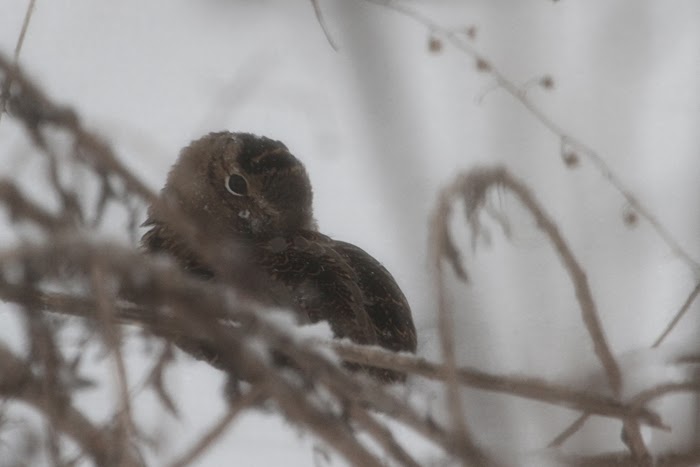
You know it's going to be a good day when....... you look out of the window and see a woodcock in the flowerbed! American Woodcock are most easily found when there is snow on the ground, as their wonderfully cryptic plumage is designed to hide them in the browns and goldens of fallen leaves [photo by Mike Crewe].


I must admit that when I set off for Cape May Point this morning, conditions didn't look all that inviting! Gray skies and drifting snow obscure Bayshore Road [photo by Mike Crewe].
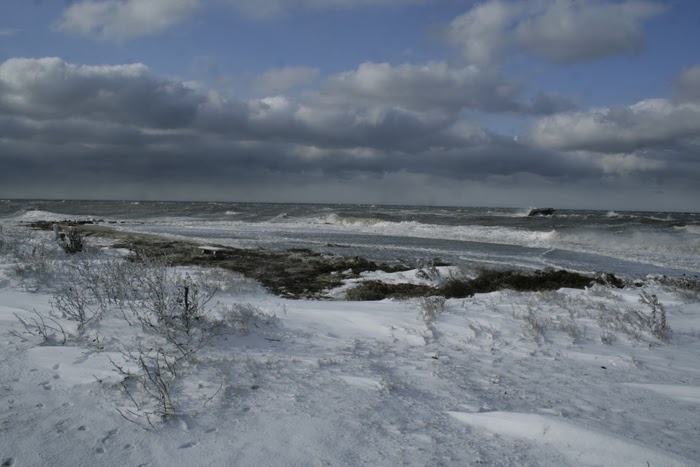
Things were no better at Sunset Beach - indeed, Sunset Beach was actually nowhere to be seen as storm surges washed right across the sand to the edge of the parking lot. The concrete ship looks suspciously as though it has taken a big hit overnight too [photo by Mike Crewe].

Despite harsh conditions (here's a view of the stone jetty at Alexander Avenue), Mike Pasquarello, Sam Galick, Chris Marks and I dug in for a while and witnessed southbound movements of Long-tailed and Snow Geese out over the bay [photo by Mike Crewe].

Most obviously on the move today - Common Grackles. Scores of them were pouring out into the turbulent winds over Delaware Bay and many of them returned pretty quickly! [Photo by Mike Crewe]

Common Grackles were everywhere at Cape May Point today and ravenous flocks of them took charge of every backyard feeder they could find. But this gave an opportunity for closer scrutinty of what is a pretty snazzy bird at close quarters. Unlike our locally-breeding Common Grackles which are largely glossed bluish-purple, many of the birds around now have bronze-olive body feathers, indicating that they are from more northerly breeding populations [photo by Mike Crewe].

Braving the tough conditions, at least 32 Horned Larks were feeding on the Rea Farm fields at the intersection of Stevens Street and Bayshore Road. Small flocks of this species were coasting along the beaches at the point today too [photo by Mike Crewe].

Calm is restored! As the morning wore on, blue skies and bright sun brought more bearable weather, though temperatures remained well below freezing and is really wasn't easy staying out for too long without regular tea breaks. Cape May Point State Park looks very different in January to autumn views that most visitors are familiar with [photo by Mike Crewe].

A walk around the state park revealed a great many birds present, all intent on finding enough food to survive in the sudden, harsh conditions. Some must surely wish they had headed further south for the winter, such as this Orange-crowned Warbler which constantly flicked its way along the back edge of the Plover Ponds. A good camera lens can do wonders for your identification skills when it comes to distant birds! [Photo by Mike Crewe]

As if further proof were needed. Sadly, so much native habitat around Cape May has disappeared under a 'devil may care' attitude toward wildlife. Manicured lawns provide zero feeding opportunities for hungry birds at this time of year and Chipping Sparrows were flocking to feed on stands of seeding Virginia Beard-grass at the state park today. There's no need to turn the whole 'back forty' over to a disheveled appearance, but there's no harm in leaving a few uncut borders so that our native wildlife has a chance to make it through the winter [photo by Mike Crewe]. 

With improved weather, it was easier to get better views of American Woodcock that had been driven out of frozen woods to seek food on the unfrozen edges of roads. This bird was one of three seen along Sunset Boulevard today [photo by Mike Crewe].

Nature red in tooth and claw. Severe weather always highlights the 'eat or be eaten' world that birds must exist in. This Merlin had just caught a Fox Sparrow on Lighthouse Avenue, which certainly drew out divided loyalties in me... [photo by Mike Crewe]

Rounding the tour of the point off just after lunch, a quick check of Lake Lily revealed a flotilla of Bonaparte's Gulls roosting out on the water - a sure sign that things are rough offshore, as these birds rarely alight on the freshwater ponds around Cape May [photo by Mike Crewe].

The final highlight of the day - for me at least - was a party of five Greater White-fronted Geese on Lake Lily (I hear that others reported seven in total here today). This is a scarce bird in Cape May and a group of this size is certainly unusual. Normally, I would expect a group of five birds to be a family party, but it is hard to be sure of the age of geese at this time of year. Juvenile White-fronts have no white on the forehead, but this is progressively molted in from mid-winter onward. Looking closely at the birds, the individual on the right is rather different to the others, having less white on the forehead, but a brighter orange bill and signs of black barring on the belly [photo by Mike Crewe].

Temperatures look set to remain low for some time to come, but south-east winds tomorrow may make it worth checking for seabird movements, especially Razorbills and maybe Dovekies. If you aim to set out into the field tomorrow, be sure to check the weather forecast, stay warm and stay safe...

Week in review: 28 December, 2013 – 3 January, 2014

CMBO is pleased to provide weekly summaries of the Cape's birding highlights. Coverage is limited to sightings in Cape May County. Readers should keep in mind that some reports may not be confirmed. Information and photos that may be of use for weekly summaries should be emailed to compiler Tom Reed (coturnicops at gmail dot com). 

Location Abbreviations: CMP (town of Cape May Point), CMPSP (Cape May Pt. State Park), SCMM (South Cape May Meadows), Tuckahoe (Cape May Co. portion of Tuckahoe/MacNamara WMA). 


Weather: The week began with mild conditions. High temperatures 28 Dec reached 55ºF across the county, and this was followed by highs near 60ºF the following day. Sunday also featured an inch of rainfall and strong southerly winds ahead of clearing skies and a return to average temperatures 30 Dec-1 Jan. An onshore flow developed along with increasing clouds on 2 Jan, ahead of a winter storm that produced 6-10" of snow throughout the county during the overnight 2-3 Jan. The final day of the period featured temperatures that struggled to reach 20ºF, coupled with strong NW winds that made it feel like 0ºF.

WATERFOWL THROUGH RAPTORS 
Some 33 species of waterfowl were recorded during the past week. Seven Greater White-fronted Geese were located at Lily Lake, CMP 3 Jan (AL, JL, m. ob.). Four Tundra Swans were roosting on the ice at Tuckahoe, a traditional location, 1 Jan (TR). At least two Eurasian Wigeon continued at CMPSP/SCMM through 3 Jan (m. ob.). Lingering Blue-winged Teal were detected at CMPSP (m. ob.) and at the Champlain Drive pond (Villas) 2 Jan (SG).  As many as six Redheads were present on Lighthouse Pond, CMPSP in recent days (M'OB, m. ob.). Two hen King Eiders, present since 26 Nov, continued throughout the period at the Nummy Island free bridge (m. ob.). Two drake Harlequin Ducks were found at the mouth of Cold Spring Inlet 2 Jan (JA). A late Brown Pelican was photographed flying south past Two Mile Beach 2 Jan (SG). Reports of lingering herons have been scarce, though a single Tricolored Heron was glimpsed at 2nd Avenue, Sea Isle City 28 Dec (MW, DW). A stealthy Northern Goshawk was reported multiple times from CMPSP (m. ob.). A Rough-legged Hawk and a Golden Eagle were viewed from Tuckahoe 1 Jan (TR).


RAILS THROUGH TERNS
Both Clapper and Virginia Rails continued in fair numbers throughout proper habitat, though it will be interesting to see how the recent colder weather affects both species. At least 60 American Oysercatchers were wintering in Hereford Inlet as of 2 Jan (m. ob.). A trio of Semipalmated Plovers persisted at Stone Harbor Point 1 Jan (m. ob.), while a hardy Lesser Yellowlegs was noted at Jake's Landing 1 Jan (TR). Western Sandpipers have not been numerous this winter, but several were noted at Stone Harbor Point (m. ob.) and Reed's Beach (TR, JN) 1 Jan. Numerous American Woodcock were found in snow-free patches on Cape Island 3 Jan (m. ob.). A Parasitic Jaeger exited Delaware Bay during the morning of 30 Dec (M'OB, SG). Strong southerly winds may have been responsible for five Razorbills and one Dovekie seen from the Cape May-Lewes Ferry 29 Dec (M'OB); 20+ Razorbills were viewed from Two Mile Beach 2 Jan (SG, MP). Small numbers of Forster's Terns appeared along the lower Delaware Bay shoreline 29-30 Dec (m. ob.), and a few continued to be seen from Villas' Miami Ave. beach 2 Jan (m. ob.). 

DOVES THROUGH FLYCATCHERS

A White-winged Dove at 113 Harvard Ave, CMP continued throughout the week (m. ob.). Two Eurasian Collared-Doves also continued in CMP (m. ob.). A remarkable irruption of Snowy Owls continued to grab headlines throughout the week, with sightings at Strathmere, Stone Harbor Point, Two Mile Beach, Cape May Point, North Cape May, and Reed's Beach. Three Short-eared Owls were tallied at Jake's Landing 3 Jan (AL, JL). Many birders continued to enjoy the Rufous Hummingbird coming to a feeder at the corner of Coral & Cambridge Avenues in CMP, while a Ruby-throated Hummingbird survived at another feeder on Cape Island through at least 2 Jan (m. ob.). Two Western Kingbirds remained at the Cresse Lane field/vineyard in Erma through 3 Jan (m. ob.), while an Ash-throated Flycatcher was identified at CMPSP 31 Dec and seen again 1 Jan (m. ob.). Lingering Eastern Phoebes continued to take up residence at Cresse Lane and CMPSP (m. ob.).


VIREOS THROUGH FINCHES 
Always a good find in winter, a Blue-headed Vireo was discovered at CMPSP 1 Jan (SW). Snow Buntings continued to be found at CMPSP, Two Mile Beach, and Stone Harbor Point (m. ob.). At least three Orange-crowned Warblers could be found at CMPSP through 3 Jan (m. ob.), and a Nashville Warbler remained at CMPSP through 1 Jan (TR). Two 'Western' Palm Warblers were a bit unusual at Jake's Landing 1 Jan (TR). American Tree Sparrow is a scarce species on Cape Island, so sightings at CMPSP on 1 Jan (SG) and 3 Jan (m. ob.). were notable. A Nelson's Sparrow was noted during high tide at Jake's Landing 1 Jan (TR). West Cape May's Blue Grosbeak made it through at least 1 Jan (TM, KA). A Painted Bunting was an outstanding find in the dunes near Whilden Ave, CMP 1 Jan (SB, BB). It was found again at the same location 3 Jan (CV). 

Contributors:
Jesse Amesbury, Kate Atkins, Bob Brown, Stephanie Brown, Mike Crewe, Sam Galick, Will Kerling, Alex Lamoreaux, Josh Lefever, Tom Magarian,  Josh Nemeth, Michael O'Brien, Mike Pasquarello, Tom Reed, Christopher Vogel, Debbi Webster, Matt Webster, Sam Wilson. 

Thursday, January 2, 2014

The best of starts to the New Year

CMBO's annual New Year's day in the field event could not have gone better yesterday. The day was chilly but easily bearable as cloudless skies accompanied our group pretty much all day, right through to a magnificent sunset over Stone Harbor Point. We started at a comfortable 10AM, allowing the early birders time to do their own thing first thing if they wished - you know how some people simply can't resist being up at first light - while others could ease themselves into the New Year after some heavy celebrating the night before.

Cape May Point State Park always serves as a good starting venue for this event and Bunker Pond provided a few ducks and other waterfowl to get us going. Raptors were up early too and Bald Eagle and Red-shouldered Hawk were both early additions to the day's list. Indeed, I think we managed to notch up no less than four Red-shouldered Hawks before the first Red-tailed Hawk made it onto our list. Having broken ourselves in early with a nice run of the regular stuff, we quite quickly found ourselves plunging headlong into one good bird after another - almost without time to catch our breath. An American Tree Sparrow beside Bunker Pond is certainly a common bird in northern North America, but remains a much desired species for the regulars of Cape May. While only the back two or three members of our party managed to see this bird, it looked like being 'bird of the day' for some, or at least it did for not much more than 20 minutes! That's because the message got through to us that a Painted Bunting had just been found  - and it was almost within sight of us! We quickly changed direction, headed for Harvard Avenue and, before long, our entire group was enjoying an emerald green beauty as it fed acrobatically on grass seeds. Now the quick fire birding began, for we only needed to cross the road to add White-winged Dove to our list, then headed just a couple of blocks to enjoy the Rufous Hummingbird that has taken up residence at Bill and Edie Schul's feeder. Birding really shouldn't be this easy! By way of a busy party of Dark-eyed Juncos, House Finches, Cedar Waxwings and a Red-breasted Nuthatch, we headed back to the state park via Lighthouse Pond and quickly added Eurasian Wigeon and Redhead to our lists.

During the short days of winter, the afternoons always seem to just disappear while you are not looking; after a lunch break, we met back up at Two Mile Beach and braced ourselves for the chilly seafront. The walk was well worth the effort and a magnificent male Snowy Owl was our main prize. Hmmm, Painted Bunting, Snowy Owl, White-winged Dove  - look at the distribution maps and see if you can work out where in the world that could happen!! The beach also gave us a nice run of seaducks, loons and shorebirds, before we headed a little further north to take in Greater and Lesser Scaups, Horned Grebe and courting Buffleheads at Sunset Lake. It's not too far from Sunset Lake to Nummy's Island - though a little convoluted by road - and before long we were back into the thick of good birds yet again. This time our highlights included the two female King Eiders that have been hanging out at the free bridge as well as a good gathering of American Oystercatchers and a perched Northern Harrier. Still a little daylight left and one last chance for the keenest members of the group to round the day off with a couple of Semipalmated Plovers and, finally, close encounters with a busy party of Snow Buntings as the sun set gloriously behind us.

What an amazing start to the year we had and what a great way for Cape May to show - yet again - why it draws birdwatchers from near and far. I hope you all had as great a New Year as we had, where ever you are and whatever you were doing. Here at CMBO we stride forward into a new year, and we hope that our program of events offers something of interest to you. Check out our event calendar, pick a weekend and come and share some great times in the field with us....

HAPPY NEW YEAR!!!!

This American Tree Sparrow may not have hung around too long on the day, but it was certainly a nice addition to some people's lists as it fed with Field Sparrows beside Bunker Pond. Interestingly another was reported from Sea Isle City later the same day [photo by Mike Crewe].

As with the tree sparrow above, Redhead is a species that is common further north but remains a good bird to see in Cape May. Recently up to six Redheads have been reported from Lighthouse Pond at the state park, including this smart group of fine males (wtih an American Wigeon) that we saw on New Year's Day [photo by Mike Crewe].

This stunning Painted Bunting was found by Stephanie Brown in the dunes at the south end of Whilldin Avenue at Cape May Point as she tried to find a better spot to view the White-winged Dove from - some people get all the luck! [Photo by Mike Crewe]
 
Can you pick yourself out in the crowd? The Painted Bunting drew quite a crowd yesterday and, though its presence in our area now appears to have been short-lived, it showed really well to all those present on the day - and the White-winged Dove was in the pines to the left! [Photo by Mike Crewe]

Rufous Hummingbird at Cape May Point yesterday - the forecast looks decidedly bad for this bird over the next few days as a winter storm menaces its way through our area. Expect a lull in birding for a couple of days, then we'll head out to see what's happening out there... [photo by Mike Crewe]

And so the day draws to an end. A little seawatching then Snow Buntings at Stone Harbor rounded off a great day in the field. Check out our Field Trips page for a list of species enjoyed by the group [photo by Mike Crewe].

Monday, December 30, 2013

Countdown to New Year

After yesterday's yucky, rainy weather, it was nice to be back out in the field today and doing some preliminary scouting for our New Year birding walk on January 1st. Though we have had the odd cold snap, this winter has so far been pretty mild, meaning that a good range of birds can be found around Cape May right now. Of course, right up at the top of the list of targets for January 1st will be a Snowy Owl and, with perhaps five birds still around in the area, there's a reasonable chance that we will stumble across one. Ducks will no doubt feature strongly too, and with the weather looking chilly but dry over the next couple of days, hopefully there will be no big freeze to push birds off the Cape May Point ponds. Today, I found Redheads at two locations, including four males and a female at the state park, while Hooded Mergansers and Buffleheads were in full display at several sites. In The Rips, a good movement of Northern Gannets, Long-tailed Ducks and Surf Scoters was taking place this morning, a Bald Eagle made a fine sight as it headed out (over a Snowy Owl!) to hunt and Purple Sandpipers were on the jetties.

Two Western Kingbirds look set to spend the winter with us (if the weather holds) at Cresse Lane, off Route 9 in Erma. The birds favor the edge of a vineyard at the east end of the lane, just north of the wildlife management area. Please note that this vineyard is private property and should not be entered without the owner's permission - I hear that one or two visiting birders have recently forgotten this common courtesy.

Other recent birds include a Ross's Goose with the Snow Goose flock north of Reed's Beach on 26th (which may still be present but this is a difficult site to view), Orange-crowned and Nashville Warblers and a Common Yellowthroat at Cresse Lane on 27th and a White-winged Dove at Cape May Point on 27th to 29th at least. A Rufous Hummingbird also continues at a feeder at Cape May Point.

Snowy Owls continue to delight birders along the Jersey Shore and offer us a great opportunity to share some great viewing with members of the public. This male has put in a few guest appearances around Cape May Point over the past 10 days or so but mostly seems very good at staying out of the limelight. While much media concern continues to get people stressed over the plight of these 'starving' birds, studies of trapped birds have shown them to overall be fit and healthy [photo by Mike Crewe].

These two female King Eiders have been hanging around the free bridge at Nummy's Island for some time and hopefully will continue to do so into the new year [photo by Mike Crewe].

One of two Western Kingbirds that have been along Cresse Lane in Erma since at least December 15th [photo by Mike Crewe].
 
This White-winged Dove was an unexpected bonus to the end of the year and has most often been seen along Harvard Avenue, Cape May Point since it was first discovered on December 27th. It was quite a few feathers missing from the left wing so may perhaps have clipped an overhead cable [photo by Mike Crewe].
 
As if to highlight how mild it has been, this group of Tree Swallows, resting on the South Cape May Beach was part of a flock of 24 birds seen there on Christmas Day [photo by Mike Crewe].

And finally, don't forget two things: a) always keep an eye on your own back yard and b) always keep the camera handy! This juvenile Red-shouldered Hawk was photographed one-handed, through my living room window, while I was in the middle of a phone call with Richard Crossley - thank heavens for image-stabilized lenses!!! [Photo by Mike Crewe]
 

With the CMBO offices closed between now and New Year, booking for our January 1st Kick off your year list walk is tricky - and there are still just a few places left. If you wish to attend and haven't booked yet, you can show up at Cape May Point State Park for a 10AM start, but do come with cash in hand to pay on the day.

Monday, December 23, 2013

Back into the old routine

Having been away for a couple of weeks, it's hard slotting back into the good old regular routine, so I'll start with a quick apology. Of course, this being Cape May, you can be sure that birds have been out there to be found in South Jersey and there has been much to enjoy. Primary on the minds of most folks has been - without question - the continuing invasion of Snowy Owls along the eastern seaboard of North America. Much has happened since we last posted on them and the fact that so many people are not only looking for, but reporting, these birds has meant that we may yet learn much more as the winter progresses. We encourage anyone seeing a Snowy Owl to get into the habit of entering the sighting into eBird, where data collected can be made available to those who are studying this notable movement of birds. If as many sightings as possible are lodged in a single place, rather than scattered across any number of different forms of media, it will be much quicker and easier to make sense of what is happening.

At the simplest level, studying photos of birds has allowed us to follow the local movements of a few birds. Further afield, a bird was trapped and had a satellite tracker attached; these pieces of kit cost over $2000 so we're not going to see too many of these out there, but the information so far received has already clearly demonstrated how much some of these birds are moving around. The bird was tagged at Assateague Island on the Maryland coast and has since moved north to Cape Henlopen, Delaware, across the bay to Cumberland County and was last reported from Cape May County. Cearly this bird is not just moving in one direction. You can read more about this story here: http://mdcoastalbays.wordpress.com/2013/12/21/the-snowball-effect-of-project-snowstorm/.

Also of great interest are the reports coming from Bruce Mactavish in Newfoundland. The numbers of Snowy Owls have been truly staggering, with over 300 birds counted during a concerted effort a couple of weekends ago!! For a full story, follow this link: http://brucemactavish1.blogspot.com/2013/12/300-snowy-owls-in-newfoundland-weekend.html?m=1

As for our local situation; the last time I checked, there was still at least one, perhaps two, Snowys in Cumberland County, possibly up to seven in Atlantic County and around five or so in Cape May County. With no shame what so ever, I present here yet another set of awesome photos of Snowy Owls, photos that have been sent to me over the past couple of weeks by people enjoying these wonderful birds. If you still haven't been out to enjoy the bird that the Inuits call 'Ukpik' then it is likely that birds will be around for a while yet. Both CMBO through our regular programs and Scott Barnes and Pete Bacinski through NJA's All Things Birds programs will be running a series of winter birding programs that offer a chance to enjoy the great owl of the north; if you want to treat yourself to the very best of starts to the New Year, check out our January programs, book yourself a place and we will see you in the field!

Snowy Owls are birds of the high Arctic, where Humans are rarely perceived as a threat to them. As such, they can be surprisingly tame at times and probably look at us more with bemusement than anything else. This male spent time loafing on a rooftop in Stone Harbor, so check out all those plastic owls around the barrier islands - one of them just might be looking back at you! [Photo by Kimberly Royster]

Shiny white male Snowy Owls might be more immediately eye-catching, but beautifully marked females such as this bird at Stone Harbor Point have a magnificence all of their own [photo by Joe Debold].

As well as the open beach fronts and dunes of the barrier islands, it is worth checking all those Osprey nesting platforms that you can see from the boulevards across the marshes. Here's one idling away the daylight hours on a platform at the Forsythe NWR (Brigantine) recently [photo by E J Nistico].

This male was at Two-mile Beach until fairly recently and may look familiar in this photo if you have been studying all the birds posted so far... I particularly like this shot of a Snowy Owl sitting among the molted shells of Horseshoe Crabs - a real South Jersey special! [Photo by Karl Lukens]

This second shot of the Two-mile Beach bird reveals that this bird was at Stone Harbor Point back in early December and is one of two that I posted pictures of from there on this blog on December 2nd. Note, especially, the tail pattern and the pattern of the lower scapulars (sorry for being technical!) [photo by Lambert Orkis].


Other news
You could easily be forgiven for thinking that the Snowy Owls have driven all the other birds out of New Jersey, such has been their grip on the world of bird news - but far from it (though conversely, I noticed in town today that it is impossible to find a fluffy Snowy Owl gift anywhere in Cape May right now, but there's plenty of other species to choose from!) So what else has been happening? Well, most recently, the local highlights have included up to two Western Kingbirds at the eastern end of Cresse Lane in Erma, two female King Eiders that have been hanging out at the free bridge at Nummy's Island and - briefly on 19th at least - a male Harlequin Duck at Cold Spring Inlet.

The 2013 Avalon Seawatch finished on something of a yucky day of wintery rain and wind yesterday and massive thanks are due to Calvin Brennan for carrying out this sometimes demanding, but essential, count. Razorbills put in a good appearance towards the end of the count last week as well as a scattering of Redheads and Canvasbacks. News on the six Sandhill Cranes seems to have dried up of late, with the last report I heard of coming on the 17th, but they may still be in the area.

Other news includes continuing late hummingbirds at a number of feeders - with Ruby-throated Hummingbirds competing with Rufous Hummingbirds to be last of the year. A Baltimore Oriole was at a Cape May Court House feeder on 22nd, a presumed escapee Whooper Swan continues to be reported along East Moss Mill Road in Atlantic County and a Laughing Gull was at Sunray Beach on 23rd.

It seems that it is not just Cape May that has had a recent influx of Sandhill Cranes. Though small numbers of these birds have been established in Salem County for some time now, there has been a marked increase in number of late with perhaps 10 new birds having appeared. This photo shows 13 of a flock of 16 that was around mid-month [photo by Jeff White].

Sunday, December 15, 2013

2013 Cape May Christmas Bird Count

Another year, another Cape May Christmas Bird Count under our belts. The weather was better than expected- the system that went through our area cleared out in the early pre-dawn hours of the morning, enough so for us to find some owls hooting around! A brisk West-North wind all day kept the birds and trees as well as birders moving. We were able to get a couple new birds species for the count regardless, and plenty of hot soup, good food, and socializing to end our day together with a tally of the days' yield.

Without further ado... The list!

Abbreviations denoted: *- first for count;  CW- Count Week;  CMPT- Cape May Point

Snow Goose
Brant
Canada Goose
Mute Swan
Tundra Swan - CW
Wood Duck
Gadwall
American Wigeon
American Black Duck
Mallard
Northern Shoveler
Northern Pintail
Green-winged Teal
Canvasback- CW
Redhead
Ring-necked Duck
Greater Scaup
Lesser Scaup
Common Eider
Surf Scoter
White-winged Scoter
Black Scoter
Long-tailed Duck
Bufflehead
Common Goldeneye
Hooded Merganser
Common Merganser
Red-breasted Merganser
Ruddy Duck
Wild Turkey
Red-throated Loon
Common Loon
Pied-billed Grebe
Horned Grebe
Northern Gannet
Double-crested Cormorant
Great Cormorant
Great Blue Heron
Great Egret
Tricolored Heron
Black-crowned Night Heron
Black Vulture
Turkey Vulture
Bald Eagle
Northern Harrier
Sharp-shinned Hawk
Cooper's Hawk
Northern Goshawk- CMPT
Red-shouldered Hawk
Red-tailed Hawk
Clapper Rail
Virginia Rail
American Coot
Black-bellied Plover
Semi-palmated Plover
Killdeer
American Oystercatcher
Greater Yellowlegs
Marbled Godwit- CW
Ruddy Turnstone
Sanderling
Western Sandpiper
Purple Sandpiper
Dunlin
Short-billed Dowitcher- CW
Wilson's Snipe
American Woodcock
Laughing Gull
Bonaparte's Gull
Ring-billed Gull
Herring Gull
Lesser Black-backed Gull
Great Black-backed Gull
Black-legged Kittiwake- 2 Mile Beach
Forster's Tern
Rock Pigeon
Mourning Dove
Eastern Screech Owl
Great Horned Owl
Long-eared Owl- CW
Short-eared Owl
Belted Kingfisher
Red-bellied Woodpecker
Yellow-bellied Sapsucker
Downy Woodpecker
Hairy Woodpecker
Northern Flicker
American Kestrel
Merlin
Peregrine Falcon
Eastern Phoebe
Blue Jay
American Crow
Fish Crow
Horned Lark
Tree Swallow
Carolina Chickadee
Tufted Titmouse
Red-breasted Nuthatch
White-breasted Nuthatch
Brown Creeper
Carolina Wren
House Wren
Winter Wren
Marsh Wren
Golden-crowned Kinglet
Ruby-crowned Kinglet
Eastern Bluebird
Hermit Thrush
American Robin
Gray Catbird
Northern Mockingbird
Brown Thrasher
European Starling
American Pipit
Cedar Waxwing
Snow Bunting
Orange-crowned Warbler
Yellow-rumped Warbler
Eastern Towhee
Chipping Sparrow
Field Sparrow
Savannah Sparrow
Nelson's Sparrow
Saltmarsh Sparrow
Seaside Sparrow
Fox Sparrow
Song Sparrow
Swamp Sparrow
White-throated Sparrow
White-crowned Sparrow
Dark-eyed Junco
Northern Cardinal
Red-winged Blackbird
Eastern Meadowlark
Rusty Blackbird
Common Grackle
Boat-tailed Grackle
Brown-headed Cowbird
Baltimore Oriole- CW
Purple Finch
House Finch
American Goldfinch
House Sparrow

Write-in Species:

Eurasian Wigeon - 1 CW
King Eider - 3
American Bittern - 2
Osprey - 1 CW
Sandhill Crane - 6
Spotted Sandpiper - 1
Lesser Yellowlegs - 1 CW
Glaucous Gull - 1
Eurasian Collared-Dove - 1
Snowy Owl - 5
Ruby-throated Hummingbird - 1
archilochus sp. - 1
Rufous Hummingbird - 1
Western Kingbird - 1 
White-eyed Vireo - 1
Sedge Wren - 1
Nashville Warbler - 1
*Black-and-white Warbler - 1
American Tree Sparrow - 1
Vesper Sparrow - 1
Lark Sparrow - 1
Lapland Longspur - 2
*Blue Grosbeak - 1
Indigo Bunting - 1
Razorbill - 3

Total: 160 + 9 CW


An excellent find in winter around Cape May- White-eyed Vireo at the Coast Guard Base! [photo by Doug Gochfeld]


Wintering Lark Sparrows in Cape May are fairly rare, we'll see how long this one lasts at the Coast Guard Base! [photo by Doug Gochfeld]


This Ruby-throated Hummingbird has survived long enough at a feeder along New England Road to make its mark on this year's CBC! [photo by Michael O'Brien]


Many freshwater ponds that back up to the Great Salt Marsh serve thousands of wintering waterfowl here with big numbers of Hooded Mergansers, American Black Ducks, American Wigeon, and Ring-necked Ducks. Sometimes you get lucky and happen into other specialty Aythyas like these two Redheads on this year's count. [photo by Sam Galick]


One of three Orange-crowned Warblers at Cape May Point State Park the day before, a normal wintering number. The Coast Guard Base yielded four Orange-crowned Warblers on count day.
[photo by Sam Galick]

Friday, December 6, 2013

Snowy-palooza

Ever since the first Snowy Owl showed up at Stone Harbor Point, I've gone there with friends everyday to see our arctic visitors from the north. I've had the pleasure of being in the presence of these regal creatures for a number of hours lately and I can't help to be transported to another place- the high arctic, where trees are non-existent, and tundra goes to to the horizon. Imagine what they have seen- what normal life is like for them day-to-day, and how out of place they must feel living on the Jersey shore for the time being. Being out of place for any bird comes with it's own challenges of finding food to eat and not becoming food themselves, even for top predators like Snowy Owls.

The morning trot out to the end of  the point.
I could go out here just for the sunrises- this only
lasted a few short minutes before it rose above the clouds.
Life is best with no filter- you never know what the day will bring!
[photo by Sam Galick]
Where prey and predators' paths meet- Snowy Owl prints crossing a small
rodent's. A recent study at Forsythe NWR in 2012 and 2013 revealed that the local Meadow
Vole (Microtus pennsyvlanicus) population was decimated from Hurricane Sandy- towards the end of
2013 the trend is finally on the rebound which is good for our winter raptors including Snowy Owls.

[photo by Sam Galick]


This female Peregrine is one of a pair that 
have been patrolling Stone Harbor Point this winter.
The big question  is- do you really want to take your vehicle
 beyond this point? Personally, I wouldn't chance it with her watching...
[photo by Sam Galick]

Terror from above- while watching the Snowy Owl
our eyes caught this bird coming in from a perch on Nummys Island 

zeroed in on the Snowy from over a mile away pumping low over the water.
[photo by Sam Galick]

Bracing for impact- The Peregrine dive bombing on the 
Snowy repeatedly caused it to throw it's wings out, making it appear 
much bigger and a threatening opponent.
[photo by Sam Galick]

"Come on, bring it!!"
[photo by Sam Galick]


[video by Tom Johnson]

What a show! This happened every morning at Stone Harbor Point the past few days- perhaps this is why there's a Snowy Owl now at a less exposed spot at the base of the toll bridge to Nummys Island perched on a boat. But is it the same bird from Stone Harbor Point? The chain of events and arrivals of birds in Cape May have been nothing short of complicated. Sometimes a timeline helps so let's have a go at it, shall we?!

Current distribution of Snowy Owls in the county.
[image courtesy of eBird.org]

11/25 - 1 Stone Harbor Point; light-colored bird
11/29 - 1 Stone Harbor Point; dark-colored bird
11/30 - 2 Stone Harbor Point; two light-colored birds
12/01 - 2 Corson's Inlet SP; one light, one dark
12/02 - 2 Avalon Seawatch; two light-colored birds
12/03 - 1 Two Mile Beach; 1 light-colored / 1 light-colored different bird at Stone Harbor Point
12/04 - 1 North Cape May; single light-colored bird, 1 Ocean City- too far away to tell coloration
12/05 - North Cape May bird moved to Stone Harbor Point!

That's right! Michael O'Brien photographed the North Cape May Snowy Owl on 12/4 and Tom Johnson photographed the same bird at Stone Harbor Point the next day 12/5! The main marker between the two here is the cross on the back of the head.

North Cape May Snowy Owl photographed on 12/4
[photo by Michael O'Brien]

Stone Harbor Point Snowy Owl photographed on 12/5
[photo by Tom Johnson]
Continued efforts to pin down how many birds are here and passing through will allow us to better understand the magnitude of this flight. We'll see what the future will hold!