Saturday, June 16, 2012

Terning the corner (!)

I'm not trying to rush along time, but we are just a few days away from the longest day and the inevitable slide into the back end of the year!! Time really does fly and, while heading toward Fall is an exciting prospect at Cape May, we have the summer birding doldrums to get through first. Lately, our attention down here at the point has been turning to terns (hence the dreadful title to this post, sorry!) and, typically for this time of year, we have been enjoying a nice array of tern species here of late. Perhaps most unusual has been the observations of both a pair of Caspian Terns and a pair of Royal Terns going through the early motions of breeding behavior. These are not species that we see breeding at the point so it is interesting to ponder what is going on. My guess is either that they are individuals breeding for the first time and so do not have established territories elsewhere yet, or they are birds that perhaps had their nests washed out by the high spring tides we have been having again this year and are doing a little bit of aimless wandering. Black Skimmers are again showing breeding behavior on the South Cape May Beach and this would certainly be a great species to be able to add to the current tally of Piping Plover, Least Tern and American Oystercatcher at the site.

Here's a few photos to get you in the mood for some summer beach birding at Cape May:

Though often rather distant in their roped-off breeding zones, Piping Plovers at the point regularly fly from the beach to the Plover Ponds along the south edge of the state park to feed and offer opportunities for great flight shots like this one [photo by Sam Galick].

Lesser Black-backed Gulls continue to increase in both number and occurrence at Cape May and can be seen - with a bit of luck - pretty much every month of the year now, with peaks during migration periods. Note how the second-calendar-year bird on the left lacks the contrasting white head of an American Herring Gull, while the third-calendar-year bird on the right already wears enough dark feathers on the back to define it readily from herring gulls too [photo by Sam Galick].
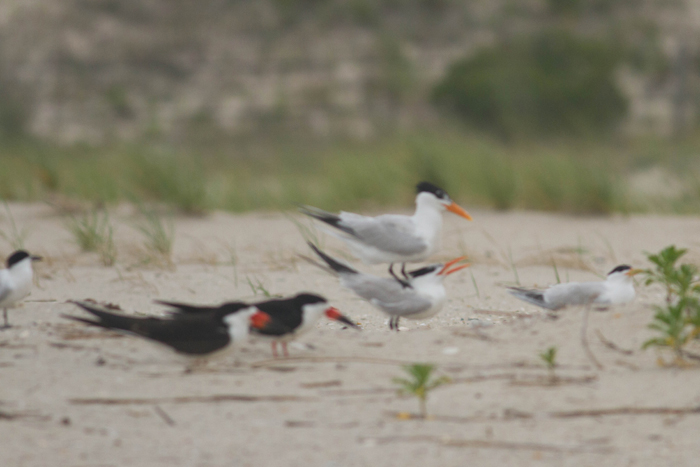
A rare Cape May Point occurrence - a pair of Royal Terns show early breeding behavior on South Cape May Beach [photo by Tom Reed].

Sandwich Terns don't breed as far north as New Jersey on the eastern seaboard of the US, but one or two turn up at Cape May each summer. This one stills sports a lot of white on its forehead and is perhaps a bird that is in its first full summer and not yet breeding [photo by Tom Reed].

Heat haze and distance can be a real problem when trying to photograph birds on the South Cape May Beach, but Karl Lukens did a good job capturing an image of this second-calendar-year Black Tern that has been showing well around The Rips and Bunker Pond lately.

Two adult Roseate Terns (center) with Common and Royal Terns on South Cape May Beach this week. Roseate Terns are a species of conservation concern and most populations are closely monitored - hence most birds you will see will be sporting leg bands like these two. Roseate Terns always stand out as very white birds with long, finely-pointed bills. In breeding plumage (as here) they also sport vivid orange-red legs and often a pinkish flush to the breast [photo by Tom Reed].

I couldn't resist cropping and zooming in on Tom Reed's photo to highlight an excellent identification mark of Roseate Tern - yet one that is rarely highlighted in the current crop of field guides on the book shelves. Look at the folded wing of this Roseate Tern and you will see a noticeable white line running along the top edge, formed by white inner webs to the primaries. This is a great feature to use to pick a Roseate out if you have a mob of terns all roosting together - maybe we will get one on our Tern Workshop on August 4th (contact us for details!).

Like an airplane leaving a condensation trail across the sky, the bill of this Black Skimmer cuts a fine line through the waters of the Plover Ponds. Watching skimmers on their evening sorties as the sun sets behind the lighthouse is surely the highlight of any summer visit to Cape May [photo by E J Nistico].

As birds take a gentle back seat for a short while, don't forget there is still so much more to enjoy at Cape May! We continue our Wednesday state park walks (with Brown Pelican, Wilson's Storm-petrel and Black and Roseate Terns all highlights this week), Pete Dunne's Monday mornings at the Meadows continue through Summer, as do boat and kayak trips and our broader wildlife walks that look at plants, dragonflies, butterflies and a whole manner of other things! Check out our online event calendar by clicking here, or stop by and pick up the latest Kestrel Express for full details. See you in the field!

Wednesday, June 13, 2012

Maine Herring Gull in Cape May


[Photograph copyright by Tony Leukering. Click on image for larger version.]

I was fortunate to join Mark Garland and his Elderhostel group on 17 May on one of those spectacular boat trips through the Cape May back bays aboard the Osprey. At the entrance to Jarvis Sound (at the toll bridge on Ocean Drive), I noted four Herring Gulls perched on individual pilings and noted that one of them was not only banded, but color-banded! As we passed fairly close to that bird, I snapped off a few pictures in hopes of being able to read the alphanumeric code on the color band on its left leg. Success!

I sent off the details and a picture (such as the one above) to the Bird Banding Laboratory (part of the U. S. Geological Survey) based in Patuxent, MD. I just heard back from that submission and wanted to share the details. The bird was banded on 15 July 2010 as a nestling/fledgling before it could fly, and was banded on Appledore Island, ME, by a crew under the direction of Dr. Sara Morris at Canisius College in Buffalo, NY.

I was particularly happy with this bird, as my estimation of its age at the time was that it was nearly two years old, as discerned by the plumage (it had some gray in the mantle) and soft-parts coloration (the bill was 3/4 pinkish). Additionally, it's outer primaries did not have the very-pointed tips typical of such birds in their first year of life. However, these large gulls are individually variable in the amount of time that they take to achieve adult plumage. In Europe, where a lot of gull study is conducted (unlike on this side of the Pond), researchers have found that a sizable minority of subadult Herring Gulls (and other large gull species) sport plumage that does not necessarily match the known age of particular individually color-banded birds. This bird, though, was spot on!

One of the take-home messages in this event is that anyone can contribute to the advancement of our knowledge of birds, it just takes a little bit of focus. So, the next time that you pass by a bunch of loafing gulls, take a bit of time to see if any are banded. Perhaps, you can provide the next piece of data that enables us to understand more fully the ecologies and strategies of even a common species such as Herring Gull.

Saturday, June 9, 2012

Summer Days, part II

[Seaside Dragonlet, near Stagecoach Road, 6 June 2012. Click on image(s) to see larger version(s). All photographs copyright by Tony Leukering.]

The true summer dragonflies and damselflies are now becoming a common part of the fauna viewable at area lakes, ponds, ditches, and streams. And at many places well removed from such water bodies. Seaside Dragonlets (above) are now showing up virtually everywhere in Cape May County and the rest of south Jersey. Despite the species' name, it really can occur anywhere down here. This very small, wide-ranging, black or black-and-yellow, southern species even has populations 100s of miles from the nearest ocean, including in New Mexico! Other real summer species now out include a variety of skimmers (Needham's [below], Great Blue, Slaty, and Bar-winged), Calico and Halloween pennants, and what may be the most numerous dragonfly in Cape May County, Blue Dasher.

[Needham's Skimmer, near Stagecoach Road, 6 June 2012]

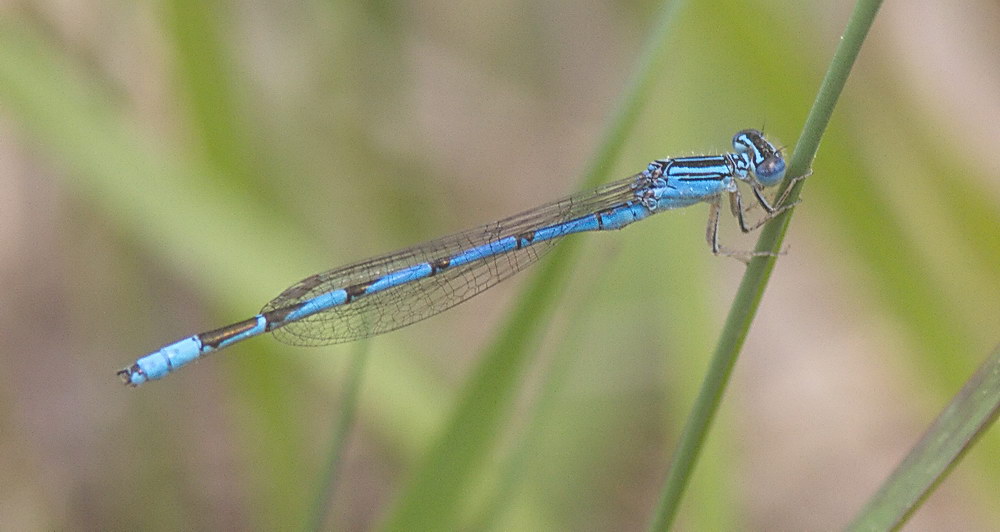
When the odonates (dragonflies and damselflies) of Cape May County were first surveyed back in the late 1980s and early 1990s), Double-striped Bluet -- a tiny species of damselfly (below) -- was unknown here. Will Kerling, Mike Crewe, and I found the first records for the county a few years ago (near Indian Trail Road) and Mike and I have been finding them in ever more places this year, including at Fort Apache Park and Cox Hall Creek WMA. While the species has not yet been found on Cape Island, I do not doubt that it will be soon.
 [Male Double-striped Bluet, Fort Apache Park, 7 May 2012]

As with all things great and small, things die and others take advantage of the bounty their deaths provide. I recently found a male Calico Pennant that was providing sustenance to a large number of water striders (genus Gerris) in a tiny puddle of water. The water striders, who may lose their pondlet to drying conditions, have the ability to fly and find other water.
[Calico Pennant, near Stagecoach Road, 6 June 2012]

Bird news includes the 10 subadult Brown Pelicans that Don Freiday saw flying over Ocean Drive yesterday evening, while Tom Reed found a Sandwich Tern -- the first of the year -- at Stone Harbor Point  this afternoon with 11 Royal Terns.

Friday, June 8, 2012

Summer Days

Those heady days of summer are creeping up on us and, with temperatures edging ever higher, it's not surprising that we had our first big thunderstorm of the season last night. Down here at the point we actually escaped the bad weather, but I hear that there were some pretty heavy hail showers on parts of the barrier islands. I was out on the barrier islands myself this morning and several times I was reminded of how much this area has to offer, yet how seldom we birders check it out. Of course, if you are in any sort of a hurry to get anywhere, the barrier islands can be very testing in high summer, but right now it's not too bad out there. As a wildlife enthusiast I can get depressed quite quickly as I pass through endless rows of faceless houses with sterile, over-manicured gardens full of non-native species and acres of bare gravel; and yet every so often, you come across a little oasis in the desert. From Ocean City, through Strathmere, Sea Isle City, Avalon and Stone Harbor to Wildwood, you will find little places where people are trying to make a difference. Ocean City, Avalon and Stone Harbor all have small but beneficial bird sanctuaries which, while maybe not attracting the numbers of birds you might find at Cape May Point or Belleplain State Forest, certainly earn their keep by providing food and shelter for breeding, wintering and migratory birds in season and all are worth a check at the right time of year. At a number of locations today I chanced across both Black-crowned and Yellow-crowned Night Herons lounging in good breeding habitat and clearly they do well while rubbing shoulders with us Humans. Glossy Ibises too were at several places and the calls of Willets seemed almost always to greet me wherever I overlooked the back bay marshes. Other pleasant surprises included an active breeding colony of Purple Martins on the edge of the saltmarsh, at least four Willow Flycatchers calling at scrubby wetlands in Ocean City and Strathmere and the first real northward push of Spot-winged Gliders that I have noticed this year, with a nice wave of these dragonflies clearly moving through. While I was off the point today, Tom Reed reported a Roseate Tern on the South Cape May beach and Karl Lukens later reported it from the wooden railing on Bunker Pond. The first of the year I think, so keep an eye out for terns with black bills!

Finally, I would like to give a heart-felt thank you to all the people of the barrier islands that I saw today keeping an eye out for Diamondback Terrapins. Female terrapins heavy with eggs were running the gauntlet of the traffic throughout the islands today but I was impressed by how few I saw that had been run over and how many times I saw someone take evasive action, or even stop and help them across the road. Thanks folks, your terrapins need you!

Adult Yellow-crowned Night Heron dodging the sunny 82F temperatures at Ocean City today [photo by Mike Crewe].

Wednesday, June 6, 2012

Emelia Birds!

I think it's fair to say that we have fun on our walks; we see plenty of great birds without needing to take it too seriously. So it's not surprising that last week we coined a new phrase - Emelia Birds. What are Emelia* Birds? Well, they are birds that are always flying away from you when you see them. There they go, disappearing over the dune top or behind a pavilion roof. Now Karl* Birds are different, they fly towards you and disport themselves in all their glory! So last week, Emelia birds were pointed out to us by Emelia and we saw the tails of Black Skimmers sneaking away behind us; Karl pointed out Black Skimmers to us and they graceful arced their bills down into the water and cut neat lines right across the Plover Ponds. You get the idea...

So today on our Wednesday walk, Emelia Birds were in evidence even when Emelia wasn't there! A bunch of 11 ibises approached and were clearly dropping in to land on Bunker Pond. So clearly, that when I first scanned through them, I quickly fell upon the tell-tale pink face with broad white surround of an adult White-faced Ibis among their number. We were going to get great views of this bird in the scopes - or so I thought! As they emerged on the other side of a line of bushes, they were already powering off towards Pond Creek Marsh - Emelia Birds without a doubt!! Immediately after this, four shorebirds shot right past us, revealing white rumps as they - inevitably it seems - quickly became Emelia Birds! They were White-rumped Sandpipers alright but they really weren't behaving for us this morning! Our walk finished with the ultimate Emelia Bird trick - two Caspian Terns that turned up the very moment that the last walk participant had just turned the corner out of the parking lot!

Of course it wasn't all like that and we enjoyed great scope views of two American Oystercatcher chicks that were just a few days old, tottering around on the beach with their parents, a pair of Cedar Waxwings carrying nest material and some very obliging Blue Grosbeaks and Indigo Buntings among others.

* Note that names may, or may not, have been changed to protect the innocent - or guilty... only those who were there know the truth!

Recent Bird News
A White-faced Ibis has headlined a series of good birds at Brigantine over the first few days of June and maybe was the same bird that flew through Cape May Point today. Brigantine also had Marbled Godwit and American Golden Plover recently - both scarce birds here in spring. Dave Lord tells me that the Semipalmated Sandpiper show remains good on sandy beaches in Cape May Harbor, as seen from our scheduled boat trips, while Tom Reed reported a late Wilson's Warbler in Avalon on June 2nd. Other wandering warblers of late have included Northern Parulas in song at Cape May Point, Cape May Point State Park and Head of River and a Yellow-throated Warbler (not surprisingly with white lores) at Cape May Point on 4th. A Least Flycatcher was somewhat unexpected in the state park on 3rd, while the three Eurasian Collared Doves continue to attract attention at Cape May Point. Elsewhere, the breeding season progresses with Indigo Buntings and Blue Grosbeaks showing well at our usual weekly walk locations and a trickle of late shorebirds passing through included a nice group of four White-rumped Sandpipers at the state park this morning.

Blue Grosbeaks are a nice feature of a summer's day around Cape May - this pair fed on old grass heads on the South Cape May dune today [photo by Karl Lukens].

Success at the beach can be measured by the patter of tiny feet on the sand! One of two still-doddery American Oystercatcher chicks seen on the South Cape May Beach on our morning walk today [photo by Karl Lukens].

Cute, or too much like a Gremlin?! A baby Piping Plover braves a new world at the South Cape May Beach [photo by Sam Galick].

Caspian Tern is certainly not a common bird at Cape May Point during the summer months, so a pair continuing to show breeding behavior here is very interesting [photo by Sam Galick].

I mentioned in a recent post that June is a good time for surprises and wandering, off-course migrants such as this Least Flycatcher at Cape May Point State Park are out there to be found... (note the slightly odd-looking bill on this bird, which seems a little too long and may be the result of a damaged tip [photo by Sam Galick].

Of course, whatever the time of year, there is always interesting bird behavior to be noted. This Prothonotary Warbler was stealing insects from spider webs at Cox Hall Creek WMA recently - a bit like going to the convenience store [photo by Tony Leukering].

Saturday, June 2, 2012

Everybody's Talking Moths...

It seems wherever I go, everyone is talking moths right now! Though an interest in moths has been big business in the UK for many years (check out, for instance, the amazing Norfolk Moths website that I used when I was over there), it is still pretty much in its infancy in the US - but things are changing fast. Perhaps with the advent of the first really usable field guide to moths in the Eastern USA, the latest in the Peterson Field Guides series (and available at CMBO stores folks!), these insects have really caught on around Cape May and sales of light bulbs at Lowe's have never been so good!

I think locally it all really started with a dodgy light fitting at Belleplain, which meant that a certain brick hut was being illuminated all night and has now become a feature at the start of my Belleplain Wildlife walks on Sunday mornings. The sheer variety of moths is stunning in itself, but there's all the complex life style types too. For example, on one recent walk we found a female Pink-striped Oakworm sitting under the eaves of the building. Now this is one of the species that attracts a male not by sight or sound, but by smell! And it was clear that the pheromone that she was invisibly emitting was working as no less than three would-be suitors were buzzing around trying to track her down.

If you haven't got 'moth mania' yet, think about adding this new dimension to your wildlife experiences. You can come and get started on our Belleplain Wildlife walks on Sundays, or just leave an outside light on and see what shows up; you can buy the book, or you can just enjoy them for what they are and not worry about the names. One request though, if you do try mothing with a light, do be aware that moth predators such as lizards, birds and even mice, soon learn about regular food supplies. So try not to run a light at the same place every night and, if possible, use a time switch or get up early so that you can turn the light off before it gets light; that way, the moths can sneak away to a daytime hiding place rather than all end up as somebody's breakfast...

Here's a few Cape May moths that I photographed during the past year, just to scratch the surface of moth diversity:

Moths can be tiny - this Suzuki's Promalactis is just 6mm long...

...or they can be monstrous - the Polyphemus Moth has a wingspan up to 150mm, that's six inches in old money!

Moths can be your basic, typical moth, or they can mimic something else - or even get the imagination going! How about this Imperial Moth for looking like an old banana skin...

...the Juniper-twig Geometer looks like a dead leaf...

...the Common Bird-dropping Moth looks like, well, a bird dropping...

...the Grapeleaf Skeletonizer flies during the day and looks pretty similar to some of our wasps...

...and the very woolly Black-waved Flannel? It looks pretty much like a sheep in need of a shave to me! (See, I told you you could use your imagination too!)

Moths can be day-flying, such as this Celery Looper Moth feeding at Wild Radish flowers at The Beanery...

...they can be wildly exuberant like this stunning Io Moth...

...or wildly improbable like the glorious pink-and-yellow Rosy Maple Moth that got many a camera clicking during our Spring Weekend events recently.

And finally, for those who anguished over the repeated near-misses of the Pink-striped Oakworm males recently - just thought you'd like to know that one of them made it!

Don't let summer 'down-time' from birds keep you indoors - there's a whole world to be explored right here in Cape May - come and join us!

Oh, just one more - how about this Snowberry Clearwing for letting your imagination run riot? I swear it looks like it's riding the sand dunes at Higbee Beach on a jet ski!!!

Friday, June 1, 2012

Everybody's on the water!

From the latest batch of photos I have been sent, it seems that everyone is enjoying the current hot weather by getting out on the water! One way to enjoy wetland birds and enjoy those pesky greenhead flies is certainly to get out in a boat, and we certainly have a great schedule of trips available for you to take in the coming summer months. Our regular Saturday trips on the Skimmer and Sunday & Monday trips on the Osprey are proving ever popular so make sure that you don't miss out on the fun. If you want to get even more up close and personal with Cape May's waterbirds, don't forget there are also our kayak trips on Wednesday mornings. Check out our events calendar for times and contact details for all of our fun birding excursions out on the back bays of Cape May.

This photo shows a Black-crowned Night Heron with a tricky problem - a nice fish in its bill, but all the green algae to get rid of first! Birds are amazingly skillful at manipulating their bills and this bird made short work of extricating the fish and getting its dinner (photo by Beth Polvino).

Glossy Ibises always make attractive subjects for photography and getting in close via a kayak is a great way to get the best views you will ever have of these birds (photo by Beth Polvino).

Don't forget the songbirds too! A good range of songbirds can be found down by the water too, especially if there is plenty of feeding opportunities to be had. This Eastern Kingbird was by the bird-rich lagoons at Heislerville recently (photo by Beth Polvino).

Forster's Terns are getting stuck into their breeding routine now and look very smart in full breeding colors. They often feed around the harbors and marinas and give plenty of opportunity to practice your skills at catching them on camera [photo by Brad Remick].

Green Herons can usually be found along the marsh edge, especially during migration periods and a rusty-necked adult is certainly a fine sight (photo by Brad Remick).

The top prize for many people on a backbay boat trip - a Clapper Rail. This bird took a typically labored flight across the marsh, right in front of birdwatchers on the Osprey and was nicely captured here by Brad Remick.

If you feel you would like some extra tuition in the art of bird photography, don't forget that Scott Whittle's walks continue on Tuesdays through June - though please note that there won't be a walk on Tuesday 5th as Scott has been dragged away to Trinidad for a few days. You have to feel sorry for him don't you?!!

Information on bird sightings has been inevitably quiet during the past few days as scattered showers have kept birds indoors a little more of late, but sunny spells continue to produce nice sightings, including an amazing seven Mississippi Kites over Cape May Point on May 31st.