Friday, October 19, 2012

Boat Trips and More on Siskins...

Though we are right in the midst of our autumn birding extravaganza, many of us here at the bird observatory are already well into our planning schedule for 2013 and it is during October that I spend most of the time thinking of our schedule for next spring. Having just spent a couple of hours going through these schedules with our local boat captains and some of our keen volunteers, you can expect to see some new ideas popping up next year - including some special kayak trips during the summer months.

Birding out on the open water is always a treat and it was a nice coincidence, having just been down at the dock talking boat trips, to receive some photos from our recent trip out of Somer's Point, courtesy of the Duke o'Fluke. While birding at Cape May, it can be easy to slip into the mistake of remaining entirely focused on Cape May Point, but look at any map of the area and you will soon see a region awash with fabulous back bays to visit. The Duke o'Fluke actually sails out of the very southern tip of Atlantic County and heads into Great Egg Harbor - the large body of backbay water where the Great Egg Harbor River and the Tuckahoe River meet. This is a fabulous area to get into by boat as there is almost no access by road, and you soon get into some wonderful out-of-the way places. Tour participant Bill Snelling sent me an array of great shots from last weekend's boat trip, including the couple I've added here. Look out for more trips up the Great Egg Harbor River next year!

Belted Kingfishers can be pretty jumpy if you try to get close to them on foot, but approaching by boat can be a different experience. Participants aboard the Duke o'Fluke enjoyed getting close enough to this bird to see the extra chest band that makes it a female [photo by Bill Snelling].

Bald Eagles getting commonplace? Surely not!! OK, so we see Bald Eagles an awful lot more now than we used to, but they are still pretty amazing things to watch. Here, a pair cozy up together on a channel marker and give great photo opportunities to our boat trip group [photo by Bill Snelling].


Pine Siskins continue to be in the news right now, as impressive numbers of these understated birds head southward. This is one of a group of northern breeding species which tend to be irruptive rather than regularly migratory, their movements dependent more on food availability than on weather. Right now, Cape May is almost awash with Pine Siskins and our walk groups are enjoying unusually good views of these confiding birds. It seems likely that tree species that regularly provide food for these birds have had a crop failure this year and the birds have no choice but to head south and look for alternative sources. Though the field guides show the wintering range of this species as being throughout the USA, in reality, they are far from guaranteed each year in any one location, so I suggest you make the best of them while they are here. To get a feel for the scale of the movement, take a look at the following maps, which Sam Galick kindly prepared from eBird data (all maps generated from eBird/Cornell Lab of Ornithology) - you can click on the maps to get larger images and see more detail.

Data from eBird showing reported sightings of Pine Siskins for September 2011

Data from eBird showing reported sightings of Pine Siskins for September 2012

Data from eBird showing reported sightings of Pine Siskins for October 2011

Data from eBird showing reported sightings of Pine Siskins for October 2012

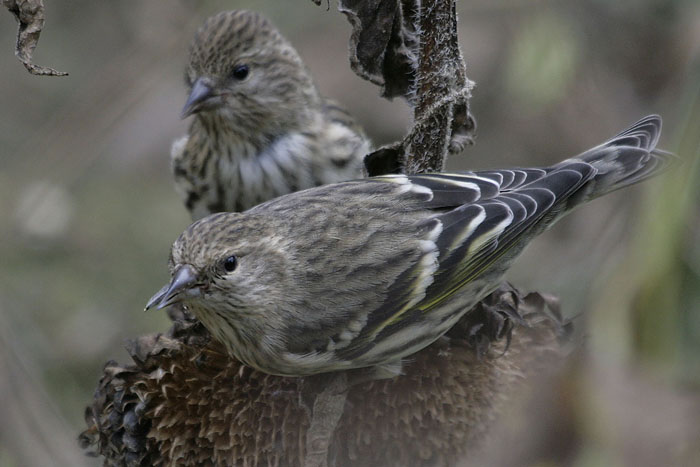
Pine Siskins are overall brownish-gray and streaky, but usually have yellowish edges to the wing feathers and have narrowly-pointed bills, ideal for probing deep into flower heads to dig out seeds. Watch for them at backyard feeders or in sunflower patches (native as well as introduced species) and expect to see them associating with American Goldfinches [photos by Mike Crewe].

Wednesday, October 17, 2012

LOST SCOPE

Did you leave a scope and tripod on the Hawkwatch Platform on October 17th? If so, we have it at the Northwood Center. Please call with details - 609-884-2736.

So many birds, so little time!!!

There's one huge perversion about Cape May that I tend to fall foul of at this time of year and that is, during October, there are so many birds that it's almost impossible to find enough time to report them all!! A nice problem to have, if one has to have a problem at all, but it doesn't do our regular blog readers any favors if they are relying on postings to plan a trip to Cape May. Well, I guess one thing to always bear in mind is that Cape May is worth coming to every October, as it would have to be a pretty weird year for there to be nothing to enjoy down here.

In reality, we hope that modern technology will help you all to keep up to date with what is going on in a variety of ways. Over the past few months, we have been gradually morphing our blogs into something that we hope you will find more helpful and more resourceful to you and I have to thank Catherine Busch, one of our regular volunteers, for being a main player in this. At the top of any one of our blogs (such as the page you are on now!) you will find a menu bar beneath the header, which will help you to navigate directly to all of our other blog pages. You will find a link to pages that contain bird lists from our walks (Field Trips), daily counts from our seasonal research projects (Seasonal Research) and other links to our stores, local conservation projects and even a news page which will keep you informed on our walks, workshops and other programs.

In addition to these, we have tried to help you in a more predictive way to identify when it looks like it will be a good day for birds. As you visit our various blogs, you will find a range of tools in the left hand margins which give you direct access to information from other sites. Perhaps most importantly if you want news of the rarer species, you can sign up to our Twitter feed which will give you the hottest news much faster than we can through a web page. You will also find a link to Cornell's eBird rarity sightings and links to sites that will tell you tide times, wind direction and even migration predictions. In the mean time, our View from the Cape blog will feed you regular doses of the birds of Cape May and keep you excited enough to want to be heading back just as soon as you can!

So for now, here's the cheap and easy route - just a few of the awesome photos that I get sent on a daily basis from those souls fortunate enough to have been here lately - when did you last Bird Cape May?!!

Though Rufous Hummingbird is a western species and not one we should expect to see on the east coast, small numbers do turn up annually and this October has been no exception. Though typically appearing later on in November, we don't mind enjoying them in October - this individual was well-watched at feeders on Stevens Street, at the residence of Michael O'Brien and Louise Zemaitis [photo by Micheal O'Brien].

Almost certainly a Rufous, though we still await the clincher photo that shows the tail tips, this hummer has been visiting a backyard in Del Haven recently [photo by Bob Fogg].

Further afield in Salem County, another probable Rufous Hummingbird but awaiting that clincher shot - here feeding on one of those amazing red sages that I am sure you all have in your yards [photo by Jeff White].

Well-watched now after staying for a few days, this American White Pelican was first reported to me by Kevin Inman and Jim Halfpenny as it rose from a flock of cormorants at Brigantine on 14th [photo by Kevin Inman].

Three's company... a nice teaching aid of three birds and three species - Lesser Black-backed, American Herring and Ring-billed Gulls at South Cape May Beach during our Meadows walk on Monday morning [photo by Karl Lukens].

Royal Terns have been very noticeable by their presence for several weeks now and continue to show well along the South Cape May beach or out in the rips [photo by Karl Lukens].


Sometimes it's nice to post some pictures just because they are great pictures and not because they are of anything super rare. These two shots of a Green Heron fit the bill nicely and were taken recently at Brigantine by E J Nistico.

Above all (perhaps!) October is about raptor movements (I feel yet another blog post coming on!) and is so often the time when you get that real 'up close and personal' encounter at the Hawkwatch Platform. This adult Bald Eagle cruised right by in front of a very appreciative audience this week [photo by Karl Lukens].

News of great October, Cape May, birding continues to flood in (and I'm stuck at my desk with a mere two species of nuthatch, Pine Siskins, Purple Finches and an Eastern Towhee at the feeder outside!!). The Avalon Seawatch is well and truly open for visitors now with Bob Fogg reporting a very impressive scoter movement today and Tom Magarian having the awesome luck to enjoy nearly an hour of Humpback Whale entertainment there on 15th. Two Red-headed Woodpeckers at Cox Hall Creek WMA on Sunday hopefully mark the return of regular wintering birds there and Monday saw a brief fly-by from a Western Kingbird at Hidden Valley, courtesy of Doug Gochfeld. Clay-colored Sparrows continue to add to an already good year for the species with singles at the Hawkwatch still on October 12th and one at The Beanery on 15th, per Paul Guris. A female Common Eider was reported from various locations on 13th and perhaps still lurks in the area and a Swainson's Hawk passed quickly by on 17th.

This morning was one of those amazing Cape May mornings that I will never tire of. The first half hour of our state park walk was simply a stand, as we couldn't get out of the parking lot! The whole time we were there, birds just flooded overhead in a crazy milling about as they pondered a Delaware River crossing. Thousands of Yellow-rumped Warblers and Tree Swallows, hundreds of Red-winged Blackbirds, American Robins, Pine Siskins, American Goldfinches and an assortment of American Pipits, Blue Jays, Red-breasted Nuthatches, Palm Warblers, Sharp-shinned Hawks - offshore, there was a madness of gulls and terns feeding in the rips, interspersed with a few Northern Gannets, while the trees further round were ringing with the calls of yet another big Red-breasted Nuthatch day - though today they were also accompanied by several White-breasted Nuthatches and Brown Creepers, also on the move. It's Cape May time again!!

Sunday, October 14, 2012

The Big Sit!

If you were at Cape May Point State Park this Saturday and thought that the Hawkwatch Platform was even more 'happening' than usual, you would be right, for Saturday was the day of Cape May's official Big Sit. I am sure that most people will know by now, but the Big Sit is a wonderful, non-competitive (ie, no prizes given!!) event that takes place on the second weekend in October each year and the aim is very simple - to record as many species as possible from a single location on a single date. I say non-competitive - and it is - but, inevitably, there is a certain honor and pride attached and, well, you know, that competitive edge just sneaks in a little! This year, event organizers allowed Big Sits to take place on either the Saturday or the Sunday, giving a certain flexibility to work around possible bad weather. Once again, Tom Reed took the bull by the horns and got us scheduled for Saturday October 13th - and what a fabulous day it turned out to be!

As ever, the mighty stalwarts of Cape May birding were out right on the beat of Midnight and it is wth much gratitude that we thank Cape May Point State Park for allowing us to be present on the Hawkwatch Platform outside of regular hours. With the count being organized slightly later than usual this year (I guess perhaps because the first weekend fell so close to the start of the month?) we were a little hard pressed to find warblers, but as it turned out, the early morning movement of late-season birds such as American Pipits, Rusty Blackbirds, Eastern Meadowlarks and the like, made up for some of the potential shortfall.

In all, some 50 people contributed to a wonderful day - and the weather was pretty wonderful too, after a mighty chilly start - and it is impossible to name all those who helped even by simply offering encouragement and keeping the atmosphere jolly. But we have to recognize the awesome staying power of the 'hardcore' of Cape May's birders that were present for most of the 19 hours that were covered this year: Tom Reed, Sam Galick, Michael O'Brien, Chris Brown, Glen Davis, Tiffany Kersten, Dave Hadeen, Vince Elia, Don Freiday, Scott Whittle, as well as many more who were there when they could be - including Cape May's very own prodigal son, Doug Gochfeld, who returned to his adopted homeland to be part of the main event! Especially awesome this year was the food, provided by so many people, but I have to single out the wonderful contributions of burgers and hot dogs by Lisa Ryan and Chris Marks (and barbecued on the spot by Lisa, Chris, Catherine Busch and others) and also the fabulous chilli provided by Libby Errickson and Alyssia Church that rounded off the day and materialized right on sundown as 27 Black-crowned Night Herons were rising out of the marsh and heading out over the bay.

The Big Sit is as much about the people as it is about the birds. The new barbecue stand installed by the state park this summer right next to the Hawkwatch Platform gets put to perfect use here by Chris Marks and Lisa Ryan - thank you ladies! [Photo by Mike Crewe]

From long before sunrise to well after sunset, Cape May's birders kept vigil in the state park. Here, Glen Davis, Michael O'Brien and Doug Gochfeld deny themselves views of a perfect Cape May sunset behind the lighthouse in favor of finding just one more bird for the list [photo by Mike Crewe].

And the final score? Well in the end, 133 species of birds were logged on the day sheet. Here's the full list posted to eBird:


Snow Goose  X
Brant  X
Canada Goose  X
Mute Swan  X
Wood Duck  X
Gadwall  X
American Wigeon  X
American Black Duck  X
Mallard  X
Blue-winged Teal  X
Northern Shoveler  X
Northern Pintail  X
Green-winged Teal  X
Lesser/Greater Scaup  X
Surf Scoter  X
White-winged Scoter  X
Black Scoter  X
Red-breasted Merganser  X
Ruddy Duck  X
Red-throated Loon  X
Common Loon  X
Pied-billed Grebe  X
Northern Gannet  X
Double-crested Cormorant  X
Great Cormorant  X
Brown Pelican  X
American Bittern  X
Least Bittern  X
Great Blue Heron  X
Great Egret  X
Green Heron  X
Black-crowned Night-Heron  X
Black Vulture  X
Turkey Vulture  X
Osprey  X
Northern Harrier  X
Sharp-shinned Hawk  X
Cooper's Hawk  X
Bald Eagle  X
Red-shouldered Hawk  X
Broad-winged Hawk  X
Red-tailed Hawk  X
American Coot  X
Black-bellied Plover  X
Killdeer  X
Solitary Sandpiper  X
Greater Yellowlegs  X
Lesser Yellowlegs  X
Ruddy Turnstone  X
Sanderling  X
Semipalmated Sandpiper  X
Pectoral Sandpiper  X
Dunlin  X
Wilson's Snipe  X
Laughing Gull  X
Ring-billed Gull  X
Herring Gull  X
Lesser Black-backed Gull  X
Great Black-backed Gull  X
Caspian Tern  X
Common Tern  X
Forster's Tern  X
Royal Tern  X
Black Skimmer  X
Parasitic Jaeger  X
Rock Pigeon  X
Eurasian Collared-Dove  X
Mourning Dove  X
Barn Owl  X
Great Horned Owl  X
Long-eared/Short-eared Owl  X
Belted Kingfisher  X
Red-headed Woodpecker  X
Red-bellied Woodpecker  X
Yellow-bellied Sapsucker  X
Northern Flicker  X
American Kestrel  X
Merlin  X
Peregrine Falcon  X
Eastern Phoebe  X
Blue Jay  X
American Crow  X
Fish Crow  X
Northern Rough-winged Swallow  X
Tree Swallow  X
Bank Swallow  X
Barn Swallow  X
Carolina Chickadee  X
Red-breasted Nuthatch  X
White-breasted Nuthatch  X
Brown Creeper  X
House Wren  X
Marsh Wren  X
Carolina Wren  X
Blue-gray Gnatcatcher  X
Golden-crowned Kinglet  X
Ruby-crowned Kinglet  X
Swainson's Thrush  X
American Robin  X
Gray Catbird  X
Northern Mockingbird  X
Brown Thrasher  X
European Starling  X
American Pipit  X
Cedar Waxwing  X
Common Yellowthroat  X
Northern Parula  X
Blackpoll Warbler  X
Black-throated Blue Warbler  X
Palm Warbler  X
Pine Warbler  X
Yellow-rumped Warbler  X
Eastern Towhee  X
Chipping Sparrow  X
Clay-colored Sparrow  X
Savannah Sparrow  X
Song Sparrow  X
Swamp Sparrow  X
White-throated Sparrow  X
White-crowned Sparrow  X
Dark-eyed Junco  X
Northern Cardinal  X
Indigo Bunting  X
Red-winged Blackbird  X
Eastern Meadowlark  X
Rusty Blackbird  X
Common Grackle  X
Boat-tailed Grackle  X
Brown-headed Cowbird  X
Purple Finch  X
House Finch  X
Pine Siskin  X
American Goldfinch  X
House Sparrow  X

The Big Sit is a major event which was started by the New Haven Bird Club, Connecticut and is hosted by Bird Watchers' Digest and sponsored by Swarovski Optik.

Thursday, October 11, 2012

Sparrows, kinglets, finches and more...

It's been pretty heavenly at Cape May this week, so good that finding time to post about it has not been easy! The weather has sorted itself out a little this past few days and a run of more typical north-west winds has seen the traditional fall locations of Cape May Point, The Beanery and Higbee Beach brimming with birds. October 7th saw some interesting movements around the point itself, with Pine Siskins dominating a nice movement of sparrows, finches and other songbirds - the same day saw Cameron Rutt tallying over 1100 Pine Siskins at the Higbee Dike and other observers reported Lincoln's and Vesper Sparrows, Horned Lark and a couple of single-observer reports of Pileated Woodpecker. Sam Galick added Western Kingbird and American Golden Plover to the week's totals and several observers reported Red Bats on migration, including a count of 25 in 30 minutes at St Mary's, reported by Dave Hadeen.

October 8th saw a continuation of the excitement of the 7th, with a Swainson's Hawk being seen by many observers at the point, a Red-headed Woodpecker at Higbee Beach and a Sedge Wren at the 'traditional' location of Hidden Valley. Clay-colored Sparrows continued to pop up seemingly everywhere and Bob Fogg reported a probable Rufous Hummingbird from Del Haven - the second of the season so far. 'Classic' late autumn species began to appear in good numbers, with several reports of Brown Creepers and Winter Wrens mingling with tardy Black-throated Blue, Cape May and Blackpoll Warblers. Nocturnal heron flights were noticeable to those who were having trouble sleeping, with small numbers of Great Blue Herons still on the move at first light some days for those on a more regular circadian rhythm. American Moorhens appeared in reasonable numbers, with individuals noted during the period from The Beanery, The Meadows and Cape May Point State Park; the latter gained at least nine American Coots on its ponds too, while The Meadows currently appears to be the best place to seek out Soras.

Late warblers often made up a colorful addition to many people's day lists, with both Prairie and Golden-winged Warbler being reported from Higbee Beach on 9th, two Cape May Warblers at the state park on 10th and a Black-throated Blue Warbler at Hidden Valley on 11th, to name but a few. Sparrows are very much the order of the day at present though, and the fields at Higbee Beach WMA are currently offering a fabulous spectacle of close-up and personal sparrows in all shapes, sizes and colors. Highlight so far has been a Nelson's Sparrow in the first field there on 9th, but no doubt there are more goodies to be found. Today has seen another great hawk flight, overwhelmingly dominated by Sharp-shinned Hawks; weather patterns might slow things for the next 36 hours or so, although there is plenty already here to enjoy - if you're planning on a weekend visit, Saturday morning looks very promising indeed, though I'll hold final judgement on that for another 24 hours yet!

The warbler show at the Northwood Center was a little later coming this year, but eventually there was a nice run of very approachable birds, such as this Northern Parula, photographed from right beside the cash register in the store!! [Photo by Mike Crewe]

Northwood's bird baths have been busy too - here, two Magnolia Warblers take a welcome dip in front of an admiring crowd [photo by Mike Crewe].

A surrpise treat at Higbee Beach this late in the season was this Golden-winged Warbler, reported by Harvey Tomlinson on October 9th [photo by Mike Crewe].

Always a star performer during any Fall migration, Golden-crowned Kinglets are all over town right now... [photo by Mike Crewe]

Pine Siskins are moving in very good numbers throughout the region now - for close encounters with these birds, try the sunflower strips at Higbee Beach WMA [photo by Mike Crewe].

Red Bats are fairly chunky mammals that go through a regular southward migration each fall. Numbers have been low in recent years, but this fall has seen some nice movements on and off throughout the season. Keep an eye out for these if you are migration-watching anywhere around the point in the early morning [photo by Mike Crewe].

It often comes as a surprise that these little 'penny bun' birds, Pied-billed Grebes, move in appreciable numbers. At least 10 have been hanging out on Bunker Pond lately, with smaller numbers on many other pools in the area. I must admit though, that I have no idea what this one is doing! [Photo by Mike Crewe]

Sparrows are definitely big business right now as we head into the best time to get to know these birds. This first-winter White-crowned Sparrow may not be as snazzy as an adult bird, but it still has a regal look about it I reckon [photo by Mike Crewe].

One of my favorite fall birds - Swamp Sparrows can be heard calling from damp fields and tangled corners all over Cape Island right now. To really learn how to become confident at sparrows, you could do no better than to take Michael O'Brien's excellent Sparrows Workshop - coming up October 20-21 and ideally timed to enjoy a wide range of species [photo by Mike Crewe].

The time for insect-watching may be fast coming to a close, but there are still weird and wonderful things out there for you to chance across. I found this amazingly snake-like Spicebush Swallowtail caterpillar on a Sassafras leaf while searching for jumping spiders with Dick Walton at Higbee Beach [photo by Mike Crewe].

Sometimes, when you have to live somewhere like Cape May, you have to suffer the indignity of good birds right in your yard! The local Bald Eagles have lately taken to de-barking the branches on the top of my Siberian Elm and have been drawing many cameras from their cases! [Photo by Mike Crewe]

Wednesday, October 10, 2012

Two Northern Wheatears!!

Tuesday morning had the phones all going off at the same time - a Northern Wheatear reported from the dune cross-over at South Cape May Meadows! Many cars and bodies were soon heading that way and the bird was shortly re-found out on the beach. This is not the first Northern Wheatear for Cape May, but it did turn into an interesting day for the species. This particular bird worked its way progressively eastward toward 2nd Avenue Jetty and was last reported in that area around 1PM. That could have ended up being an end to the story, but around 4:30PM, a Northern Wheatear was reported on the mown lawn beside the lighthouse (what we like to call the frisbee field!) and Glen Davis shortly found it sitting right on the bench at the east end of the grassy area. Questions then started to be asked; would a bird, that had been working eastward, suddenly have turned around and flown all the way to the west end of the point? Well, yes, I am sure it is possible and certainly not improbable, but the question had been raised. So, having enjoyed both wheatear visitations, late last night I set about trying to compare my photos of the two, looking for any differences or similarities that could resolve the problem - one bird or two...

Well, interestingly, I never came to a firm conclusion and went to bed satisfied that the likelihood of there being two birds was low enough that it wasn't really a worthwhile consideration. Roll forward to 10:30AM today when I ran into someone at the Northwood Center who told me that he had seen the bird on the grass near the lighthouse, then re-visited the beach south of the meadows and found a wheatear to be there too! Most importantly, I was told that the bird on the beach was then photographed around 6PM - I, and several others, were certainly still with the lighthouse bird at 6PM, so, no matter how alike the two birds may or may not appear in photos, it does look as though there was certainly two Northern Wheatears here yesterday.

Northern Wheatear number 1 - the morning bird on South Cape May Beach [photo by Cameron Rutt]

Northern Wheatear number 1 on the South Cape May Beach. Note the very different upperpart color, caused by different lighting conditions, compared with the picture above [photo by Mike Crewe].

Northern Wheatear number 2 - the afternoon bird in the state park, by the lighthouse. Northern Wheatears are notoriously difficult to age after the post-breeding/post juvenile molt and banders who have them in the hand generally rely purely on the color of the inside of the upper mandible (not too easy in the field!). However, in reality, first-winter birds tend to show much broader pale margins to the tertials and greater coverts and both these birds seemed likely to be first-winter birds [photo by Mike Crewe].

Typically, both of these birds appeared to be of the large, richly-colored race, leucorrhoa which is the form that breeds closest to us, in Greenland and Arctic Canada. Both birds were rather chunky, often pot-bellied in appearance and had rich, almost cinnamon washes to their chests.

Saturday, October 6, 2012

Just a pile of sticks?

If ever a case could be argued in favor of good habitat, it's a rough old pile of sticks that stands in Cape May Point State Park, right along the south side of Bunker Pond. This is the state park's burn pile; the place where damaged vegetation and all those invasive plant prunings get taken to, ready to be periodically burned. Luckily, state park staff have recognized the value of this pile and tend to leave the burning for later in the year - and what a pile of brushwood it creates, ideal for a whole bunch of birds to take cover from predators in, find food in, and even roost in at night. Sadly, many people these days live in all-too-sanitized plots of land, with the mere sight of a twig or autumn leaf lying on the ground being seen as an eyesore - a blot on the landscape. If you have the room to allow a modest pile of branches to be stacked somewhere in a corner of your yard, you will be surprised what delights it can bring you - and don't be in too much of a hurry to burn it, remember there may be creatures roosting, or even hibernating in there. Here's just a few pictures from the state park brush pile, all taken during a short period this afternoon:

The famous Cape May Point State Park brush pile with attentive audience today.

Yellow-rumped Warblers are well and truly 'in town' now and can be expected to dominate warbler movements from now on. Look for them anywhere there is a branch to sit upon!

The rapid tail-flicking of Dark-eyed Juncos, revealing flashes of white, will soon be a common sight in our back yards. Small numbers have already started to arrive at the point.

Palm Warblers have been plentiful some days in the brush pile, as well as scurrying around in the dunes. This is a typically drab western birds; birds from the eastern population have extensive yellow on the underparts.

As more and more sparrows pass through Cape May Point, keep an eye out for small numbers of the attractive White-crowned Sparrow. Adults are obvious with their 'skunk-striped' heads, but first-winter birds such as this one are more subtly marked.

Today's main attraction in the brush pile - a Clay-colored Sparrow. This species continues to increase as a passage migrant on the east coast in fall.

Not a great photo as such, but it's not often that you get a chance to catch two Clay-colored Sparrows in one photograph at Cape May!

Just to ring the changes, this House Wren also mooched about in the brush pile today [all photos in this post by Mike Crewe].