Thursday, March 8, 2012

Things that go beeep in the night - and cross the road!

With temperartures edging upwards there's a sense of spring in the air and that classic combination of sunny spells interspersed with rainy spells has got the flower buds popping open and all sorts of animal activity going on. This time of year is particularly a time to be careful if driving after dark - for things are a-foot out there! This was brought home to me when I heard about last weekend's Woodcock Dance which sounded like they had an amazing time. Short-eared Owls and Northern Harriers parading right before the group, a singing Seaside Sparrow, then some wonderfully obliging woodcocks that displayed from right in the middle of the track. All fantastic stuff and hopefully all to be repeated this coming weekend. We still have just a few places left on this coming Saturday's Woodcock Dance program so don't miss out if you want a close encounter with the 'Timberdoodle' - call Chris Tonkinson on 609-861-0700 to find out how to take part.

I mentioned driving after dark above and the main reason I did this is because we are rapidly heading into amphibian time. Over the next few weeks, our amphibian species will be emerging from winter hiding places and making their way to traditional breeding pools, some of which have been used for many generations. Amphibians most often move in greatest number on wet nights and their routes often take them across roads. So do please be alert to little guys weaving across the lanes and try to avoid them as best you can. Many of our amphibians are in steep decline due to habitat loss and the devastating effect on their populations of feral and domestic cats, so anything we can do to help will surely be appreciated by them.

Why did the Timberdoodle cross the road? To get to this weekend's Woodcock Dance of course! This guy actually crossed the road in front of me at 3pm and gave me a nice opportunity for a broad daylight photo session from the comfort of the driving seat! [Photo by Mike Crewe]

New Jersey Chorus Frogs are kicking up a right racket at a pond near you right now! This species seems to be particularly common from Rio Grande north to Goshen and Swainton. [Photo by Mike Crewe]

A prize find at any time! Tiger Salamanders are rare in Cape May but still present at suitable locations. This is a State Endangered species and should not be molested without authorization. Salamanders are early birds and large species are already well into their breeding season. The location where I found this adult also had a large number of salamander tadpoles present. [Photo by Mike Crewe]

And talking of crossing the road - watch out for big guys as well as little guys while you are out and about in Cape May! Wild Turkeys are getting into courtship mode now and traffic sense will no doubt go out of the window for a few weeks! [Photo by Mike Crewe]

Tuesday, March 6, 2012

Grebe, Hummer, Piper...

As of Monday, the Western Grebe was still keeping a little beyond decent viewing point - no news yet today but I'm guessing it's still around. It's very difficult to pin it down for anyone trying to see the bird; generally, on a falling tide it tends to drift out of the bay so is more likely to be seen around the end of the point from the St Mary's or St Peter's dune crossings. On an incoming tide, it can be as far north as the ferry terminal - as yet we have no reports from north of there. If you're not sure of the tide, or it's somewhere in between high and low, the best bet is probably to try Sunset Beach or Alexander Avenue.

The Broad-tailed Hummingbird continues to delight visitors to Batts Lane and, despite drawing much attention, doesn't seem to have changed its routine much. It still remains faithful to the same perches in the hydrangea or firethorn bushes either side of the gate to the right hand side of the house.

Other news this past couple of days headlines with an early return of Piping Plovers to New Jersey's beaches. Two were at the South Cape May beach on March 3rd, found by Warren Cairo and Claudia Burns, while Tom Wilson emailed me to report that one had returned to Absecon Inlet up in Atlantic County on 4th. American Oystercatchers are on the move too; although we get reasonable numbers wintering with us, many do head further south and there is a clear indication of movement right now with small parties being seen passing offshore or stopping off on the stone jetties around the point. Up to two Black-headed Gulls continue to visit Miami Beach at the north end of Villas and Dunlin, Bonaparte's Gulls and Forster's Terns can all be seen there in good numbers - probably best about an hour either side of high tide. The two male Blue-winged Teal (now looking very smart in breeding dress) continue in the state park, as does the Nashville Warbler this morning. One or two Eastern Phoebes have also been reported, though none seems to be hanging around for long; the latest was noted at Higbee Beach on March 4th by Don Freiday.

Piping Plover - one of two on South Cape May Beach, March 3rd [photo by Warren Cairo].

Western Grebe - getting closer!! [Photo by Karl Lukens.]

American Oystercatchers stop off at Higbee Beach jetty [photo by Sam Galick].

It's confirmed now! Eurasian Collared Dove on the nest at Cape May Point [photo by Sam Galick].

Friday, March 2, 2012

Broad-tailed Hummingbird - more pictures

The Broad-tailed Hummingbird continues to show itself to visiting birdwatchers today and last night I was sent some more great pictures of the bird, so I'm sharing them here. All pictures are copyright of Michael O'Brien.


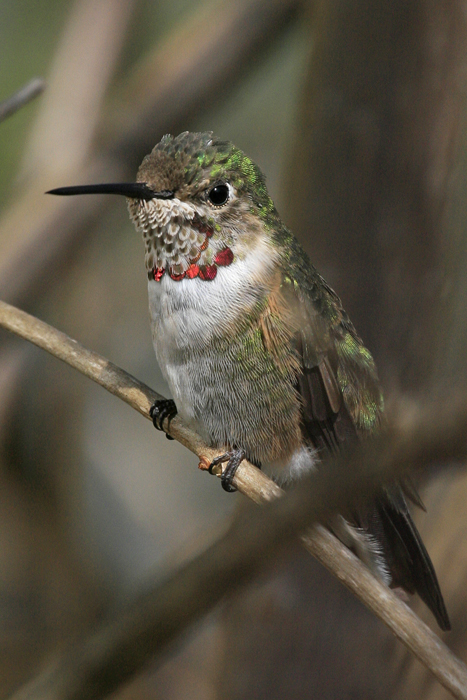
The two pictures above were taken on January 7th and making an interesting contrast with what the bird looks like now. Note the juvenile tail with extensive white tips. It's easy to be right with hindsight and we can ponder on those broad outer tail feathers that rule out Allen's Hummingbird, but the green feathers coming though on the chest sides are flashing before me in my nightmares now!!


The above four pictures show the bird on March 1st. Even more green on the flanks, a rose-red tint to the throat feathers - and just look at that tail! As Michael O'Brien put "..a no-brainer" now!! [All photos by Michael O'Brien]

Other bird news.
If you are visitng this weekend, wrap up for some wet weather Saturday, but Sunday should be better. While you are here: the Western Grebe remains elusive but still present today off Sunset Beach/Alexander Avenue. According to tide (further north on in-coming, further south on out-going) it may be anywhere from St Mary's to the ferry terminal and usually anything up to a mile offshore (there's a lot of loons out there at the moment too!!). The Glossy Ibis is still at the South Cape May Meadows (Cove Pond end today), Lake Lily had Common Goldeneye and Redhead on Thursday, the Nashville Warbler was seen again at the state park near the small blind overlooking Lighthouse Pond. The Cackling Goose is still moving areound with Canada Geese, most recently on Shunpike Road near Stimpson Lane and two Horned Larks have been seen on the fields at the junction of Stevens and Broadway.

With apologies for the late update - I started this post exactly eight hours ago but life has been a bit hectic today!!

Thursday, March 1, 2012

Broad-tailed Hummingbird!!

Mega news from Cape May! A male Broad-tailed Hummingbird is currently viewable at a private yard in Cape May. This will represent the first state record for New Jersey of this western species if accepted by the relevant committees.

PLEASE READ AND FOLLOW THESE ON-SITE INSTRUCTIONS CAREFULLY:

Thie bird is at a private feeder at 1026 Batts Lane, Cape May. The owner has given permission for birders to visit. The bird can be seen from the front lawn as it often sits in a hydrangea bush on the right hand corner of the house as you view from the road. The feeder is in the side yard to the right of the house. Please do not approach the feeder or the front of the house too closely and you should get views of the bird. IMPORTANT: Batts Lane is a narrow, residential street and the bird is right on a bend in the road. We strongly recommend that you park in nearby Shunpike Road and walk through (it is only about 150 yards). There is ample roadside parking on Shunpike Road. Please respect other local residents who may not understand the ways of us birders!

This hummingbird has been visiting a feeder in Batts Lane, Cape May since late last fall, but has been in juvenile plumage and was presumed to be a Rufous Hummingbird. Indeed, close inspection appeared to confirm that. However, the bird has now molted its tail which is conclusively that of an adult male Broad-tailed Hummingbird.


Broad-tailed Hummingbird, Cape May. Note the full, all dark tail with narrowly pointed tips to the inner feathers. [Photo by Mike Crewe]

Broad-tailed Hummingbird, Cape May. The tail shape is just visible here again; also note the extensive green adult feathers on the flanks, replacing the buffy juvenile ones. [Photo by Mike Crewe]

Tuesday, February 28, 2012

Weekend Photos

The weather has been improving on a daily basis this past four days or so and, though we look set to get something of a deterioration shortly, it has certainly been nice enough to get people outside and looking for birds. Sunday proved to be a short-lived wonderment of early arriving migrants as Monday failed to come up with the goods. The best that Tony Leukering and I could muster was a nice count of 41 Tree Swallows and one Barn Swallow at Tarkiln Pond. Interestingly, not a single Ring-necked Duck remained from the day before, so they are certainly on the move now. Belatedly, I hear that at least six Snow Buntings remain on the beach at the state park so do keep an eye out for them.

I came back to the office today to a nice mixed bag of emails, many of which contained some great photo highlights from the weekend, so here's a few of them.

Belted Kingfishers are becoming more noticeable now as they return to favored ponds in our area. Several sites currently hold noisy, calling birds, including this one at The Beanery [photo by Sam Galick].

The Yellow-breasted Chat remains elusive but still present at the state park. It's best looked for around Winged Sumac fruits (you can just see some in the top right corner here) on the red trail. [Photo by Sam Galick]

Adult Bald Eagles always make fine subjects for a photo-shoot if you can find a cooperative one. This bird was trying to catch American Coots on Lighthouse Pond at the state park. [Photo by Sam Galick]

Warm weather gets the raptors up once the thermals start rising. This young Red-shouldered Hawk was circling with nine Red-tailed Hawks and 26 Turkey Vultures over the state park on Sunday. [Photo by Sam Galick]

I was surprised to receive this picture from Karl Lukens as I had no idea that this bird was still around! It's the Selasphorus hummingbird from Batts Lane, off New England Road (taken on 26th) which has presumably been present all winter now.
I received this photo in an email simply headed 'Uh-oh'. Here we have the first real sign that Eurasian Collared Doves are finally here to stay in Cape May. This bird seems set on nest building so, provided they don't all turn out to be boys (or girls!) it looks like we could be ticking them off annually from now on. This species has been a remarkable success story, colonising the whole of Europe in roughly 30 years from Turkey to the UK and even Iceland and is now steadily taking over North America. It does appear to be surprisingly benign and this is perhaps largely due to it favoring man-made environments and thus not being a threat to other local bird species. [Photo by Scott Whittle]


Tony Leukering and I had one of our 'up-county' adventures on Monday and our findings included this fabulous Eastern Red Bat. We watched it for some 20 minutes, hawking insects along a dirt road in bright sunshine and Tony's superior equipment to mine (and superior skills of course!) ensured he outshone me with these awesome photos. We eventually lost the bat when a Sharp-shinned Hawk swung in to catch it. We managed to scare the hawk off (I know, I know, interfering with nature etc. etc. etc!) but the bat decided it was time to head off elsewhere.

Monday, February 27, 2012

SPRING!!! Really? Are you sure?

What a strange year this is already turning out to be. A remarkably mild winter has produced some fascinating sightings already - and today maybe really laid down the foundation upon which an exceptionally interesting spring may be built. Don Freiday kicked off the 'Best Bird of the Year' competition with the discovery at 2:30pm of a Western Grebe on the Delaware Bay, floating quite quickly southward past the ferry terminal on an out-going tide. Many local birders managed to get at least some sort of a glimpse until the bird was eventually lost to sight well south of St Peter's, off Cape May Point. Perhaps this bird wasn't quite so unexpected, as there has been a Western Grebe on the Delaware off Lewes for some time now and perhaps this may even be the same bird. But it's still a great find for Cape May County and, if it passes muster through official channels, it may well become the first, multi-observer, fully documented record for the county.

Though a great highlight of the day, this bird was actually the icing on the cake after what had been an action-packed morning. Roger and Kathy Horn walked the Rea Farm and turned up a whole host of great birds, including a singing Eastern Meadowlark, Horned Lark, Eastern Phoebe, Rusty Blackbird and Wood Duck, but the real startler was a Barn Swallow seen at the Willow Pond. I haven't yet had time to research more recent records, but Sibley's Birds of Cape May lists March 9th as the earliest date for Cape May for Barn Swallow so this is a really noteworthy find. Perhaps equally noteworthy was a female Purple Martin at the point, seen on several occasions around the state park/St. Mary's/Coral Avenue area. Though the date is not a record-early one (Sibley gives February 22nd), what is very surprising is that today's bird was a female. Typically, male Purple Martins head north first, often arriving around 10 days ahead of the females, so this bird was a real surprise. Yesterday had produced reports of several Tree Swallows, including at least six at the point and five at Beaver Dam in South Dennis, so a few more today was perhaps not too surprising. Karen and Brian Johnson reported nine Tree Swallows (as well as 150 Ring-necked Ducks) at Tarkiln Pond on Weatherby Road today - a site not much visited this time of year. Also up at the 'top end', a male Eurasian Wigeon was reported from the Corbin City section of Tuckahoe WMA. Finally, (though actually reported first today!) a Pine Warbler was at Cox Hall Creek WMA.

Aside from birds, other sightings were a little thin today as, despite cloudless blue skies, a chilly wind kept temperatures lower than had been hoped. Nevertheless, Wood Frogs were in evidence at Beaver Dam and both Mourning Cloak and Orange Sulphur were noted at the Rea Farm.

The Oscars were awarded tonight, but I don't think this picture will win the award for best photography! Western Grebe (honest!) off Sunset Beach. [Photo by Mike Crewe]

Just to put it into context - spot the Western Grebe (bottom right corner) with the Cape May-Lewes ferry passing by! [Photo by Mike Crewe] A fine example of how a 400mm lens can't compete with the viewing power of a good scope, which gave me roughly the equivalent of a 6000mm lens so allowed for better views than could be achieved through the camera!

Top tip for tomorrow? Laughing Gull at the ferry terminal or Miami Beach - I'm guessing that's why Don was there today!!

Friday, February 24, 2012

Recent sightings...

Nearly a whole week has passed since I last had time to post - so humble apologies to regular readers! Though birding has generally been quiet this past week, I have received some interesting photos from a unmber of people so I'll share some of them here. But first a bird and wildlife update ready for the coming weekend:

The past week has seen a continuation for a number of wintering individuals around Cape May Point, including the Glossy Ibis, male Eurasian Wigeon and Cackling Goose - with perhaps two of the latter around. A little further afield - but not by much! - I hear that the Western Grebe is still present (to 21st at least) near the ferry terminal at Lewes, Delaware. If only the curve of the earth didn't prevent us from scoping it from here! The first 'new' bird of note came on February 22nd with a male Wood Duck on lake Lily, reported by Karl Lukens - and duly scoped from the Northwood Center. With spring not too far away now (see below!) attention is rapidly turning to the Bayshore side of the peninsula and regular checks at Miami Beach by several observers have turned up a Black-headed Gull there, as well as a rather surprising count of 66 Red Knot there on 23rd.

The weather is see-sawing a little at the moment and, though continuing relatively mild, gray skies and light rain are currently slowing things a little. Northern Gannets and Red-throated Loons are starting to build off Sunset Beach I hear, the female Dickcissel has been more co-operative and enjoyed by several visitors at the Northwood Center today and the female Rufous Hummingbird still hangs out up at Goshen. But the forecast for the weekend doesn't look too bad, especially Sunday, so let's see what the weekend brings!

This photo from Beth Polvino, taken at the state park on 21st, alerted me to the fact that the overwintering Yellow-breasted Chat is still present there. I hadn't heard of any sightings of it for a while but looks as though it is still finding plenty of Winged Sumac fruits to eat!

From West Creek, up near Tuckerton, Wayne Morley sent me this great picture of a Baltimore Oriole that has been coming to his suet block this winter. It's been a good winter for this species in South Jersey with a higher than average number of sightings throughout the last three months or so. What I want to know though is how come Wayne gets an oriole at his suet block and I just get starlings and grackles?!


My recent post about leucistic birds, prompted Cindy Ferguson to send me these photos of a leucistic Dunlin that she found at Stone harbor last weekend. Shorebirds can be tough at the best of times, but when they do this to you it really isn't playing by the rules!! Such birds needn't be too tough though and this individual is helpful in not sporting a combination of colors and markings that would make it confuseable with anything else. The overall whiteness might make you think of Sanderling, but the brownish rather than grayish or black wing feathers, coupled with that all too long bill soon put that species out of the frame.

The intrepid Will Kerling continues to re-write the record books! Above, a mating pair of Orange Sulphurs seem determined to get the 2012 season off to an early start...

... while this Blueberry Azure, photographed by Will Kerling at Beaver Dam in South Denis on 23rd, sets another new earliest date for Cape May County.

Late February is about the time we would normally expect to start listening for the first frog chorus of spring, so their appearance now is not so surprising. I have been told of Southern Leopard Frogs and Spring Peepers starting to call in the county now, while Will Kerling photographed this Wood Frog (one of three he saw) in South Denis yesterday. On a slightly different note, Keith Seager mentioned to me that he had seen Fiddler Crabs at Higbee Beach yesterday. I don't know much about the timing of fiddler crabs and their movements but I wouldn't be surprised if this wasn't an early date too.