Saturday, August 16, 2014

Week in review: 9 – 15 August, 2014

CMBO is pleased to provide weekly summaries of the Cape's birding highlights. Coverage is limited to sightings in Cape May County. Readers should keep in mind that some reports may not be confirmed. The vast majority of information utilized in these reports comes from eBird data and "Keekeekerr" text alerts. Observers are encouraged to send reports and photos to compiler Tom Reed (coturnicops at gmail dot com).

Location Abbreviations/Explanations: CMP (town of Cape May Point); CMPSP (Cape May Pt. State Park); HB (Higbee Beach Wildlife Management Area); Higbee Dike (dredge spoils at northwest corner of Cape Island, site of CMBO's Morning Flight count); SCMM (South Cape May Meadows); SHPt (Stone Harbor Point).

 --===============--


WATERFOWL THROUGH TERNS
       Approximately 100 Black Scoters, and at least 2 Surf Scoters, continued their stay at CMP through the period (m. ob.). Wilson's Storm-Petrel reports continued to diminish, but a handful were seen during ferry crossings (m. ob.). The fall's first Green-winged Teal appeared at CMPSP 14 Aug (TR). A juvenile White Ibis was seen at the Cox Hall Creek marsh, along Clubhouse Drive in Town Bank, 12 Aug (TM, m. ob.). There have been no reports since. Westerly winds brought a Broad-winged Hawk over SCMM 15 Aug (VE). The season's 7th American Avocet was found at SCMM 14 Aug and continued through 15 Aug (RT, m. ob.). An Upland Sandpiper made for a surprising sight on the west path of SCMM 15 Aug (VE). A strong movement of shorebirds followed heavy rain associated with a cold frontal passage 13 Aug. This flight was easiest to observe at Cape Island, where 550 Lesser Yellowlegs and 120 Stilt Sandpipers flew south past SCMM during the AM hours (MO'B, m. ob.). Multiple American Golden-Plovers were noted after the storm at Cape May Airport 13 Aug (JN, BB), and 2 were seen over West Cape May 14 Aug (MO'B). Several observers sent along reports of White-rumped Sandpiper in recent days, including multiple sightings at SCMM. Mid-August can be a good time to find Marbled Godwit-- a group of 4 dropped in at SHPt 13 Aug (EH). SHPt was also home to 600 Sanderlings and 9 Lesser Black-backed Gulls 14 Aug (m. ob.). Black Terns became more obvious during the second half of the period, with sightings logged at SHPt, SCMM, and CMP (m. ob.). The SCMM beachfront was home to a pair of Sandwich Terns 15 Aug (VE). 
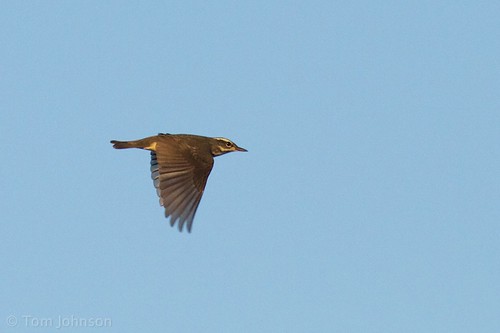

Louisiana Waterthrush - New 
Jersey
[Louisiana Waterthrush flying past the Higbee Dike, 14 Aug. Photo by Tom Johnson.]


DOVES THROUGH SPARROW
       A White-winged Dove put in a brief appearance at SCMM 11 Aug (m. ob.). It was last seen flying off toward West Cape May and has not been reported again. CMP's Eurasian Collared-Dove was last noticed near the corner of Lehigh & Lincoln Avenues 14 Aug (EO). Single Olive-sided Flycatchers were noted at HB (MeC, MiC) and CMPSP (m. ob.) 14 Aug. The season's first big push of songbird migrants arrived 14–15 Aug, on the heels of the cold front. Observers stationed atop the Higbee Dike tallied ~400 Eastern Kingbirds, 5 Louisiana Waterthrushes, 190 Northern Waterthrushes, 625 American Redstarts, 2 Cerulean Warblers, 365 Yellow Warblers, and 380 Bobolinks on the move during the early-morning hours 14 Aug (TJ, MG). Passerine arrivals at Cape Island included Yellow-bellied Flycatcher 10 Aug (MJ), Bay-breasted Warbler and Blackburnian Warbler 14 Aug (m. ob.), and Alder Flycatcher 15 Aug (NP). Other notables included a Golden-winged Warbler at HB 15 Aug (CB, m. ob.) and a Mourning Warbler at SCMM the same day (TR). Lastly, an adult Lark Sparrow was a splendid find at the Rea Farm/Beanery 9 Aug (m. ob.). 

  
--===============--


Contributors:
Bill Boyle (BB), Catherine Busch (CB), Megan Crewe (MeC), Mike Crewe (MiC), Vince Elia (VE), Matt Garvey (MG), Emily Heiser (EH), Matt Jewel (MJ), Tom Johnson (TJ), Tom McParland (TM), Josh Nemeth (JN), Michael O'Brien (MO'B), Emelia Oleson (EO), Nick Pulcinella (NP), Tom Reed (TR), Robert Templeton (RT).

----
References:

*eBird. 2012. eBird: An online database of bird distribution and abundance [web application]. eBird, Cornell Lab of Ornithology, Ithaca, New York. Accessed 15 Aug 2014. Available: http://www.ebird.org
*Fogg, B. 2013. Keekeekerr: Recent Text Alerts. Accessed 15 Aug 2014. Available: http://keekeekerr.com/textalerts/keekeekerr


Thursday, August 14, 2014

...Go!!!

At the risk of sounding as though I am saying "I told you so" - I told you so!! Well, predicting bird arrivals is a very tricky thing; weather conditions have to be just right, including wind direction, wind strength, lack of precipitation (or, if it does rain, the right amount in the right place at the right time) and, of course, the birds have to be in the right place at the right time to be delivered to us. After suggesting that Higbee Beach would be the place to be this morning, I got panicky about the forecast 14mph winds, set to last all night. Perfect migration conditions for songbird flights generally require a light head wind, not gusty double-figures...

However, it all turned out good this morning. The annoying thing about Cape May (I know, I know, even paradise has problems!) is that there are always choices to be made when it comes to where to head for first thing in the morning; the dune line at the point can be excellent in the right conditions, as can Sunset Beach, and Higbee Beach. Then at Higbee's, do you go to the fields or the dike? Tom Reed tells me that the point was pretty quiet today, so I did make the right decision in heading for the fields - but the dike was pretty impressive too I hear. Overall, Higbee Beach provided some great early-season birding this morning, with exciting movements of Red-winged Blackbirds, Cedar Waxwings, Bobolinks and Eastern Kingbirds. The latter species is building up nicely in the fields too (a traditional staging area, where the birds are currently feeding on this year's bumper crop of Black Cherries) and we saw around 150 Easterm Kingbirds today - though the wheeling around of the main flock made accurate assessments tricky.

In the fields, Yellow Warblers, American Redstarts and Indigo Buntings seemed to be the main species on the move, but there were Black-and-white Warblers too, a handful of Common Yellowthroats and a few Worm-eating Warblers. Our first juvenile Chestnut-sided Warbler of the season was nice to see and David La Puma later reported a Blackburnian Warbler from the parking lot. Flycatchers usually feature early in the season and create headaches for most of us as they really are just too darned similar to each other for comfort. A probable Willow Flycatcher toyed for our attention for some time, but a nicely teed up Olive-sided Flycatcher gave no such problems.

If you missed this morning's activity, tomorrow morning looks promising too, as north-west winds are forecast to last another 24 hours. If you want some help and guidance with your migrants, or just some good company, join our CMBO walk which departs the Higbee Beach parking lot at 7AM tomorrow morning (easily found at the dead-end, western end of New England Road, just south of Cape May Canal - see you there!


Arrrg, a Fall Flycatcher!! Many of the flycatchers seem impossible to deal with in the fall but, with some species, there is hope - don't give up too soon!! This Olive-sided Flycatcher was found by my wife this morning and there is much about it that helped us to identify it pretty quickly. Olive-sided is not one of those hideous Empidonax flycatchers, it's a Contopus - which immediately offers us hope! Start by ignoring the detail and look at the outline of this bird; look how disproportionately big the head and bill look and how short the tail appears - all good Olive-sided clues. When it comes to plumage, notice the dark marks on the undertail coverts, but note especially the smudgy, dark breast sides. These are classic Olive-sided features; many books mention the appearance of a dark vest, but I think of the dark chest of an Olive-side Flycatcher like this; imagine a car mechanic working on a car with oily hands; the phone rings, he needs to answer it - where does he wipe his hands? Down his chest! And the greasy finger marks are streak, not evenly dusky like the pattern on the chest of an Eastern Wood Pewee. One final clue to the identity of this bird - notice how it is sitting right up against the sky, atop a dead snag - classic Olive-sided Flycatcher behavior [photos by Mike Crewe].

Wednesday, August 13, 2014

Ready, Steady...

With Northwest winds forecast to last all night tonight, it might just be time to think about heading for Cape May Point tomorrow. The first songbirds of fall have been trickling through over the past few days, but a push of northwesterlies may well speed this trickle up. A period of winds with a southerly element has seen an exciting movement of shorebirds today, with Michael O'Brien's shorebird workshop logging 550 Lesser Yellowlegs and 150 Stilt Sandpipers this morning, while our Wednesday morning walk also recorded a great shorebird passage. A juvenile Black Tern off Sunset Beach was the first juvenile of the year for me, with two also noted from St Peter's.

Keep an eye on the weather forecast and prepare for at least a couple of days of potentially exciting birding. The weekend sees a return to southwesterlies so it may be worth switching back to shorebirds - hopefully, the next three days of forecast sunny weather will drop water levels again. Recent very heavy rain pushed a lot of birds out temporarily and I hear that even Bombay Hook is struggling to hold birds, as roosting shorebirds head to nearby farmland at high tides.

Our extraordinary summer of over-summering 'winter' birds continues; this rather scruffy and sorry-looking Common Loon was photographed on the beach at Cape May Point last Thursday and, having very little in the way of flight feathers, must certainly have been lurking in the area for some time. The plumage suggests that, as with the over-summering scoters that we have, this is a first-summer bird that probably wouldn't have bred this year any way [photo by Carrie Harris]

Terns continue to delight our walk groups on the Cape May beaches, giving ample opportunity for us to study different species side by side. Walk volunteer extraordinaire, Karl Lukens, has kindly labelled a few birds here to show an interesting array of birds of different ages [photo by Karl Lukens].

Right on queue - our first surprise songbird of August came on our very first Saturday Rea Farm walk of the season. This Lark Sparrow spent the morning feeding on grass seeds along the crop rows and stayed long enough for a few people to enjoy this western species that continues to increase in number on the east coast [photo by Mike Crewe].
 
Fall warblers are what we all long for at Higbee Beach and the first of these are coming through now. The early birds are always more southerly breeding species that don't have that far to come, so be on the lookout for Worm-eating Warblers (above), Northern Waterthrushes, Black-and-white Warblers and Blue-winged Warblers right now - with many more to come! [Photo by Mike Crewe]  
 
Star bird of Higbee Beach on Tuesday morning was this Golden-winged Warbler. Unfortunately, autofocus doesn't cope too well with soft-edged birds lurking behind sharp-edged branches, but I still reckon this shot captures the magic of this declining species. A suggestion of a yellowish wash is evident on the chest here, but was not apparent on this bird in the field and may just be an artefact of the photo. Golden-wings famously hybridize all too readily with Blue-winged Warblers and birders are always on the lookout for signs of infidelity between these two species, but the wingbars and head pattern look fine for Golden-winged Warbler here [photo by Linda Widdop]

Tuesday, August 12, 2014

Spotlight on: Eastern Hercules Beetle

When something crunched under Sam Galick’s shoe as he stepped out his back door a few weeks ago, he assumed it was a twig that had fallen onto the deck. He certainly wasn’t expecting to lift his foot and see North America’s biggest beetle crawling away, quite unharmed. And when I say big, I mean big – the Eastern Hercules Beetle is more than two inches long.


It turns out that Sam’s beetle was a female, drawn to the lights on his porch. As you can see in the above photo, she’s olive green and sprinkled with irregular black spots. A male would have been even bigger – though not by much – with a pair of horns at the front, one that curves up from the head and a second even longer one that curves down from the pronotum (the segment of the body behind the head) to meet it. Despite their somewhat scary appearance, the beetles are not dangerous and not known to bite; certainly Sam and his roommate handled this one repeatedly with no bad experiences.

Although the beetle is quite widespread in forests throughout the east, ranging from New York state to Florida, and west to southern Illinois, western Arkansas and eastern Texas, it isn’t easy to see, as it spends most of its life underground. Females lay their eggs directly in the soil. At 3/16 of an inch (5 mm), these shiny, white eggs are huge for an insect. The eggs hatch roughly a month after they’re laid, and the white grubs live underground, feeding on decaying plant material. For males in particular, finding a good food source is important; the better their nutrition levels as larvae, the longer their horns are!

Often, the larvae move from the soil up into rotting tree stumps, feeding on the decaying heartwood; they never attack living trees. After 6-12 months of stuffing themselves, the larvae pupate, emerging a few weeks later as adults. Even then though, they remain underground, waiting until spring to venture forth. Males seek out ash trees and make “sapping spots” on the branches, using their long horns to shove rival males away from the food sources. The sap attracts females too, which use pheromones to attract males for mating.

While most of us are unlikely to be as lucky as Sam in finding an adult Eastern Hercules Beetle, it is possible you might come across a larva lurking in the earth as you dig in your garden. Keep an eye out for a very big C-shaped grub!

Saturday, August 9, 2014

Week in review: 2 – 8 August, 2014

CMBO is pleased to provide weekly summaries of the Cape's birding highlights. Coverage is limited to sightings in Cape May County. Readers should keep in mind that some reports may not be confirmed. The vast majority of information utilized in these reports comes from eBird data and "Keekeekerr" text alerts. Observers are encouraged to send reports and photos to compiler Tom Reed (coturnicops at gmail dot com).

Location Abbreviations/Explanations: CMP (town of Cape May Point), CMPSP (Cape May Pt. State Park), SCMM (South Cape May Meadows).

 --===============--
 
WATERFOWL THROUGH STORK
       An unseasonably large group of Black Scoters, likely still numbering over 100 individuals, remained at CMP through the period (m. ob.). At least 4 Surf Scoters could also be found with this group at times (m. ob.). Gadwall remained a regular sight at CMPSP and SCMM; a recent high count of 13 was obtained at CMPSP on 6 Aug (m. ob.). Wild Turkey reports included a group of 8 near the corner of New England & Bayshore Roads 4 Aug (MeC), and a female leading 2 young birds along Lighthouse Avenue, CMP 8 Aug (TR). Wilson's Storm-Petrels are becoming less regular from shore, as often happens after mid-Jul. This week's only land-based reports were all of single birds, viewed from CMP 3 Aug (MS) and 8 Aug (TR). A whale-watching trip produced 15 Wilson's Storm-Petrels on 4 Aug (DL). A Cattle Egret flew in off the ocean before it briefly put down at SCMM 4 Aug (VE). A juvenile White Ibis entertained numerous observers at SCMM 3–4 Aug (DF, m. ob.). It was last seen along Stevens Street, West Cape May 4 Aug (m. ob.). Several White Ibises have appeared in the Delaware Valley since mid-Jul, and observers should be on the lookout for this southern stray. Another wanderer from the south was a Wood Stork over CMP 7 Aug (MP, MiC, JS). This individual represents approximately the 12th Cape May County record. A Wood Stork was also reported later the same day, flying over Route 47 near Reed's Beach (WK). There have been no sightings since. 
 
 
[White Ibis at SCMM, 3 Aug. Photo by Karl Lukens.]
 
 
RAPTORS THROUGH SKIMMER
       Cape Island's first Broad-winged Hawk of the season was noted near the corner of New England & Bayshore Roads 7 Aug (MiC) and more interestingly, a juvenile Red-shouldered Hawk was photographed over Cape Island the same day (AA). Water levels at SCMM and CMPSP have become unfavorable for shorebirds, and most reports during the past week were restricted to fly-over migrants. The county's 6th American Avocet of the season shot past CMPSP 2 Aug (DF et al.). An evening shorebird flight along the Delaware Bayshore included a Hudsonian Godwit and a Long-billed Dowitcher over Reed's Beach 8 Aug (TR). Intriguing were the 2 Pomarine Jaegers spotted from the 2nd Avenue jetty in Cape May City 3 Aug (SR). A Sandwich Tern and a Black Tern put in brief appearances on the CMPSP beachfront 5 Aug (VE), and Royal Tern numbers increased through the week (m. ob.). Approximately 100 Black Skimmers have been noted at Poverty Beach in recent days-- the species is nesting at the site this summer (fide NJDFW). 
 
 
[Wood Stork over CMP, 7 Aug. Photo by Mike Pasquarello.]
 
 
COLLARED-DOVE THROUGH SONGBIRDS
       After another lengthy absence, a Eurasian Collared-Dove was seen from SCMM as it flew toward Cape May City 7 Aug (TR). Observers are encouraged to continue reporting any sightings of this species. On the heels of the latest cold front, a couple of Common Nighthawks were observed over CMP 7 Aug (MP), followed by another over Erma 8 Aug (TB). Red-headed Woodpeckers bred in the Green Creek section of Middle Township this year; an adult and two juveniles were noted on private property 4 Aug (TB). Merlins have appeared with increasing frequency during Jul and Aug in recent years-- 2 were ahead of schedule at SCMM 8 Aug (m. ob.). A locally scarce migrant, the season's first Olive-sided Flycatcher was a smidge early at Higbee Beach WMA 7 Aug (VE). The flycatcher was part of a post-frontal songbird movement that also included 50 Blue-gray Gnatcatchers, 100 Yellow Warblers, 55 American Redstarts, 20 Orchard Orioles, and the season's first Chestnut-sided Warbler at Higbee Beach (VE). Additional southbound arrivals at Higbee included Mourning Warbler 4 Aug (MS), Least Flycatcher 7 Aug (VE), and Warbling Vireo 8 Aug (MG). 

 
 --===============--


Contributors:
Amar Ayyash (AA), Tom Baxter (TB), Megan Crewe (MeC), Mike Crewe (MiC), Vince Elia (VE), Don Freiday (DF), Mark Garland (MG), Will Kerling (WK), David Lord (DL), Karl Lukens, New Jersey Division of Fish & Wildlife staff (NJDFW), Mike Pasquarello (MP), Tom Reed (TR), Steven Rodan (SR), Jessica Schera (JS), Matt Sharp (MS).

----
References:

*eBird. 2012. eBird: An online database of bird distribution and abundance [web application]. eBird, Cornell Lab of Ornithology, Ithaca, New York. Accessed 8 Aug 2014. Available: http://www.ebird.org
*Fogg, B. 2013. Keekeekerr: Recent Text Alerts. Accessed 8 Aug 2014. Available: http://keekeekerr.com/textalerts/keekeekerr
*JerseyBirds [electronic mailing list]. 2014. August archives. Accessed 8 Aug 2014. Available: https://lists.princeton.edu/cgi-bin/wa?A1=ind1408&L=Jerseybi

Clapper time!!

Now is a great time to take to the water and look for Clapper Rails, and where better place to do that than in the back bays of Cape May County. Clapper Rails are probably one of the commonest non-passerine bird species in Cape May County - yet how often do you see them? They are out there, but they are good at hiding in the vast acres of saltmarsh that we have - not for nothing are they known locally as Mud Hens!

How best to see one? Well, check out the CMBO activities calendar for our boat trip sailings with The Skimmer and The Osprey and take your binoculars for a ride on the water with us!


These photos of young Clapper Rails were taken during a recent boat trip on The Osprey. While views like this are never guaranteed, you certainly have a very good chance of seeing these birds right now [photos by Bob Lubberman/Birding by Boat]

Tuesday, August 5, 2014

beaches, meadows, shorebirds

Summer's heat has settled in to Cape May and a post-breeding season, pre-migration lull could easily take a hold if you just take your eye off the ball for a second. But Cape May always has something to offer, and our weekly walks continue to provide a wonderful array of wildlife experiences. At this time of year, the best rewards come from coastal wetlands as migratory shorebirds continue to move through. Unfortunately, good habitat for shorebirds is hard to find this year as occasional overnight downpours are keeping water levels high, but The Nature Conservancy is to be commended for efforts to keep conditions at The Meadows as close to ideal as possible.

It's still a little early for juvenile shorebirds to be passing through Cape May on their way south from Arctic breeding grounds, but juvenile Spotted Sandpipers, with their dapper wing bands, are starting to show up having fledged from nests much closer to here than the Arctic. Most other shorebirds, however, continue to appear as rather scruffy-looking adults; and these are fascinating to study as field guides don't tend to illustrate such birds, so there's not only an extra challenge in identifying them at times, but also much to be learned. These birds will be in the midst of losing their breeding colors and growing fresh, non-breeding plumage. The molt cycle, again, is an area that field guides generally steer away from. But birds - especially larger non-passerines such as gulls and birds of prey - spend a significant amount of their annual cycle going through a molt of some sort, so learning to identify birds when they are in these transitional phases can be challenging, but useful. So, here's the week's highlights, a mixture of surprise finds and thought provoking birds...

Keep an eye on the skies - some shorebirds really don't hang about. A flyover bird may seem daunting to identify, but there's plenty of clues to work with. If you keep in mind which parts of the bird to look at, it can be done quite quickly and efficiently. In these birds, check bill length/shape, presence/absence of a pale rump, presence/absence of a wing bar... these all dark birds with long, decurved bills are easily identified as Whimbrels - to brush up your shorebird skills, you might like to try our shorebird workshop with Michael O'Brien - there's no better way to learn these fascinating birds [photo by Mike Crewe].

Stranger on the shore - Red Knot can look very odd at this time of year; the pale edges have all worn off on the upperpart feathers, leaving a heavy, dark appearance and the rich rufous underparts are stained and sullied. After a complete molt, this bird will be a dapper pale gray but for now, well, he doesn't look like the picture in the book. So try and use consistent features to aid your identification - judge size compared against other nearby birds, judge bill length relative to head length and judge leg length relative to body size. To my eyes, Red Knot are chunky, medium-sized shorebirds with a mid-length bill (not too short, not too long and about the same length as the head from bill base to nape), while the legs are stocky but short and always look just a little too short for the size of the bird - a unique combination [photo by Mike Crewe].

Make your birding count. Sanderlings are a long way from the pale gray and white birds of winter right now, so look for a dull brown back and - especially - washes of reddish brown around the face and chest. Sightings of returning adults at this time of year can be of increased significance if the bird is wearing a color flag, for the observation can be submitted online and will add valuable information to a growing database of knowledge on these global wanderers. The color of the flag tells you the country that it was tagged in - yellow on this bird indicates Guyana - so this bird is already of great interest. Hopefully my sighting of E2M at Stone Harbor recently will tell researchers a lot about its movements; if you find such a bird yourself, you can enter the information at the Banded Bird website [photo by Mike Crewe].

Now is the perfect time to start trying to understand molt in birds, for now they are in the thick of it. Check out the gulls on the local beaches and you will soon find some scruffy looking individuals that will help you unravel what is going on. Birds such as this third calendar year American Herring Gull are ideal since it is at this age that this species finally swaps the brown primaries of a youngster for the gray, black and white ones of adulthood. This makes spotting the difference between old and new feathers a lot easier, because the contrast is easily seen - this bird has three outer primary flight feathers still to switch out for new ones - notice how each feather is molted sequentially, not all at the same time, so that the bird's flying ability is not affected. The first new feather just in from the three outer, old ones, is clearly much shorter and still growing [photo by Mike Crewe]

Throughout the summer, there is plenty of opportunity to study Lesser Black-backed Gulls, as these essentially Old World birds now seem settled on this side of the pond. Here in Cape May, we are not far off the same latitude as NW Africa, where large numbers of immature, non-breeding Lesser Black-backs spend their summers before they are finally old enough to breed, so it's not surprising that we get a few here now. To seek them out for study, try Stone Harbor Point or the South Cape May Beach. Though both sites are heavily disturbed by tourism, with patience you can usually pin one or two for study or photos for a short period at least [photo by Mike Crewe].

While out looking for shorebirds, keep an eye on the tern flocks that shift around Cape May Point looking for a bit of peace and quiet. One or two Sandwich Terns usually show up at this time of year, but they remain elusive and flighty here. As seen here, look for a bird with a shaggy hair cut and black bill, tipped with yellow. This bird is banded, so it is not the same individual as was present at Bunker Pond recently [photo by Mike Crewe].

Another recent visitor, this juvenile White Ibis wandered up from the south and was seen at The Meadows on Sunday evening, then again briefly on Monday morning. It was last seen feeding on a rain pool off Stevens Street on Monday, before heading toward Pond Creek Marsh... maybe it's still out there [photo by Mike Crewe].

And finally... photos of molting birds and of rarities can be educational or have scientific value, but don't forget to just enjoy photographing birds for art's sake sometimes... Black Skimmers favor The Meadows in the evenings and can put on a great show at times [photo by Mike Crewe].


DON'T FORGET - coming up - Purple Martins at Mauricetown, August 8 & 9, Shorebirds workshop with Michael O'Brien, August 13 & 14, Butterfly workshop with Will Kerling, August 21... and so much more - just check out our Activities Calendar.