Thursday, November 3, 2011

Slightly Looking Backwards

Copious amounts of dust are finally settling around us all at the bird observatory as we recover from another great Autumn of birds and birding, and we catch up on ceaseless emails and all those other everyday items that were put on temporary hold. After the hideous Nor'easter of last Saturday, the weather has been pretty gentle on us here at Cape May, though our New Jersey Audubon headquarters up in Bernardsville is still without utilities, so please do bear with us if you experience communication difficulties. With a steady north-east flow of cold air and some ground frosts in the area, we are experiencing birds shipping out in good numbers at the moment. Typical birds of the season showing up now include Orange-crowned Warblers (ever-elusive!), Golden-crowned Kinglets and Vesper, Lincoln's and Nelson's Sparrows along with large numbers of other sparrow species and Yellow-rumped Warblers. One or two Common Eiders are appearing with the scoter flocks and Golden Eagles are brightening up the hawkwatch counts. A scattering of Baltimore Orioles and Yellow-breasted Chats lurk in Porcelainberry tangles and there was a report of a possible Sedge Wren in the state park on November 1st, though I have no further details of that bird. An individual of the distinctive Gambel's form of White-crowned Sparrow was at the Hawkwatch on November 1st and a White-winged Dove put in a brief appearance there on 2nd. This may well be the same bird that was seen briefly on October 28th, so it's worth keeping an eye out around the point. Two female (apparently from their behavior!) Eurasian Wigeons continue on Bunker Pond and the Rufous Hummingbird was still present at Goshen on November 1st but I've had no reports as yet since. Finally for now, a couple of Red-breasted Nuthatches put in an appearance by the Hawkwatch Platform on Wednesday, reminding us that they have been very obvious by their absence so far this season.

Flashing back to the storm on Saturday, October 29th, I think that this picture from Sam Galick sums the day up! Believe it or not, this is Nummy's Island on an astronomically high tide - no island, just swimming Brant and a Great Black-backed Gull!

Blackpoll Warblers have been a real feature of the late October period at Cape May this year with good numbers noted daily for some time now. Many birds have been observed eating Porcelainberry or - as here - Virginia Juniper (Eastern Red Cedar if you prefer!) berries and it is this ability to switch from insects to fruit that enables certain warbler species to leave their southward migration until a little later than some other species are able to do. [Photo by Tony Leukering]

The king is crowned! Golden-crowned Kinglets are now calling from evergreen patches all over Cape May Point. This picture from Tony Leukering does a nice job in showing that wonderful, yellow head stripe.

Tony Leukering has a habit of capturing the unusual with his camera! Here, a passing ibis is doing a peculiar head rub against his neck whilst in flight - see if you can do it, it's not easy!

The Osprey nesting platform near the beach at the South Cape May Meadows has never yet been favored for its intended purpose, but raptors use it as a look out perch frequently - as here with this passing Peregrine during one of our Meadows walks.

Merlins continue to pass the Hawkwatch in fair numbers, and some are even managing to find a few straggling Green Darners to tuck into. [Photo by Tony Leukering]

Late October and - especially - November are prime times to look for Golden Eagles at Cape May. When they are youngsters with this amount of white at the base of the primaries, identifying them is not too hard [photo by Tony Leukering].

Rail duet: coots and moorhens differ from most other members of the rail family in being primarily birds that spend a lot of time swimming, rather than lurking in thick vegetation. American Moorhen (right) remains a scarce but regular stray this far north and most birds are youngsters with a poorly-defined white flank streak and pale faces.

A sure sign of winter on the horizon - a trickle of Bonaparte's Gulls has been witessed around the point this past week so keep an eye along the tideline anywhere along the beaches. [Photo by Tony Leukering]

Ever present at the ponit these days it seems, Lesser Black-backed Gulls still linger in ones and twos but will most likely have shipped south by the end of this month. [Photo by Karl Lukens]

A friend in need... The Cattle Egret continues to hang out at The Beanery and now has to settle for sharing time with the only other birds that like the grassy meadows there - the local gun club's plastic decoy geese!! [Photo by Mike Crewe]

Perhaps the most elusive of the regular warblers at Cape May is Orange-crowned Warbler. Even if one is located, it seems to be unusual for it to still be around once other birders arrive on the scene! This bird spent several days in a hedgeline at The Beanery but was never easy to watch, often flitting from hedge to weeds to trees then off across the field and being lost until mysteriously reappearing back where you last saw it again! [Photo by Mike Crewe]

A good sign that the season is fast drawing on is when you suddenly realize that all the Palm Warblers you are seeing are yellow on all the underparts and are thus of the easterm form hypochrysea. These birds are plentiful here at present and spend a fair amount of time feeding on the ground in fields and dunes. [Photo by Mike Crewe]

Sunday, October 30, 2011

Another Awesome Autumn Weekend!

Well the dust hasn't settled in the parking lots, but general agreement appears to have been settled upon - it was another great Autumn Weekend here at Cape May; I dread to think just how many photos were taken over the past three days, and just how long it's going to take for all those bird pictures to be catalogued and filed away! As forecast, Saturday turned out to be a pretty dreadful day weather-wise but, to be honest, it could have been worse - we certainly didn't get the foot and a half of snow that some places in North Jersey got! Some localized flooding from astronomically high tides affected the barrier islands and a few roads had to be closed for a while, but somehow our Autumn Weekend kept going. Yes, the boat trips had to be cancelled, but it was impressive the way the weekend participants soldiered on and I particularly liked the way that a variety of impromptu seawatches seemed to spring up anywhere that there was places to stand out of the wind and rain. Also worthy of high commendation was the way that our volunteer leaders turned up in such dreadful conditions, just in case there was anyone wanting a walk - thanks guys!

My Saturday was rather strange as it started with me singularly failing to find my waterproofs and having to travel to good old Walmart for another set! But it was well worth as Saturday proved to be a great day for birds. Early morning walks that did go ahead produced an interesting array of sparrows (presumably mostly hangovers from the day before), while the Cape May Point walk produced the bizarre site of a shearwater which did a turn high over the state park before disappearing back out into the bay... At Cape May Airport, shorebirds escaping the flooded coastline included sone 200 or so Black-bellied Plover and a few Dunlin. The seawatch at the Grand Hotel (5th floor, great view!) produced a couple of Common Eider and the season's first Snow Bunting was reported from Brigantine. My own seawatching experience took place at Sunset Beach with my wife and refugees from the rained out Beanery and Meadows walks. We managed three Horned Grebes, two Parasitic Jaegers, four Red-throated Loons, a male Long-tailed Duck, two Bonaparte's Gulls and plenty of Northern Gannets and Royal Terns. At least three Great Blue Herons slowly beat their way back in off the bay against the rain and two American Pipits were feeding on the tideline.

Indoor events were understandably popular in such stormy conditions - but surely would have been popular in their own right; Kevin Karlson, Michael O'Brien, Pete Dunne, John Kricher, Ted Floyd, Kenn Kaufman - an amazing team of speakers with a wealth of knowledge, humor and insight to impart.

Sunday was certainly a release for us outdoor types as we headed back out for the final day of events. After a day of stormy conditions, birds were hungry and eager to be out feeding. Sparrows were very much the order of the day at most locations and great waves of birds scurried for cover in front of appreciative groups. Kenn Kaufman's group at The Beanery enjoyed a very late Orchard Oriole and the same site also produced Cattle Egret, Golden Eagle, up to three Bald Eagles, two Vesper Sparrows, Yellow-breasted Chat and Tennessee and Black-and-white Warblers. A Yellow-billed Cuckoo was still at Higbee's Beach and at least three Baltimore Orioles, various fly-over Rusty Blackbirds and oodles of both Ruby-crowned and Golden-crowned Kinglets were around - many at amazingly close range. The Rufous Hummingbird at Goshen was joined by a Ruby-throated and the afternoon's Stone Harbor walk produced a Black-throated Green Warbler along with a nice range of shorebirds. A Glossy Ibis at the South Cape May Meadows was followed by reports of a very obliging American Bittern and at least two approachable Vesper Sparrows. Events at the end of the day were to make the meadows the place to be as Kathy and Roger Horn spotted a Black Rail from the viewing platform (Will Kerling had flushed one earlier in the day during a butterfly survey walk at the Plover Ponds which may well have been a different bird). As the masses gathered, all that could be found was a Sora, but those who stayed until dusk were rewarded with a Black Rail calling, along with no less than 21 American Bitterns and two Short-eared Owls leaving the marsh to head south!

Boat trips on The Osprey resumed today and highlights from there included the Brown Booby (yes, it really is still here!), Brown Pelican, Common Loon, Horned Grebe, Bufflehead, Tricolored Heron and a Short-eared Owl. What more can a say? An amazing weekend and, as always, you had to be here to be part of it. Start planning for next year now folks!!!

CLICK HERE TO SEE A FULL SPECIES LIST FOR THE THREE-DAY WEEKEND (TOTAL = 203 SPECIES)
I was busy all day with guided walks today, but in celebration of a great weekend for sparrows, I offer up this Vesper Sparrow, one of two showing well at the South Cape May Meadows. Telling them apart can be tricky, but the sparrows have a subtle charm all of there own and many are really quite beautiful once seen well [photo by Mike Crewe].

Weekend photos

Great Cormorants, like this juvenile, sometimes hang out on the jetties in front of the Avalon Seawatch (7th Street in Avalon).

Friday was a stunning day at the Avalon Seawatch, with 62,000 scoters tallied (read Tom Reed's report here). Here, a large rush of scoters passes in front of the casinos of Atlantic City as seen from Avalon.

Blackpoll Warblers have been moving through in large numbers this October, and have lingered in force through the end of the month. Several were feeding on cedar berries today in Cape May Point State Park.

Two Golden Eagles, including this stunner with lots of white in the wings and tail, passed through Cape May today. One headed south over the ocean while the other one drifted off to the north.

Numbers of dabbling ducks are high around Cape May Point and the South Cape May Meadows (TNC Migratory Bird Refuge) right now. This Northern Pintail flew past while I was looking for rails and bitterns today.


[all photos copyright Tom Johnson]

Friday, October 28, 2011

Bad Weather Update - and more

For those taking part in our Autumn Weekend who may not have been present at the meal this evening, please not that, due to the severity of Saturday's forecast, we have deemed it necessary to cancel the mini-pelagic on the Cape May Ferry and the backbay boat trips. If you are signed up for any of these events and need an update, please contact CMBO on the usual numbers.

Note also that Kevin Karlson's 12 Noon outdoor photography session has been moved to 1:00PM on Sunday and that a special indoor seawatching event has been set up on the fifth floor of the Grand Hotel - just in case!!

All other events are expected to take place as scheduled - and who knows, maybe we will dodge the worst of the weather!

Today proved to be a fabulous opening day for the three-day festival with White-winged Dove, Rufous Hummingbird and Clay-colored Sparrow being rarity highlights on a morning that saw a fabulous rush of American Robins, Yellow-rumped Warblers, kinglets and assorted sparrows (including Vesper Sparrow at The Beanery). The Seawatch at Avalon really excelled, finishing with a day total of some 75,000 birds, including 62,000 scoter. Other highlights there included a high total of 13 American Golden Plovers passing south. At least three American Moorhens were reported today, as well as the first Fox Sparrow I have heard of this season.

Palm Warblers were much in evidence at Higbee's Beach this morning, with all but one of those that we saw on our second walk this morning being of the Eastern race (hypochrysea), with an extensive yellow wash on the underparts [photo by Mike Crewe].
Hermit Thrushes put on their first good showing of the season this morning. This species bucks the trend of Catharus thrushes by showing itself to its admirers instead of skulking in the shadows somewhere! [Photo by Mike Crewe]

Our 'flying things other than birds' walk proved almost a complete luck-out due to the cool and overcast conditions, but was redeemed in spectacular fashion by the discovery of a very obliging Black Witch right at the start - what an awesome place this is!!

Black Witch (Ascalapha odorata) at Cape May Point State Park this afternoon. This species is a large tropical moth with a wingspan of up to six inches (that's longer than a Palm Warbler!) and is the largest owlet moth in North America. Despite its tropical distribution, it is prone to vagrancy and has been recorded from all 50 US states and Canada. It is overall most rare in the north-east however, and this is probably the first Cape May record for a number of years. The narrow, pale pink band on this individual indicates that it is a female [photo by Mike Crewe].

Tomorrow's forecast doesn't bode well for a day spent out in the field but remember, forecasts can be - and often are - wrong. Our guides will be out there, we look forward to seeing you. Fingers crossed!!

Thursday, October 27, 2011

Out and About

 It was a funny old day today and one where you either hit the right place - or you didn't. The Morning Flight count at Higbee Dike seemed to be a bit so-so by all accounts, leaving Tom Johnson with time to head out to the backbays on a very full high tide and report good numbers of salt sparrows (ie Seaside/ Saltmarsh/ Nelson's - delete as necessary!). Tom sadly also found a dead Northern Saw-whet Owl on Avalon Boulevard, presumably hit by a car during the night. A couple of recent reports of fly-by Short-eared Owls suggest that owl time is upon us. In contrast to the dike count, my walk at Hidden Valley this morning scored an amazing total of 90 Eastern Meadowlarks, with a biggest single-flock count of 48. This is far and away the biggest count I have had of this rapidly declining species in Cape May over the last couple of years and more reminiscent of the 'good old days' when there was more grassland in the eastern US.

At lunchtime today I made it as far as the South Cape May Meadows for the first time in many months and found plenty of Swamp and Savannah Sparrows and a nice range of ducks to enjoy. Offshore, at least 14 Parasitic Jaegers were harassing terns with some of them coming in quite close to shore, including a wonderful 'golden-headed' juvenile with blond hair like a Golden Eagle! Northern Gannets are present in good numbers in The Rips and Surf and Black Scoters are piling into the bay now. Here's some pictures from the last couple of days (all photos by Mike Crewe):

American Coots continue to increase at the point with probably over 200 now, scattered around the state park and meadows ponds. This is a good number for here, but what does it suggest? A good breeding season, or sign of bad weather further north?

American Wigeon and Gadwall flying off Bunker Pond. Checking the axillaries in the 'armpits' of the wigeon is a good way to look for Eurasian Wigeon - which has gray not white axillaries.

Michael O'Brien reported four Long-billed Dowitchers from the South Cape May Meadows yesterday and they were still there today (one of them is off to the left and wouldn't fit in the photo!). Long-bills tend to favor freshwater ponds over tidal saltflats and are far less common here in Cape May than Short-bills.

Tern numbers have dwindled considerably since the heady days of August and early September, but there's still a few hundred Forster's Terns out there with their little black 'bandit masks'. Note the gray-winged Common Tern at the top - there was still two of these hanging out on the beach today.

Lest we forget - yes, Yellow-rumped Warblers are massing all over the place still, but this one caught my eye for some reason. When it turned its head I realised why...

It had these strange white patches on both sides of its face! That's one way to stand out in the crowd I guess!!

Elsewhere today, there's been reports on and off lately of a Selasphorus hummingbird at our Goshen Center and Vince Elia reports that it is still present as I write. We assume this is either an Allen's or a Rufous, or maybe even a Broad-tailed Hummer. Juveniles of these three are notoriously difficult to identify and an out-of-range bird often even more so. The Seawatch continues to turn up interesting counts daily now, with today producing 80 Purple Sandpipers last time I heard, while some nice counts of Wood Ducks passing offshore with scoter are always interesting to ponder on - perhaps they've learnt that it's better than being shot!!

STOP PRESS - Before I even finish the post, I hear that the hummingbird at Goshen is identifiable as a Rufous Hummingbird. A nice bonus for the Autumn Weekend Birding Festival if it hangs around!

Tuesday, October 25, 2011

Some Recent Pictures

It's always nice to get pictures from our many visitors, who always seem to leave Cape May with sand in their shoes - which means they will return some day. Here's a few I received recently.

Sam Galick sent me this truly amazing picture of a Chimney Swift and we present it here in celebration of an amazing day on Saturday when more than 500 of these 'flying cigars' were tallied passing through Cape May Point. A remarkable event so late in the season.
Horned Grebes like to hang out in the main channels and are not always that approachable, so Mike Newlon did a nice job getting a photo of this guy from The Osprey last week.

Wildwood resident Dave Fleming snapped this wonderfully moody shot of 23 Brown Pelicans with his phone while on the seafront. It's been a great autumn here for this species with good numbers passing in late September and early October.

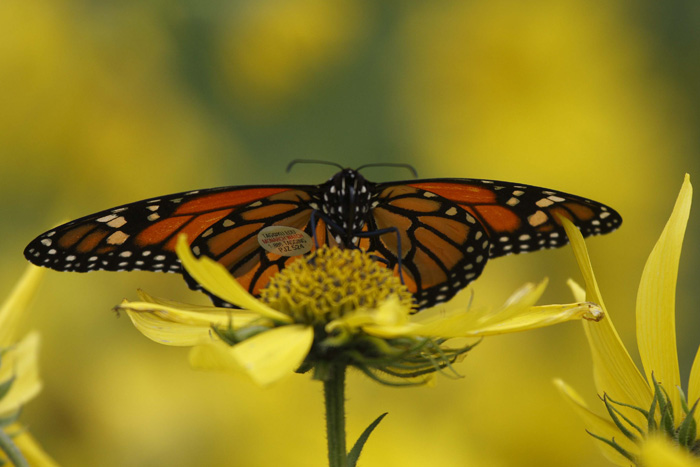
And of course, Cape May migration is about more than just birds; Linda Widdop sent me this great photo of a Monarch nectaring at the Giant Sunflowers in the state park - and look, it's got one of our tags on it!! Don't forget to keep an eye out for Monarchs with these little round tags stuck on the underside of a hind wing. Most tagging projects rely on people spotting and reporting the Monarchs as they head south. (Don't forget to note the number on the tag!)


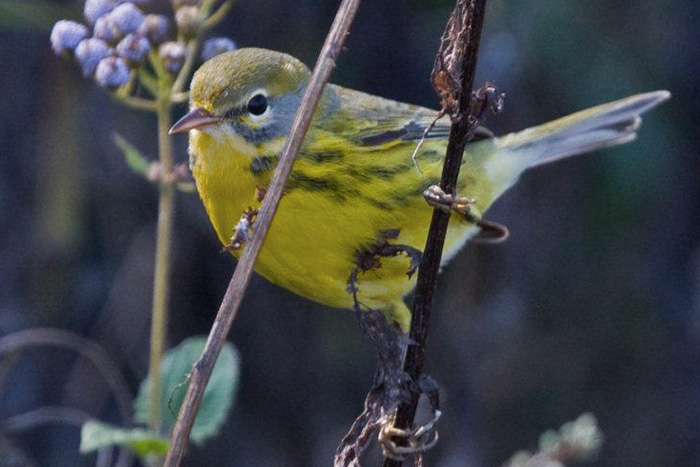
We finish with three pictures from David and Susan Disher from North Carolina. Warblers may be subtly less colorful in the Fall than they are in Spring but you sure can see them better this time of year! Here are fine portraits of Northern Parula, Yellow Warbler and Prairie Warbler. The last two are pretty much done heading through here now so these are nice finds (the Prairie Warbler was seen October 17th and the Yellow Warbler on 18th).

Excitement builds as we head towards this year's Autumn Weekend Birding Festival and there is still plenty of birds to see - with a very promising forecast for the weekend itself! The Hawkwatch Platform was aglow with excitement when I stopped by a short while ago, as a dark morph Swainson's Hawk had been showing itself spectacularly well to the gathered admirers. A steady stream - yes a stream! - of Northern Harriers was breezing through, along with an even greater number of American Kestrels and Merlins. Bald Eagles? Yeah, they were there, you know, you see them every day now!!!

Bunker Pond is filling up nicely with a good selection of ducks, plenty of Pied-billed Grebes, and I counted 118 American Coots - and no sign of that Coot menace from last year yet...

Saturday, October 22, 2011

Higbee's A-Hoppin'

Higbee's Beach was certainly alive with birds today (see, I told you to get down here!), with Tom Johnson recording some 15,000 Yellow-rumped Warblers on the Morning Flight Project at Higbee Dike, as well as an impressive show of other birds, including Blackpoll Warblers, American Robins and the first notable passage of Hermit Thrushes for the season. Yesterday's dark morph Swainson's Hawk arose early from somewhere in the Hidden Valley area and headed out early - though not before making a pass at the Hawkwatch Platform. As for the fields at Higbee's... Well it took us some time just to walk the last few yards of road to get into the fields in the first place, as wave after wave of Yellow-rumped Warblers, Ruby-crowned Kinglets and White-throated Sparrows poured across in front of us. Eastern Towhees were calling in impressive numbers from deep in cover and good numbers of Chipping Sparrows and American Robins were present too. We spotted a Swainson's Thrush high in a Virginia Creeper, then shortly after we were distracted by little parties of Palm Warblers (mostly the yellower Eastern form) and a smart Blue-headed Vireo. We didn't get as far as we had intended, but we didn't need to, for the birds came to us! One little corner of Porcelainberry harbored eight Hermit Thrushes, as well as several Gray Catbirds and Brown Thrashers and single Yellow-billed Cuckoo, Magnolia Warbler, Yellow-breasted Chat and Lincoln's Sparrow. Further on, we came across a second Yellow-billed Cuckoo and heard about a second Yellow-breasted Chat, while kinglets and warblers continued to entertain the gathered admirers.

 At the Hawkwatch, there was plenty of overhead action throughout the day and, besides a great day for hawks on the move, Chimney Swifts put on an excellent show - perhaps surprisingly so given the late date - and that inveterate counter, Tony Leukering had tallied some 500 of them by the day's end. Northern Rough-winged Swallows were notably in good numbers too and certainly outnumbered Tree Swallows at the Higbee fields this morning. Other highlights today included a Vesper Sparrow briefly at the Hawkwatch, an unidentified Selasphorus hummingbird at the CMBO Goshen Center, a Grasshopper Sparrow reported by Bob Fogg from the Schellenger Tract (Del Haven) and a Red-breasted Nuthatch at the Northwood Center - the latter species has been remarkably scarce here so far this Fall. I haven't heard from the Seawatch yet today, but take a look at yesterday's figures here and you'll see that things are pretty busy up there at the moment...

A heavy wave of sparrows this morning made up for a shortage of these birds over the past week or so. This Lincoln's Sparrow was our prize find amongst the hordes of White-throated, Song, Swamp, Field, Chipping and Savannah Sparrows [photo by Mike Crewe].

It's probably rude to take someone's picture when they are busy eating...

...but this Blackpoll Warbler just posed so nicely in the Porcelainberry [photos by Mike Crewe].

Our second Yellow-billed Cuckoo this morning proved to be very popular with photographers as it actively hunted crickets and other insects along the edge of the second field at Higbee's Beach. Indeed, it was so approachable...

...that sometimes it seemed almost too close! And no, this bird isn't in the hand, it really is in the bush!! [Photos by Mike Crewe]

Our garden came up trumps again before work this morning with a nice range of birds, including this Nashville Warbler [photo by Mike Crewe].