Saturday, June 23, 2012

White-winged Dove and other news

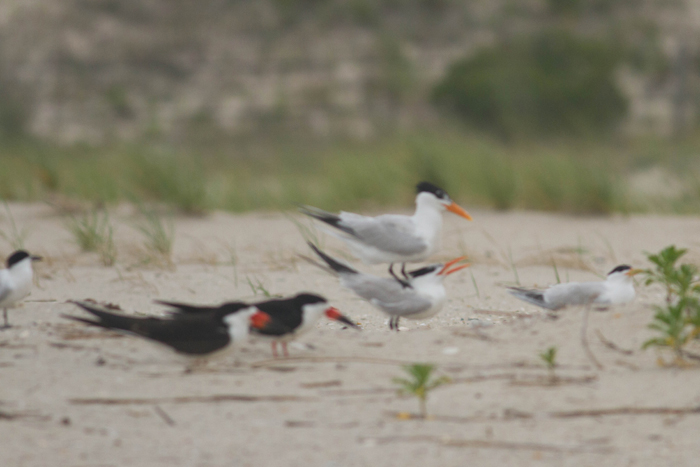
Yesterday, Sam Galick and Vince Elia were out on a saltmarsh breeding bird survey and reported a White-winged Dove which flew across the parking lot at Corson's Inlet State Park. There's been one or two fly-through reports of this species already this year so it is certainly worth giving any dove you see a second look. Bob Lubberman from The Osprey reported a Gull-billed Tern nesting among other Terns on the back bays behind Wildwood, while Black Skimmers steadily increase at Cape May Point, which may be associated with disruption at the main breeding colony at Malibu Beach where a cat has apparently been seen recently.

Further afield at Forsyth NWR, Brigantine, single Snow Goose and Brant were seen on the most recent wildfowl count there and reports continue to come in on a singing male Dickcissel near mile marker 9 on the driving loop. A White-faced Ibis appears to be summering at the refuge too.

One bird that slipped my net was a Cliff Swallow, reported by Sam Galick at Cape May Point State Park on June 16th - another one of those weird June things!

This White-winged Dove flew through Corson's Inlet out on the barrier islands on June 22nd - keep your eyes peeled for that distinctive white wing stripe [photo by Sam Galick].

Annual surveys carried out by New Jersey Audubon staff are proving to be the best way to get an idea of population levels of saltmarsh breeding birds. Many of these species are very elusive simply because they live in a world that is very difficult for us to access because of all the water and thick mud, and because the very dense vegetation makes viewing the birds very difficult (not to mention the bugs!). Early morning surveys to record singing birds give us a much better feel for breeding of numbers of species such as Saltmarsh (above) and Seaside Sparrows, and Clapper Rails [photo by Sam Galick].

Friday, June 22, 2012

June Birds & Recent Pictures

Flaming June has hit Cape May with a vengeance right now as temperatures sour into the 90s and everything ducks for cover. Good tern watching continues at South Cape May Beach and fluffy Piping Plover chicks can now be seen on the Plover Ponds. First signs of return migration are already under way with one or two reports of Whimbrels coming through now. At a little before 8:00AM this morning, Sam Galick reported a White-winged Dove which did a quick fly-by at the parking lot at Corson's Inlet. A White-breasted Nuthatch at the corner of Bayshore and New England was something of a surprise this morning.

Time for a quick review of the batches of photos that I have been sent recently.

A trip around the back bays can produce great birding pretty much any time of year, and is certainly well worth while mid-summer while migration takes a back seat for a short while. An adult Glossy Ibis offers a perfect photo opportunity at the Wetlands Institute at Stone Harbor [photo by Jane Ellison].

Tricolored Herons are never common here, but they can be seen in small numbers without too much difficulty. This bird was photographed recently at the Wetlands Institute, Stone Harbor [photo by Jane Ellison].

In contrast to Tricolored Herons, the back bays are brimmed full of Eastern Willets, a bird that never misses an opportunity to announce its presence, especially during the breeding season [photo by Tony Leukering].

If you leave the back bays and head to the South Cape May Beach, keep an eye out for gulls along the tideline. In contrast to other gull species, that mostly loaf higher up the beach and go off to feed elsewhere, Lesser Black-backed Gulls regularly feed along the tideline and this can be a good way to locate them. This second-calendar-year Lesser Black-back is currently hanging out on the South Cape May Beach [photo by Tom Reed].

American Oystercatchers are busy catching mole crabs along the tideline right now...

...and feeding them to their growing youngsters [photos by Jane Ellison].

Many people don't realize that Ghost Crabs can be a big threat to young beach birds. Ghost Crabs feed mostly at night when birds are roosting and will readily take small birds or eggs if they get the chance [photo by Jane Ellison].

The first sign of autumn migration - a calling Whimbrel over Cape May Point on the longest day of the year [photo by Tom Reed].

It is interesting how native bird species adapt to feeding from introduced plants. This male Orchard Oriole is feeding on nectar from the flower spikes of Red-hot Pokers (Kniphofia spp.) and will help to pollinate the flowers in the process. Red-hot Pokers are native to Southern Africa but are popular garden plants in many countries; in Europe, bird species as diverse as Blue Tits and Great Spotted Woodpeckers regularly nectar-feed from these flowers [photo by Debbie Hudson].

Once in a while you chance across something really unusual out in the wild - recently, Debbie Hudson came across this albino snake at Cox Hall Creek WMA. Identifying albino snakes can be tricky as there is always the possibility of it being an escaped pet and thus a non-native species. However, this species looks as though it is most likely a local Rat Snake [photo by Debbie Hudson].

Wednesday, June 20, 2012

Terns again

Shortly after posting my last blog piece on terns, I received a text message, alerting me to a Roseate Tern on the wooden railing that sticks out into Bunker Pond. Having just done the post, I already knew that I was short on Roseate Tern photos so quickly shot out to address this! By the time I got there, the bird had already flown, but this just pushed me to work a little harder for my bird...

Deciding to check the beach, I soon found a Roseate Tern among a group of 20 or so Common Terns - the latter a species that doesn't use the railing at Bunker Pond anywhere near as much as do Forster's Terns. The terns were too far for photographs, perched as they were inside the roped off breeding beach, and I decided to move away quickly as the Black Skimmers clearly didn't want me there! The sight of the male skimmer feigning injury to draw me away and then avidly strafing the top of my head was plenty enough for me to work out that they are quite definitely breeding this year! What was unusual to me about the Roseate Tern was that it was not banded - much research effort has gone into banding Roseate Terns to allow much closer study and a better understanding of this species, which remains very scarce throughout much of its range and vulnerable to pollution incidents and disturbance during the breeding season. Walking straight back into the state park, I was very surprised to then find not one but two Roseate Terns on the Bunker Pond railing - and both were banded! So here's where you can help out; with a close enough view, good optics and a fair dollop of patience, you can have a go at reading the band numbers on the legs of these two terns. Here's some pictures to point you in the right direction and get you started - let's see if we can get all the numbers between us!

At a distance, a Roseate Tern strikes you as a rather pale bird overall, with a long, dark bill. This adult Roseate Tern (center) is among a gathering of adult (red bills) and second-calendar-year (black bills) Common Terns on the South Cape May Beach. Though the young Common Terns have black bills, note that they also have white foreheads and black carpal bars (the dark line on the wing) [photo by Mike Crewe].

Coming in much closer, the Roseate's features are even more apparent. Note the long, finely-pointed bill, the relatively pale upperparts and the very long tail streamers. The white upper edge to the folded wing that I mentioned in the last post is hard to see here because of the pale sky behind, but it is present and this feature should always be looked for [photo by Mike Crewe].

If you have a real stroke of luck, you can get the birds to line up for you on the Bunker Pond railing! Here, left to right, are Forster's Tern, Common Tern and Roseate Tern. Look carefully at the relative proportions of bills, the upperpart and underpart color and - especially - the length of the outer tail streamers relative to the wing tips on each bird. Here, I have drawn a short red line to indicate where the tips of the tail streamers fall for each bird. The Forster's Tern is intermediate, the Common Tern very short (falling well short of the wing tip) and the Roseate Tern by far the longest (click on the photo for a slightly bigger picture) [photo by Mike Crewe].

Here's how you can really help - zooming right in on the Roseate Tern photos, it is actually possible to read some of the digits on the bands. On this bird, it is possible to see 482 on the right (closest) leg and a 2 on the left leg with a smaller 6 above it. So we have a start - if we can get the whole number, researchers can learn about the movements of this bird - and so can we! [Photo by Mike Crewe]

And don't forget to keep an eye out for other birds in the area too. I was very surprised to see this second-calendar-year Bonaparte's Gull turn up on June 16th at Bunker Pond - a winter visitor in mid-June! [Photo by Mike Crewe]

If you are keen to learn more about tern identification, why not consider joining our special one-day tern workshop which take places on Saturday, August 4th. Contact our program registrar for more details on 609-861-0700.


Saturday, June 16, 2012

Terning the corner (!)

I'm not trying to rush along time, but we are just a few days away from the longest day and the inevitable slide into the back end of the year!! Time really does fly and, while heading toward Fall is an exciting prospect at Cape May, we have the summer birding doldrums to get through first. Lately, our attention down here at the point has been turning to terns (hence the dreadful title to this post, sorry!) and, typically for this time of year, we have been enjoying a nice array of tern species here of late. Perhaps most unusual has been the observations of both a pair of Caspian Terns and a pair of Royal Terns going through the early motions of breeding behavior. These are not species that we see breeding at the point so it is interesting to ponder what is going on. My guess is either that they are individuals breeding for the first time and so do not have established territories elsewhere yet, or they are birds that perhaps had their nests washed out by the high spring tides we have been having again this year and are doing a little bit of aimless wandering. Black Skimmers are again showing breeding behavior on the South Cape May Beach and this would certainly be a great species to be able to add to the current tally of Piping Plover, Least Tern and American Oystercatcher at the site.

Here's a few photos to get you in the mood for some summer beach birding at Cape May:

Though often rather distant in their roped-off breeding zones, Piping Plovers at the point regularly fly from the beach to the Plover Ponds along the south edge of the state park to feed and offer opportunities for great flight shots like this one [photo by Sam Galick].

Lesser Black-backed Gulls continue to increase in both number and occurrence at Cape May and can be seen - with a bit of luck - pretty much every month of the year now, with peaks during migration periods. Note how the second-calendar-year bird on the left lacks the contrasting white head of an American Herring Gull, while the third-calendar-year bird on the right already wears enough dark feathers on the back to define it readily from herring gulls too [photo by Sam Galick].

A rare Cape May Point occurrence - a pair of Royal Terns show early breeding behavior on South Cape May Beach [photo by Tom Reed].

Sandwich Terns don't breed as far north as New Jersey on the eastern seaboard of the US, but one or two turn up at Cape May each summer. This one stills sports a lot of white on its forehead and is perhaps a bird that is in its first full summer and not yet breeding [photo by Tom Reed].

Heat haze and distance can be a real problem when trying to photograph birds on the South Cape May Beach, but Karl Lukens did a good job capturing an image of this second-calendar-year Black Tern that has been showing well around The Rips and Bunker Pond lately.

Two adult Roseate Terns (center) with Common and Royal Terns on South Cape May Beach this week. Roseate Terns are a species of conservation concern and most populations are closely monitored - hence most birds you will see will be sporting leg bands like these two. Roseate Terns always stand out as very white birds with long, finely-pointed bills. In breeding plumage (as here) they also sport vivid orange-red legs and often a pinkish flush to the breast [photo by Tom Reed].

I couldn't resist cropping and zooming in on Tom Reed's photo to highlight an excellent identification mark of Roseate Tern - yet one that is rarely highlighted in the current crop of field guides on the book shelves. Look at the folded wing of this Roseate Tern and you will see a noticeable white line running along the top edge, formed by white inner webs to the primaries. This is a great feature to use to pick a Roseate out if you have a mob of terns all roosting together - maybe we will get one on our Tern Workshop on August 4th (contact us for details!).

Like an airplane leaving a condensation trail across the sky, the bill of this Black Skimmer cuts a fine line through the waters of the Plover Ponds. Watching skimmers on their evening sorties as the sun sets behind the lighthouse is surely the highlight of any summer visit to Cape May [photo by E J Nistico].

As birds take a gentle back seat for a short while, don't forget there is still so much more to enjoy at Cape May! We continue our Wednesday state park walks (with Brown Pelican, Wilson's Storm-petrel and Black and Roseate Terns all highlights this week), Pete Dunne's Monday mornings at the Meadows continue through Summer, as do boat and kayak trips and our broader wildlife walks that look at plants, dragonflies, butterflies and a whole manner of other things! Check out our online event calendar by clicking here, or stop by and pick up the latest Kestrel Express for full details. See you in the field!

Wednesday, June 13, 2012

Maine Herring Gull in Cape May


[Photograph copyright by Tony Leukering. Click on image for larger version.]

I was fortunate to join Mark Garland and his Elderhostel group on 17 May on one of those spectacular boat trips through the Cape May back bays aboard the Osprey. At the entrance to Jarvis Sound (at the toll bridge on Ocean Drive), I noted four Herring Gulls perched on individual pilings and noted that one of them was not only banded, but color-banded! As we passed fairly close to that bird, I snapped off a few pictures in hopes of being able to read the alphanumeric code on the color band on its left leg. Success!

I sent off the details and a picture (such as the one above) to the Bird Banding Laboratory (part of the U. S. Geological Survey) based in Patuxent, MD. I just heard back from that submission and wanted to share the details. The bird was banded on 15 July 2010 as a nestling/fledgling before it could fly, and was banded on Appledore Island, ME, by a crew under the direction of Dr. Sara Morris at Canisius College in Buffalo, NY.

I was particularly happy with this bird, as my estimation of its age at the time was that it was nearly two years old, as discerned by the plumage (it had some gray in the mantle) and soft-parts coloration (the bill was 3/4 pinkish). Additionally, it's outer primaries did not have the very-pointed tips typical of such birds in their first year of life. However, these large gulls are individually variable in the amount of time that they take to achieve adult plumage. In Europe, where a lot of gull study is conducted (unlike on this side of the Pond), researchers have found that a sizable minority of subadult Herring Gulls (and other large gull species) sport plumage that does not necessarily match the known age of particular individually color-banded birds. This bird, though, was spot on!

One of the take-home messages in this event is that anyone can contribute to the advancement of our knowledge of birds, it just takes a little bit of focus. So, the next time that you pass by a bunch of loafing gulls, take a bit of time to see if any are banded. Perhaps, you can provide the next piece of data that enables us to understand more fully the ecologies and strategies of even a common species such as Herring Gull.

Saturday, June 9, 2012

Summer Days, part II

[Seaside Dragonlet, near Stagecoach Road, 6 June 2012. Click on image(s) to see larger version(s). All photographs copyright by Tony Leukering.]

The true summer dragonflies and damselflies are now becoming a common part of the fauna viewable at area lakes, ponds, ditches, and streams. And at many places well removed from such water bodies. Seaside Dragonlets (above) are now showing up virtually everywhere in Cape May County and the rest of south Jersey. Despite the species' name, it really can occur anywhere down here. This very small, wide-ranging, black or black-and-yellow, southern species even has populations 100s of miles from the nearest ocean, including in New Mexico! Other real summer species now out include a variety of skimmers (Needham's [below], Great Blue, Slaty, and Bar-winged), Calico and Halloween pennants, and what may be the most numerous dragonfly in Cape May County, Blue Dasher.

[Needham's Skimmer, near Stagecoach Road, 6 June 2012]

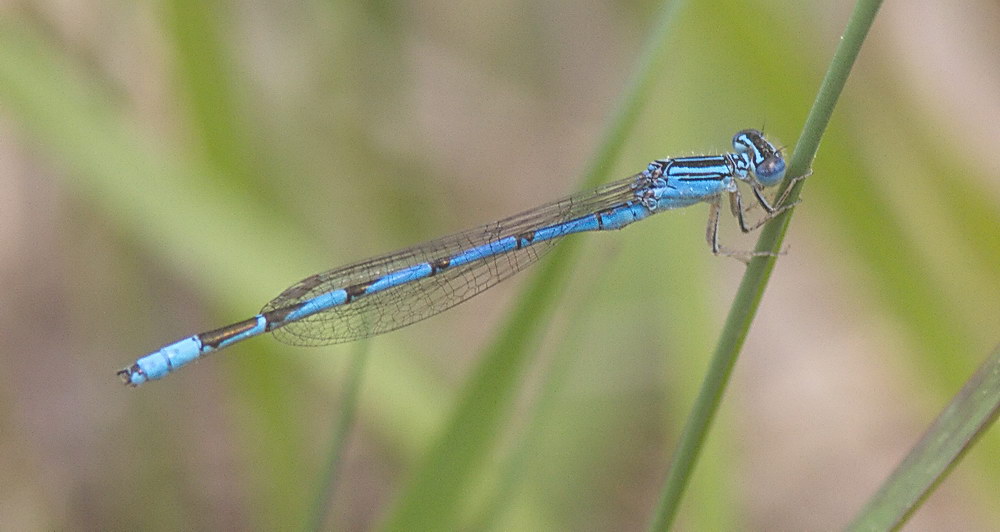
When the odonates (dragonflies and damselflies) of Cape May County were first surveyed back in the late 1980s and early 1990s), Double-striped Bluet -- a tiny species of damselfly (below) -- was unknown here. Will Kerling, Mike Crewe, and I found the first records for the county a few years ago (near Indian Trail Road) and Mike and I have been finding them in ever more places this year, including at Fort Apache Park and Cox Hall Creek WMA. While the species has not yet been found on Cape Island, I do not doubt that it will be soon.
 [Male Double-striped Bluet, Fort Apache Park, 7 May 2012]

As with all things great and small, things die and others take advantage of the bounty their deaths provide. I recently found a male Calico Pennant that was providing sustenance to a large number of water striders (genus Gerris) in a tiny puddle of water. The water striders, who may lose their pondlet to drying conditions, have the ability to fly and find other water.
[Calico Pennant, near Stagecoach Road, 6 June 2012]

Bird news includes the 10 subadult Brown Pelicans that Don Freiday saw flying over Ocean Drive yesterday evening, while Tom Reed found a Sandwich Tern -- the first of the year -- at Stone Harbor Point  this afternoon with 11 Royal Terns.

Friday, June 8, 2012

Summer Days

Those heady days of summer are creeping up on us and, with temperatures edging ever higher, it's not surprising that we had our first big thunderstorm of the season last night. Down here at the point we actually escaped the bad weather, but I hear that there were some pretty heavy hail showers on parts of the barrier islands. I was out on the barrier islands myself this morning and several times I was reminded of how much this area has to offer, yet how seldom we birders check it out. Of course, if you are in any sort of a hurry to get anywhere, the barrier islands can be very testing in high summer, but right now it's not too bad out there. As a wildlife enthusiast I can get depressed quite quickly as I pass through endless rows of faceless houses with sterile, over-manicured gardens full of non-native species and acres of bare gravel; and yet every so often, you come across a little oasis in the desert. From Ocean City, through Strathmere, Sea Isle City, Avalon and Stone Harbor to Wildwood, you will find little places where people are trying to make a difference. Ocean City, Avalon and Stone Harbor all have small but beneficial bird sanctuaries which, while maybe not attracting the numbers of birds you might find at Cape May Point or Belleplain State Forest, certainly earn their keep by providing food and shelter for breeding, wintering and migratory birds in season and all are worth a check at the right time of year. At a number of locations today I chanced across both Black-crowned and Yellow-crowned Night Herons lounging in good breeding habitat and clearly they do well while rubbing shoulders with us Humans. Glossy Ibises too were at several places and the calls of Willets seemed almost always to greet me wherever I overlooked the back bay marshes. Other pleasant surprises included an active breeding colony of Purple Martins on the edge of the saltmarsh, at least four Willow Flycatchers calling at scrubby wetlands in Ocean City and Strathmere and the first real northward push of Spot-winged Gliders that I have noticed this year, with a nice wave of these dragonflies clearly moving through. While I was off the point today, Tom Reed reported a Roseate Tern on the South Cape May beach and Karl Lukens later reported it from the wooden railing on Bunker Pond. The first of the year I think, so keep an eye out for terns with black bills!

Finally, I would like to give a heart-felt thank you to all the people of the barrier islands that I saw today keeping an eye out for Diamondback Terrapins. Female terrapins heavy with eggs were running the gauntlet of the traffic throughout the islands today but I was impressed by how few I saw that had been run over and how many times I saw someone take evasive action, or even stop and help them across the road. Thanks folks, your terrapins need you!

Adult Yellow-crowned Night Heron dodging the sunny 82F temperatures at Ocean City today [photo by Mike Crewe].